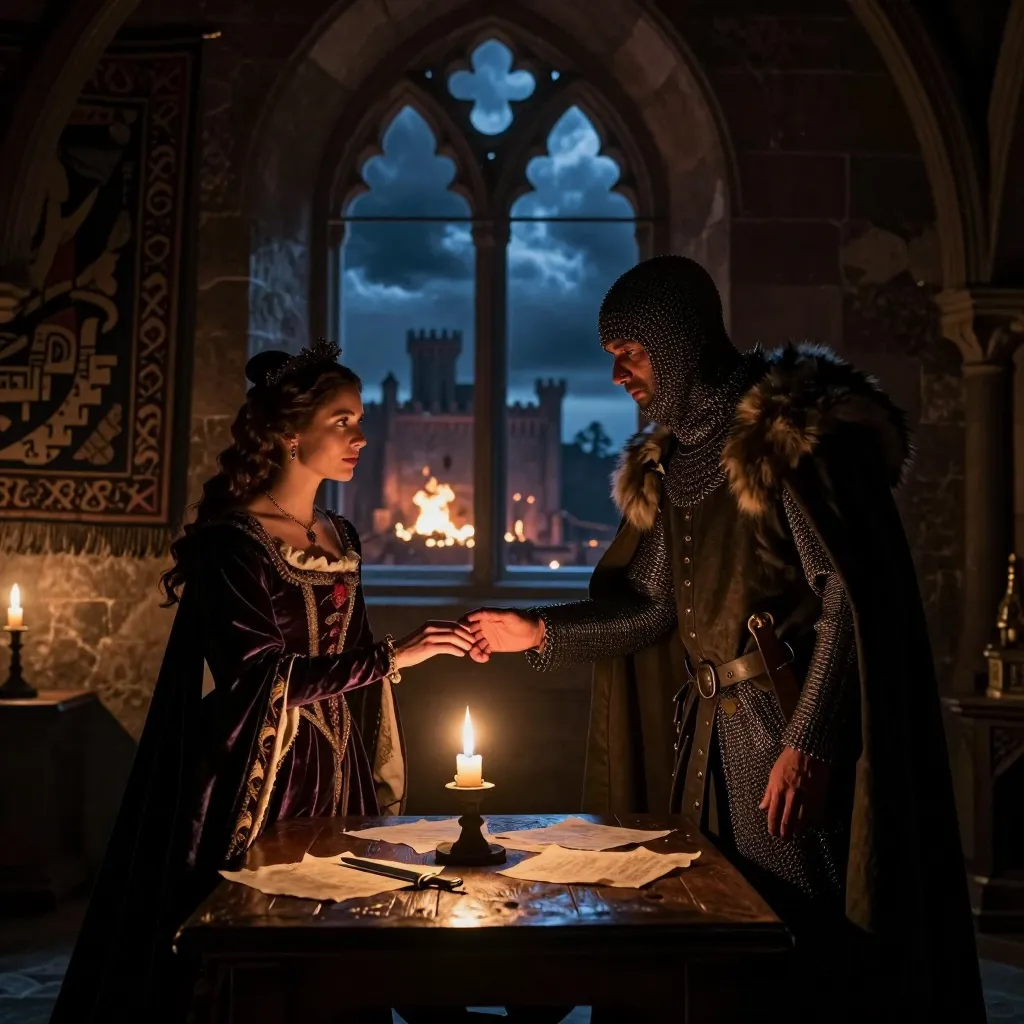
Mortimer and Isabella: The Lovers Who Brought Down King Edward II
Exiled and humiliated, Queen Isabella and Roger Mortimer formed a lethal alliance to overthrow King Edward II. Their reign of vengeance ended the influence of royal favorites but spiraled into a new era of tyranny and mysterious executions that forever stained the English crown.
The She-Wolf’s Vengeance: The Downfall of Edward II
[cite_start]In the autumn of 1326, a fleet of 95 ships cut through the violent swells of the North Sea, carrying a cargo that would dismantle a monarchy[cite: 11, 14]. [cite_start]At the helm was not a conquering king, but Isabella of France—Queen of England—and her lover, the exiled Marcher lord Roger Mortimer[cite: 16, 27]. [cite_start]This was more than a political maneuver; it was a cold-blooded invasion born of a decade of humiliation, betrayal, and the influence of a "dark favorite" who had led the English throne into ruin[cite: 15, 21].
A Marriage of Neglect and Scandal
[cite_start]The roots of this rebellion took hold in 1308, when the 12-year-old Isabella was married to Edward II[cite: 32, 33]. [cite_start]While Edward possessed the physical stature of a legendary warrior, he lacked the temperament for medieval kingship[cite: 34, 36]. [cite_start]From the night of their coronation, the King’s obsession with his favorite, Piers Gaveston, sidelined his young bride[cite: 37, 38]. [cite_start]Edward’s blatant favoritism extended to gifting Isabella’s own jewelry to Gaveston, fueling a scandal that alienated the Queen and the English nobility[cite: 40, 44].
[cite_start]Though Gaveston was eventually executed by a faction of rebellious barons in 1312, the pattern of Edward’s rule did not change[cite: 45]. [cite_start]By the late 1310s, a new and more predatory figure had seized the King’s ear: Hugh Despenser the Younger[cite: 52].
The Rise of the Despensers
[cite_start]The Despenser family’s influence was far more sinister than Gaveston’s ever was[cite: 74]. [cite_start]Hugh Despenser and his father used their proximity to the King to systematically dismantle the power of the Marcher lords and seize royal estates—including those belonging to Queen Isabella[cite: 52, 75].
Resistance to the Despensers was met with brutal retaliation. [cite_start]After a failed uprising in 1322 led by the Earl of Lancaster and Roger Mortimer, Edward II unleashed a wave of executions[cite: 66, 68]. [cite_start]Lancaster was beheaded, and Mortimer was cast into the Tower of London[cite: 66, 67]. [cite_start]For Isabella, the final betrayal occurred when Edward and the Despensers abandoned her in Tynemouth during a Scottish incursion, leaving her to face the enemy alone while they fled to safety[cite: 77].
The Paris Conspiracy
[cite_start]In 1323, Roger Mortimer achieved the impossible: he escaped the Tower of London and fled to the French court[cite: 71]. [cite_start]Two years later, Isabella joined him in Paris under the guise of a diplomatic mission[cite: 80]. [cite_start]There, the neglected Queen and the vengeful exile formed a lethal alliance that soon became an open romantic affair[cite: 87, 88].
[cite_start]Together, they gathered a force of English exiles and foreign mercenaries[cite: 92]. [cite_start]Isabella refused to return to England, declaring she would not live with the Despensers[cite: 81]. [cite_start]By late 1326, she was ready to return—not as a wife, but as a liberator bringing a firestorm to her husband’s shores[cite: 20].
The Collapse of a Reign
The invasion was swift and devastating. [cite_start]As Isabella’s forces marched toward London, the King and Hugh Despenser fled in terror, only to find themselves hunted through the Welsh borderlands[cite: 96, 105]. The "dark favorites" met grisly ends:
- [cite_start]Hugh Despenser the Elder was captured at Bristol and fed to hounds after being hacked into pieces[cite: 101].
- [cite_start]Hugh Despenser the Younger was hauled to Hereford and subjected to the traitor’s death—hanged, drawn, and quartered[cite: 112].
[cite_start]In January 1327, Edward II was forced to abdicate his throne to his 14-year-old son, Edward III[cite: 117]. For the former king, however, abdication was merely the prelude to a mysterious death.
The Mystery of Berkeley Castle
[cite_start]While under house arrest at Berkeley Castle in September 1327, Edward II died suddenly[cite: 123]. [cite_start]While official reports claimed natural causes or a "broken heart," the timing was far too convenient for the new regents, Isabella and Mortimer[cite: 124, 125]. [cite_start]Rumors of a violent assassination immediately began to circulate, a shadow that has haunted Isabella’s legacy for centuries[cite: 125, 126].
The Fall of the Regents
The "liberation" quickly soured into a new tyranny. [cite_start]As regents, Isabella and Mortimer grew corrupt, enriching themselves from the royal treasury and executing those who questioned their authority[cite: 119, 122]. [cite_start]Mortimer’s arrogance eventually reached a breaking point; he began presiding over the young King Edward III as if he were the sovereign himself[cite: 128].
[cite_start]In October 1330, the 17-year-old Edward III staged his own coup[cite: 139]. [cite_start]Entering Nottingham Castle through a secret passage, the King’s men seized Mortimer[cite: 140]. [cite_start]Despite Isabella’s pleas for mercy, Mortimer was hanged at Tyburn as a traitor[cite: 141, 142]. Isabella was forced into a quiet retirement, ending a dark chapter of English history defined by a Queen who chose to burn a kingdom down rather than remain a victim of its court.