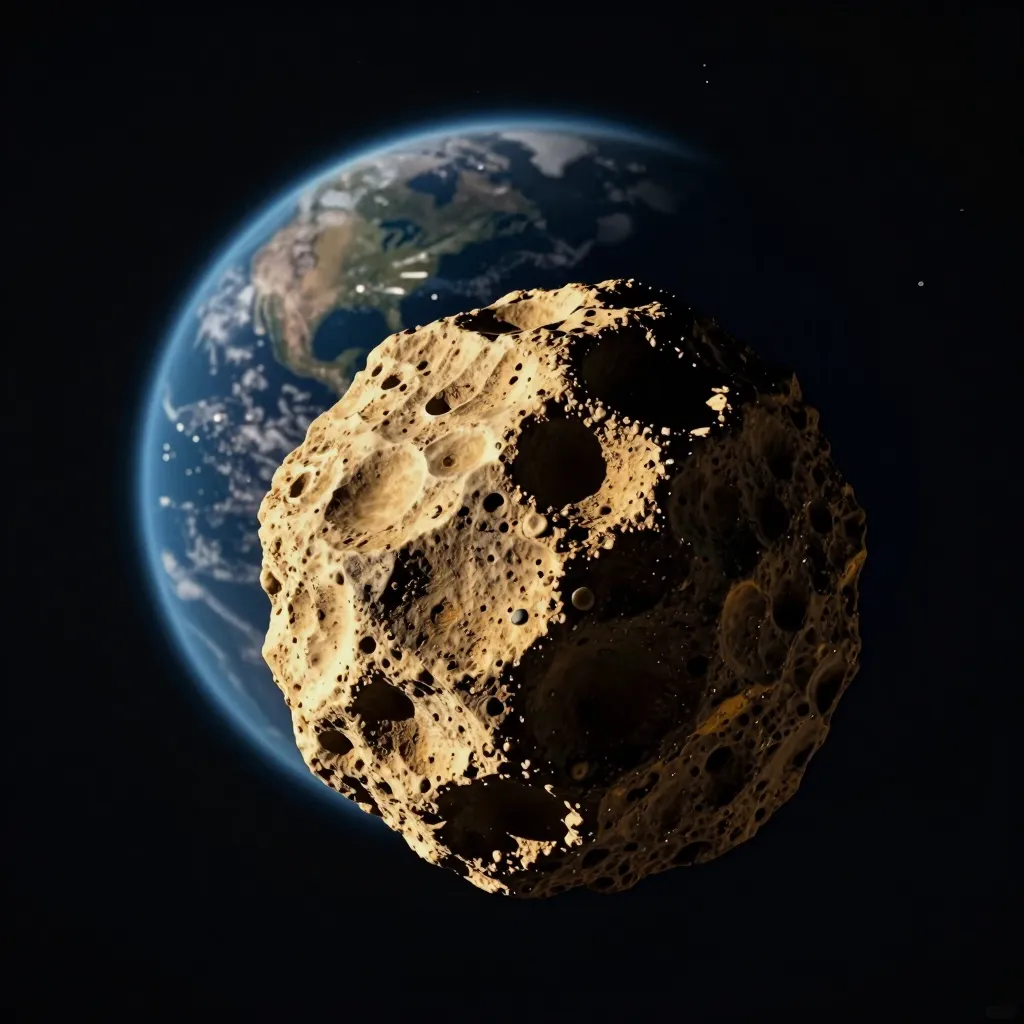
Asteroid Apophis: The 2029 Close Encounter That Has Scientists on Alert
On April 13, 2029, asteroid Apophis—named after the Egyptian serpent god of destruction—will pass within 20,000 miles of Earth, closer than our geostationary satellites. Discovered in 2004 with initial impact fears, this rare cosmic visitor now offers scientists an unprecedented opportunity to study a large near-Earth object up close while raising haunting questions about what else lurks undetected in the void.
The God of Chaos Returns: Asteroid Apophis and the 2029 Encounter That Has Scientists Watching the Skies
In the silent theater of deep space, where ancient rocks have drifted since before humanity first looked upward with wonder, one particular traveler carries a name that echoes with mythic weight. Apophis—the Egyptian deity of darkness and destruction, the serpent who nightly threatened to swallow the sun—lends its ominous title to an asteroid that will make history before this decade ends.
A Discovery That Raised Alarms
The story began in the summer of 2004, when astronomers at Arizona's Kitt Peak National Observatory detected something troubling. A space rock, later estimated at 340 meters in diameter—roughly the size of a large cruise ship—was tracking on a course that brought it unsettlingly close to our planet. What made the discovery particularly chilling was the initial calculation: a 2.7% probability of impact with Earth in 2029.
For a brief window, Apophis represented the most significant cosmic threat humanity had ever identified and tracked. It achieved something no other near-Earth object had managed before or since: a Level 4 rating on the Torino Impact Hazard Scale, the highest threat classification ever assigned to a space rock. The scale, designed to communicate the risks of potential impacts to both scientists and the public, had never seen such an alarming classification.
The Odds Shift, But the Story Deepens
Subsequent observations and refined calculations gradually eased those fears. The probability of collision dropped dramatically—to roughly one in 100,000—and Apophis was downgraded to Level 0 on the Torino scale, indicating no significant threat. NASA now maintains that the asteroid poses absolutely no danger to Earth for at least the next century.
Yet dismissing Apophis as a false alarm would miss the extraordinary scientific opportunity it presents.
A Celestial Close Call
On April 13, 2029, Apophis will pass within approximately 20,000 miles of Earth's surface—closer than some of our own satellites and roughly one-tenth the distance to the Moon. To put this in perspective, that's closer than the ring of geostationary satellites that beam television signals and GPS data to our devices daily.
The rarity of such an event cannot be overstated. Objects of this size—large enough to cause regional devastation should they strike—simply do not pass this close to Earth with any regularity in human timescales. NASA has noted that an encounter of this magnitude likely has no precedent in recorded human history, and certainly none since we've possessed the technological capability to observe, track, and study such visitors.
What We Stand to Learn
The 2029 flyby represents more than a cosmic near-miss—it is a scientific goldmine. Astronomers will have an unprecedented opportunity to study a large near-Earth asteroid up close, gathering data on its composition, structure, rotation, and how it responds to Earth's gravitational influence. Such information proves invaluable for understanding the population of potentially hazardous asteroids and developing strategies should we ever need to deflect one.
Radar observations during the encounter may reveal surface features as small as a few meters across. Spectroscopic analysis could determine whether Apophis is a solid monolith or a rubble pile held together by gravity—distinctions that matter enormously for any future planetary defense scenarios.
The Deeper Mystery
There remains something haunting about Apophis's name and timing. Ancient Egyptian mythology portrayed the serpent Apophis as an eternal adversary of order, battling the sun god Ra each night in the underworld. The asteroid's discovery during an era of global uncertainty, its initial threat assessment, and its eventual reclassification all mirror humanity's complex relationship with the unknown—our capacity for both fear and rational understanding.
The 2029 encounter serves as a reminder that our planet exists within a dynamic cosmic environment, one where the same forces that shaped our world continue to operate around us. While Apophis will pass harmlessly by, its visit prompts reflection on deeper questions: How prepared are we for the inevitable day when detection and deflection become necessary? What other objects might remain undetected in the darkness beyond our current observational capabilities?
As April 2029 approaches, telescopes around the world and in orbit will turn their gaze toward this messenger from the void. For a few hours, the God of Chaos will dominate our skies—not as a harbinger of destruction, but as a teacher, offering rare insights into the mechanics of our solar system and the nature of the rocks that occasionally cross our planetary path.
In the end, Apophis may prove less a threat than a gift: a cosmic object lesson in vigilance, scientific progress, and humanity's growing capability to understand the universe that surrounds us—even when that universe sends us something named after an ancient god of darkness.