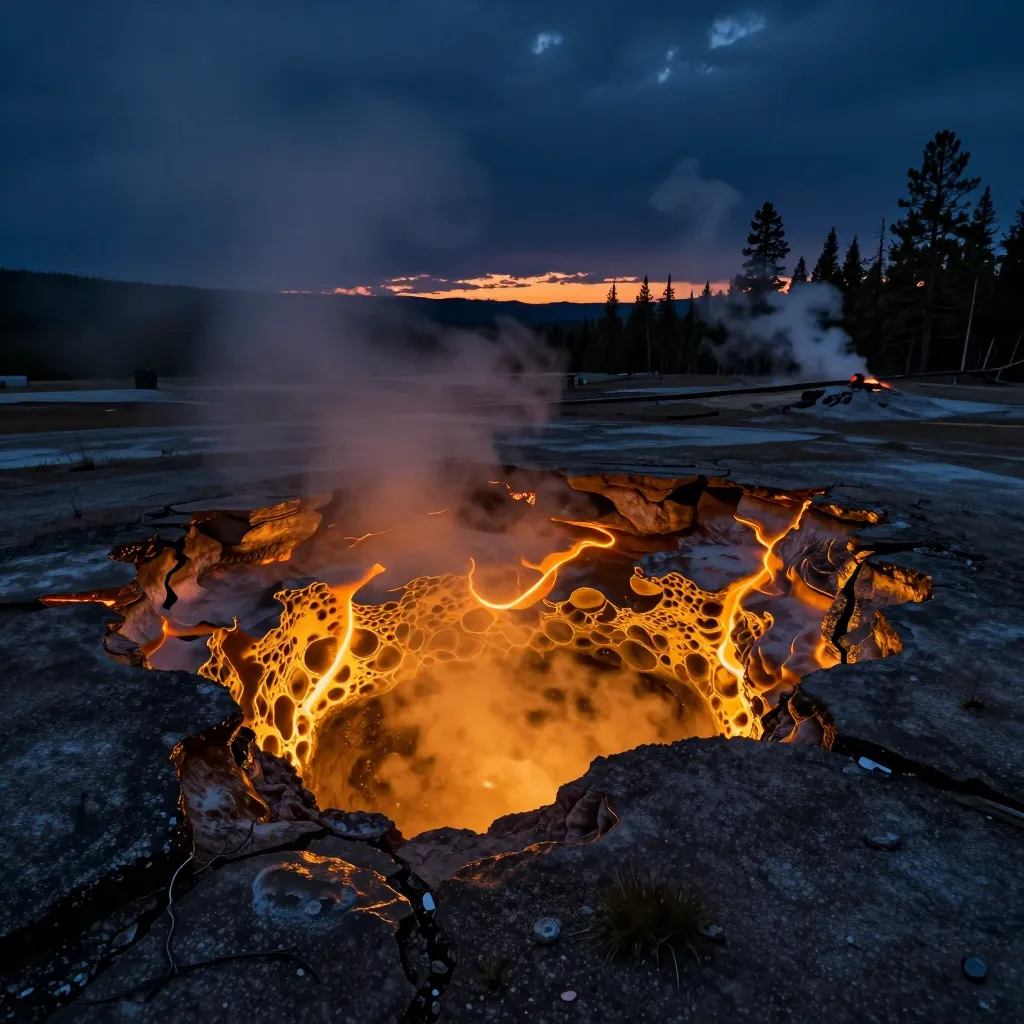
Yellowstone's Hidden Engine: The Mystery of the Magma Mush
New research reveals Yellowstone's supervolcano isn't fueled by one chamber, but a complex 'magma mush' network. This unsettling discovery makes the sleeping giant's behavior harder to predict, posing a mysterious threat to global stability for scientists and truth-seekers alike.
The Hidden Furnace Beneath Yellowstone: New Research Rewrites What We Know
Beneath the geysers, hot springs, and roaming bison of Yellowstone National Park lies a geological engine of terrifying scale—a supervolcano capable of altering global climate patterns and threatening civilization itself. While visitors marvel at the Grand Prismatic Spring's rainbow waters, few realize they're standing atop one of Earth's most volatile secrets.
Recent scientific findings have fundamentally changed our understanding of what fuels this sleeping giant. Contrary to long-held assumptions, Yellowstone's magma system isn't sustained by a single, massive chamber of liquid rock waiting to explode. Instead, researchers have discovered something far more intricate and unsettling: a sprawling, sponge-like network of partially molten material permeating the Earth's crust.
This "magma mush"—a term that hardly captures its apocalyptic potential—extends across a vast region beneath the park. Unlike the classic image of a pressure-cooker magma chamber building toward a catastrophic release, this discovery reveals a decentralized system where molten material moves, pools, and evolves through a complex, interconnected web.
The implications are profound. A distributed magma system behaves differently than a contained chamber. Pressure doesn't concentrate in one location; instead, the entire network influences volcanic behavior in ways scientists are only beginning to comprehend. This complexity makes prediction more challenging, transforming Yellowstone from a known threat into something more mysterious.
The supervolcano has erupted three times in the past 2.1 million years, with the most recent blast occurring approximately 640,000 years ago. Each event was cataclysmic—ejecting enough material to bury Texas under five feet of ash and triggering volcanic winters that reshaped ecosystems across continents.
Yet the new research doesn't suggest an eruption is imminent. Current monitoring shows no signs of the ground deformation, seismic swarms, or gas emission patterns that would signal awakening. The discovery instead serves as a humbling reminder: even in an age of satellite surveillance and deep-earth imaging, the forces beneath our feet retain their ancient secrets.
Scientists continue their vigilant watch—measuring the subtle breathing of the land, tracking the tremors that ripple through the crust, sampling the sulfurous gases that escape through fumaroles. Each data point adds to a map that grows more complex with every revelation.
Yellowstone remains a place of dual nature: a sanctuary of natural wonder above, a realm of molten mystery below. The new findings don't change the odds of eruption, but they deepen the enigma—reminding us that some of Earth's greatest powers still elude our understanding, waiting in the dark beneath the wonder.