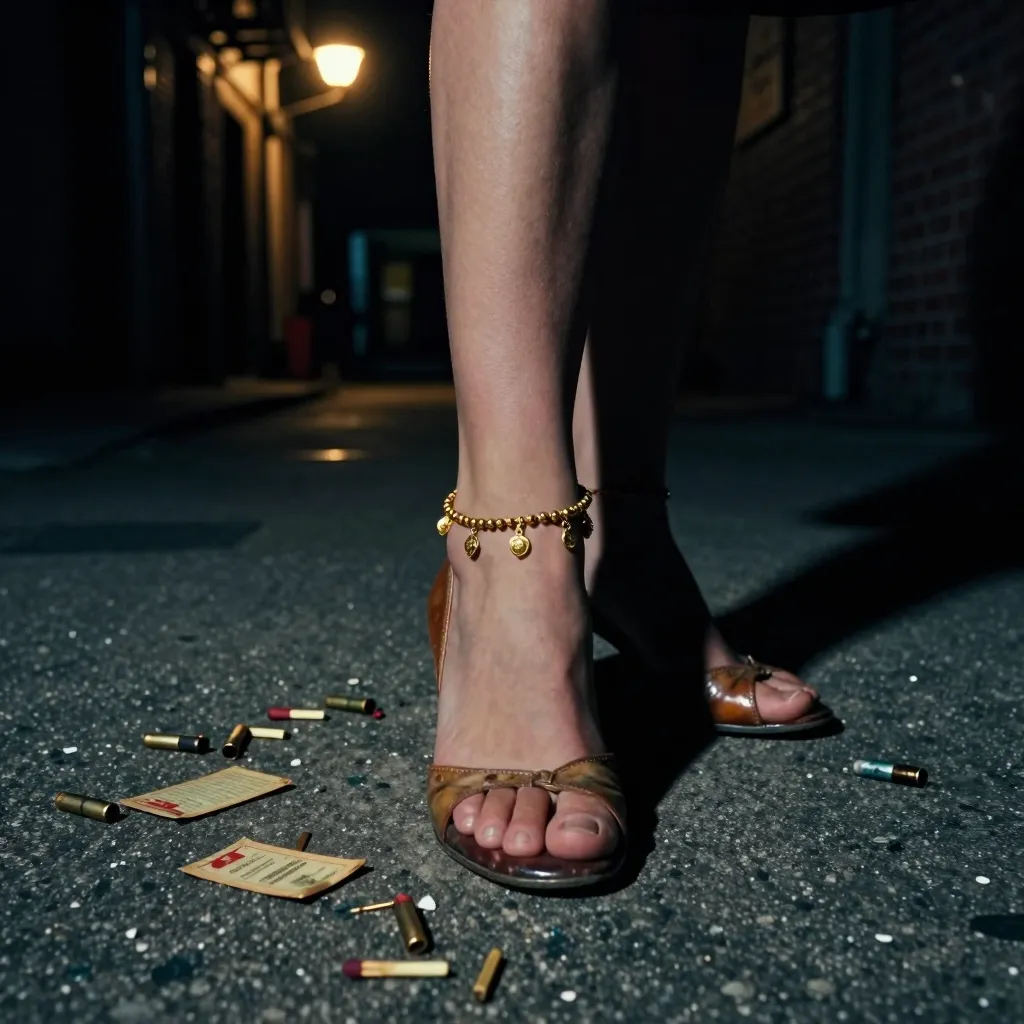
That's a Honey of an Anklet: Women, Noir, and the Art of Writing Dark
Classic noir often cast women as objects of the male gaze. Now, female writers are reclaiming the genre, transforming the femme fatale into an architect of her own survival and revealing that women—not men—were always the ones solving the mystery of the dark.
The Dark Heart of Noir: How Women Rewrote the Rules of Fatal Attraction
Noir has always been a genre of shadows—shadows that stretch across rain-slicked streets, that pool in the corners of smoke-filled rooms, and that lurk behind every seductive smile. But the deepest shadow in classic noir is one that rarely gets named: the male gaze, which doesn't merely observe the story but architects it, frame by frame.
The Anklet and the Architecture of Desire
Consider the iconic moment in Double Indemnity (1944). Walter Neff, an insurance salesman with more ambition than morals, rings the doorbell of the Dietrichson house. When Phyllis appears at the top of the stairs, the camera doesn't just show her—it consumes her. Neff tilts his head back. The audience tilts with him. We see what he sees: legs, anklet, the promise of transgression wrapped in silk and perfume.
The dialogue that follows operates like a chess match played with innuendo:
"That's a honey of an anklet you're wearing, Mrs. Dietrichson."
"I wonder if I know what you mean."
"I wonder if you wonder."
This is noir's seduction engine at full throttle. The woman is fragmented into desirable pieces—anklets, perfume, the curve of a chair. The man is the unified consciousness through which the entire narrative filters. We sympathize with his temptation. We understand his ruin. The femme fatale exists as a gravitational force, pulling him toward destruction, and the genre expects us to feel his vertigo, never hers.
The Unseen Gaze
What classic noir rarely interrogates is what the woman sees when she looks back. John Berger's observation that "men look at women; women watch themselves being looked at" finds its cinematic twin in these films. The female characters are hyper-aware of their own performance of desirability because survival depends on it. Phyllis Dietrichson isn't merely seducing Walter Neff—she's calculating him, measuring his greed against his lust, determining exactly how much rope he'll need to hang himself.
But the camera never lingers on her calculation. We don't get interior monologues revealing her strategy. We get anklets and shadows and the slow burn of cigarette smoke. The architecture holds.
When the Lens Shifts
The true revolution in noir began when women stopped being the subject of the gaze and started controlling the camera—or, in literary terms, the narrative perspective. Dorothy B. Hughes's 1947 novel In a Lonely Place represents a seismic shift. Where Hollywood later softened the story for Humphrey Bogart, Hughes's original work plunges readers into the mind of a serial killer with terrifying banality. There is no romantic veneer. The darkness is absolute.
More subversively, Hughes gives us a woman who loves the killer without illusion. She sees his charm, his violence, his broken promises—and she leaves. Not because a man saves her, but because she recognizes the architecture of her own endangerment. The gaze has shifted. The woman is watching herself being looked at, and she chooses to walk out of the frame.
The Geography of Risk
Noir desire functions differently than romance because its obstacles are structural, not incidental. In romance, barriers exist to be overcome—the misunderstanding, the rival, the timing. In noir, the obstacle is the attraction. Walter Neff doesn't want Phyllis despite the risk of murder and execution. He wants her because of it. The danger amplifies the desire. The transgression validates the feeling.
This is why noir maps so perfectly onto true crime's most haunting cases. The relationships that end in violence often carry this same distorted gravity—the sense that love and destruction are twin engines, impossible to separate. When investigators reconstruct the final days of a victim, they often find this noir architecture: one person calculating risk as romance, another recognizing danger too late.
Rewriting the Script
Contemporary women writing noir face a fascinating challenge: how to preserve the genre's electric tension while dismantling its foundational inequality. The solution lies not in softening the darkness but in redistributing it.
Start with waiting. Classic noir characters circle each other endlessly, talking around their desires because the Production Code demanded it—but also because restraint generates voltage. When two people want each other and cannot immediately have each other, every glance becomes charged. Every word carries subtext sharp enough to cut.
Then shift the ground. In the best contemporary noir, the person who appears to be manipulated turns out to be the architect. The femme fatale becomes the femme fatale in the original French sense—not merely fatal to others, but fated herself, operating within constraints that the narrative gradually reveals. The detective in the trench coat discovers that his investigation serves someone else's design.
Most crucially, trust the woman's gaze. Women in noir carry a different awareness of darkness because they navigate it differently. The threat assessment that happens unconsciously—checking exits, reading rooms, calibrating the risk of walking alone—becomes part of the narrative texture. When a woman in noir looks at a man, she isn't just measuring his desirability. She's calculating his capacity for harm.
The Moment of Leap
Every noir relationship reaches a precipice: the moment when two people face each other across a gulf of mistrust, fear, and desire. Will she step forward? Will he? The answer determines not just the arc of the relationship but often who survives the story.
In classic noir, this moment belongs to the man. He chooses pursuit or retreat, salvation or ruin. When women control the narrative, the moment transforms. It becomes a question not of conquest but of survival calculation. Every touch is a gamble. Every kiss could be a betrayal or a blade. The woman at the center isn't choosing between lovers—she's choosing whether to trust her own perception of danger.
This is where noir intersects most powerfully with true crime's unsolved cases. The victims who sensed danger but stayed. The witnesses who recognized evil but couldn't prove it. The survivors who trusted their instincts and ran. These real-world narratives carry noir's DNA: the architecture of desire and threat, the fatal miscalculation, the moment of leap that cannot be undone.
The Haunted Boardwalk
Noir has always been a genre of place as much as person. The rain-slicked Los Angeles of Chandler. The neon-drenched corruption of Chinatown. These locations aren't backdrops—they're characters with their own wounds and memories.
Atlantic City, with its faded grandeur and stubborn resilience, embodies noir perfectly. A town that has been knocked down, left for dead, and resurrected too many times to count. Its boardwalk theaters, with their backstage corridors and mothball perfume, carry the weight of every performance that ended badly. The city wears its damage like a woman wears dark lipstick after tragedy—defiant, theatrical, refusing to disappear.
In such places, magic and murder become natural companions. Both rely on misdirection. Both require the audience to look exactly where the performer wants, while the real action happens elsewhere. The woman who has been sawed in half onstage understands something fundamental about perspective: the world looks radically different from inside the trick.
The New Noir
The evolution of noir doesn't require abandoning its shadows. It requires illuminating them differently. When women write from inside the box—literally and figuratively—they reveal the mechanics of the illusion. The anklet was never just an anklet. The perfume was never just perfume. Every element of seduction in classic noir was simultaneously an element of strategy, and the women who deployed them were survivalists in silk.
Contemporary noir that honors this legacy doesn't soften the darkness. It makes it more precise. The danger a woman faces when she trusts a man isn't abstract—it's statistical, historical, visceral. When she extends her hand across that gulf of mistrust, she's not just gambling with her heart. She's calculating odds that the genre, at its best, forces the reader to confront.
The trench coat and toothpick remain. The notebook filled with clues still exists. But now the detective might be the one wearing the anklet, and the mystery she's solving might be her own capacity to survive the story she's entered.
In the end, noir's greatest trick was always making us believe that the woman was the mystery to be solved. The truth is simpler and more unsettling: she was always the one doing the solving. We just weren't looking in the right place.