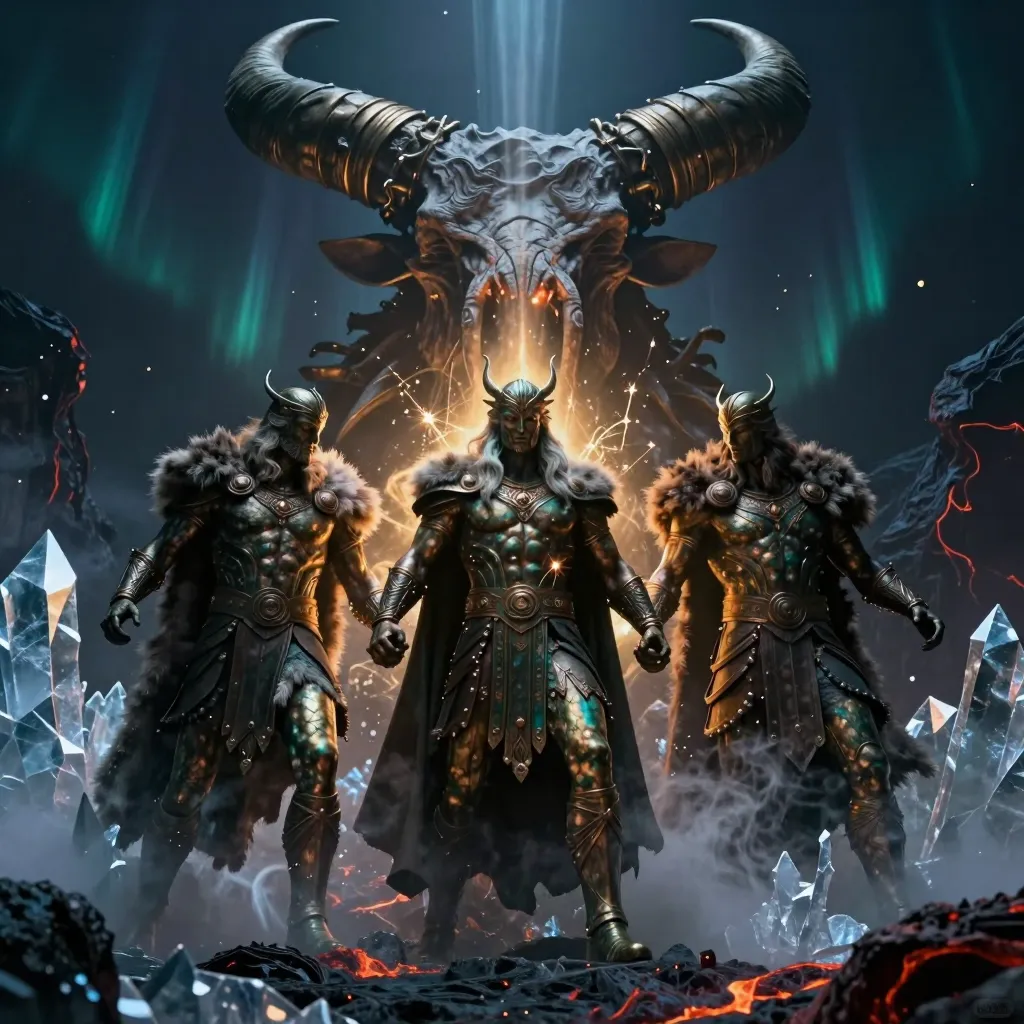
Vili and Ve: The Forgotten Brothers of Odin and Architects of the Norse Cosmos
While Odin dominates Norse myth, his brothers Vili and Ve were essential to the creation of the cosmos. This article explores their ancient origins, their role in slaying the giant Ymir, and why these powerful personifications of Will and the Sacred eventually faded into mythological obscurity.
Vili and Ve: The Forgotten Architects of the Norse Cosmos
In the shadowed halls of Norse mythology, where Odin's one-eyed gaze dominates the collective imagination, two figures stand quietly at the dawn of creation—brothers who shaped the world yet faded from the songs of skalds. Vili and Ve, whose names carry the weight of will and sacred space, were instrumental in forging the cosmos from primordial chaos, yet their stories remain fragments, whispers from an ancient past.
The First Gods
According to the medieval Icelandic scholar Snorri Sturluson, Odin, Vili, and Ve emerged as the first true Aesir gods. Born to Borr, a proto-deity of mysterious origins, and Bestla, a giantess of the frost-rimed wilderness, these three brothers represented a convergence of divine lineage and primordial power. Their birth marked a pivotal moment in the mythological timeline—the transition from the raw, unformed existence of the giant Ymir to the structured reality of the nine worlds.
The brothers' most significant deed remains one of mythology's most visceral creation narratives. Together, they confronted Ymir, the hermaphroditic giant whose sweat had spawned an entire race of frost giants, and ended his primordial existence. From Ymir's massive corpse, they constructed the cosmos itself: his flesh became the earth, his blood the oceans, his bones the mountains, his skull the sky, and his brains the clouds. This act of cosmic architecture transformed violence into order, death into the foundation of all life.
The Triad of Creation
The names of these brothers reveal layers of meaning that illuminate their roles in the Norse cosmological framework. Vili translates to "Will" or "Conscious Intention"—the faculty of purposeful thought and desire that transforms impulse into action. Vé carries connotations of "Temple" and "Sacred Enclosure," representing the hallowed space where the profane meets the divine, the boundary between chaos and order.
When combined with Odin, whose name derives from concepts of fury, inspiration, and poetry, the triad forms a complete philosophical system: Inspiration (Odin), Will (Vili), and the Sacred (Ve). These three forces—ecstatic vision, determined purpose, and consecrated space—constitute the essential elements required to transform chaos into cosmos. Without any one of these pillars, creation remains incomplete, unstable, vulnerable to collapse.
This interpretation suggests that Vili and Ve were not merely supporting characters in Odin's story but represented fundamental cosmic principles. Their presence at creation was not incidental but necessary, each brother contributing an essential ingredient to the formation of reality.
Etymological Echoes of Antiquity
Perhaps the most compelling evidence of Vili and Ve's ancient significance lies in linguistic archaeology. Reconstructed Proto-Germanic forms of their names—Woðanaz (Odin), Weljon (Vili), and Wixan (Ve)—display deliberate alliteration, a poetic device highly valued in Germanic oral traditions. This alliterative pattern suggests the triad existed as a cohesive unit long before the Viking Age, possibly dating back one or two millennia before the first Norse raids on English monasteries.
Such longevity implies these deities held substantial religious importance among early Germanic tribes. Minor figures rarely survive the transformations of oral tradition across such vast stretches of time. The fact that Vili and Ve persisted, even as their stories were gradually eclipsed by Odin's rising prominence, indicates they once stood as equals in the Germanic pantheon.
Shadows in the Sagas
Beyond their cosmogonic role, Vili and Ve appear fleetingly in surviving literature. The most notorious incident occurs during Odin's temporary exile from Asgard, the celestial stronghold of the Aesir. According to Snorri's Ynglinga Saga and the eddic poem Lokasenna, when Odin practiced seiðr—a form of magic considered "unmanly" by warrior standards—he was banished from his throne. During his absence, Vili and Ve shared the bed of Frigg, Odin's wife and queen of the Aesir.
The implications of this episode remain frustratingly obscure. Did the brothers usurp Odin's authority? Did Frigg consent, or was this an act of betrayal? The sources offer no resolution, leaving modern interpreters to speculate on the political and sexual dynamics of this divine drama. Some scholars suggest this narrative reflects ancient succession myths, where royal brothers claim the throne and queen during a king's temporary incapacity. Others see echoes of seasonal fertility rituals, where the goddess's consort changes with the turning year.
In Snorri's Prose Edda, three mysterious figures—Hárr ("High"), Jafnhárr ("Just as High"), and Þriði ("Third")—appear as Odin's disguises or perhaps as distinct entities who instruct King Gylfi in mythological lore. Some researchers identify these three with Odin, Vili, and Ve, suggesting the brothers occasionally served as Odin's mouthpieces or alternate manifestations. However, all three names are elsewhere applied solely to Odin, complicating this interpretation.
The Diminishing of the Divine
The sparse literary record of Vili and Ve presents a puzzle: why did two gods of such apparent antiquity and cosmological importance fade into near-obscurity? Several factors likely contributed to their eclipse.
As Norse society evolved, particularly during the Viking Age, Odin's cult grew increasingly dominant. Associated with war, death, poetry, and magic, Odin addressed the pressing concerns of an expansionist, honor-driven culture. His complex character—simultaneously wise and treacherous, generous and demanding—offered richer narrative possibilities than his more abstract brothers. The one-eyed god's personal charisma, demonstrated through his relentless pursuit of knowledge and willingness to sacrifice himself to himself on the world tree Yggdrasil, captured the imagination in ways that Vili and Ve's static principles could not.
Additionally, the conversion to Christianity may have accelerated the brothers' disappearance from the record. Christian scribes, while preserving pagan mythology, often emphasized figures who could be most easily demonized or most readily adapted to monotheistic frameworks. Odin, with his hanging sacrifice and thirst for wisdom, bore superficial resemblances to Christ that may have facilitated his preservation, while Vili and Ve lacked such convenient parallels.
Archaeological Silence
Unlike Odin, who appears frequently in archaeological finds—from the Torslunda plate depicting a one-eyed warrior to the numerous runic inscriptions invoking his name—Vili and Ve leave almost no material trace. No certain depictions of the brothers survive in Viking Age art. No amulets invoke their protection. No place-names definitively honor their memory.
This archaeological silence does not necessarily indicate their unimportance; rather, it reflects the selective nature of material preservation and the possibility that their worship occurred primarily in contexts less likely to leave durable traces. Alternatively, by the Viking Age, their cult may have been so thoroughly absorbed into Odin's that independent veneration had ceased.
The Philosophy of the Three
Despite their literary scarcity, Vili and Ve offer profound insights into Norse cosmological thought. The triad of Odin-Vili-Ve represents a sophisticated understanding of creation as a process requiring multiple, distinct forces. Inspiration without will remains unrealized potential; will without sacred space lacks grounding and direction; sacred space without inspiration and will remains empty form.
This tripartite structure echoes across Indo-European mythologies. The Hindu trimurti of Brahma (creator), Vishnu (preserver), and Shiva (destroyer) offers a comparable division of cosmic functions. Greek mythology presents Zeus, Poseidon, and Hades dividing dominion over sky, sea, and underworld. Whether these parallels reflect common Indo-European heritage or convergent human attempts to conceptualize cosmic complexity remains debated among scholars.
In the Norse context specifically, the three brothers' collaboration suggests a worldview that valued collective action over individual heroism—a striking contrast to the solitary figure of Odin that dominates later sources. The creation of the world was not a solo performance but a cooperative endeavor, requiring the combined efforts of all three divine brothers.
Modern Resonance
Contemporary interest in Norse mythology, fueled by popular media and renewed spiritual movements, has largely bypassed Vili and Ve. They appear rarely in modern retellings, overshadowed by Thor's hammer and Loki's schemes. Yet their conceptual significance—their representation of will and sacred space—offers valuable frameworks for understanding not only ancient Norse religion but the human relationship to creation itself.
In an age that often celebrates individual genius and singular vision, the story of Vili and Ve reminds us that the most enduring achievements typically require multiple forces: the flash of inspiration, the steady commitment of will, and the establishment of boundaries that transform raw possibility into meaningful structure. The cosmos, in this view, is not the product of a lone creator but the collaborative work of complementary powers.
The brothers' gradual fade from mythological prominence also serves as a meditation on memory and loss. Not all who shape the world receive lasting recognition. Foundations, once laid, often disappear beneath the structures they support. Vili and Ve, in their quiet persistence at the edges of the stories, embody this truth—the necessary but forgotten labor that makes civilization possible.
Conclusion
Vili and Ve stand at the threshold of Norse mythology, present at the beginning yet largely absent from what follows. Their names—Will and the Sacred—suggest they were never meant to be characters in the conventional sense, but rather principles given temporary narrative form. In creating the cosmos alongside Odin, they performed their essential function, establishing the conditions within which stories could unfold.
To encounter Vili and Ve is to touch the deepest strata of Germanic religious thought, to glimpse a time before the gods had personalities and dramas, when they were forces rather than figures. In their obscurity, they offer a different kind of mythological experience—not the excitement of Thor's battles or the psychological complexity of Odin's wanderings, but the solemn recognition that creation itself is the most profound mystery, one that requires more than a single hand to accomplish.
The next time you encounter the Norse creation story, spare a thought for the brothers who stood beside the Allfather, who gave their names to the will that shapes reality and the sacred space that contains it. Though their stories have crumbled like the ruins of forgotten temples, their contribution remains woven into the fabric of the world—visible in every mountain, felt in every breath of wind, present in every boundary between the wild and the hallowed.