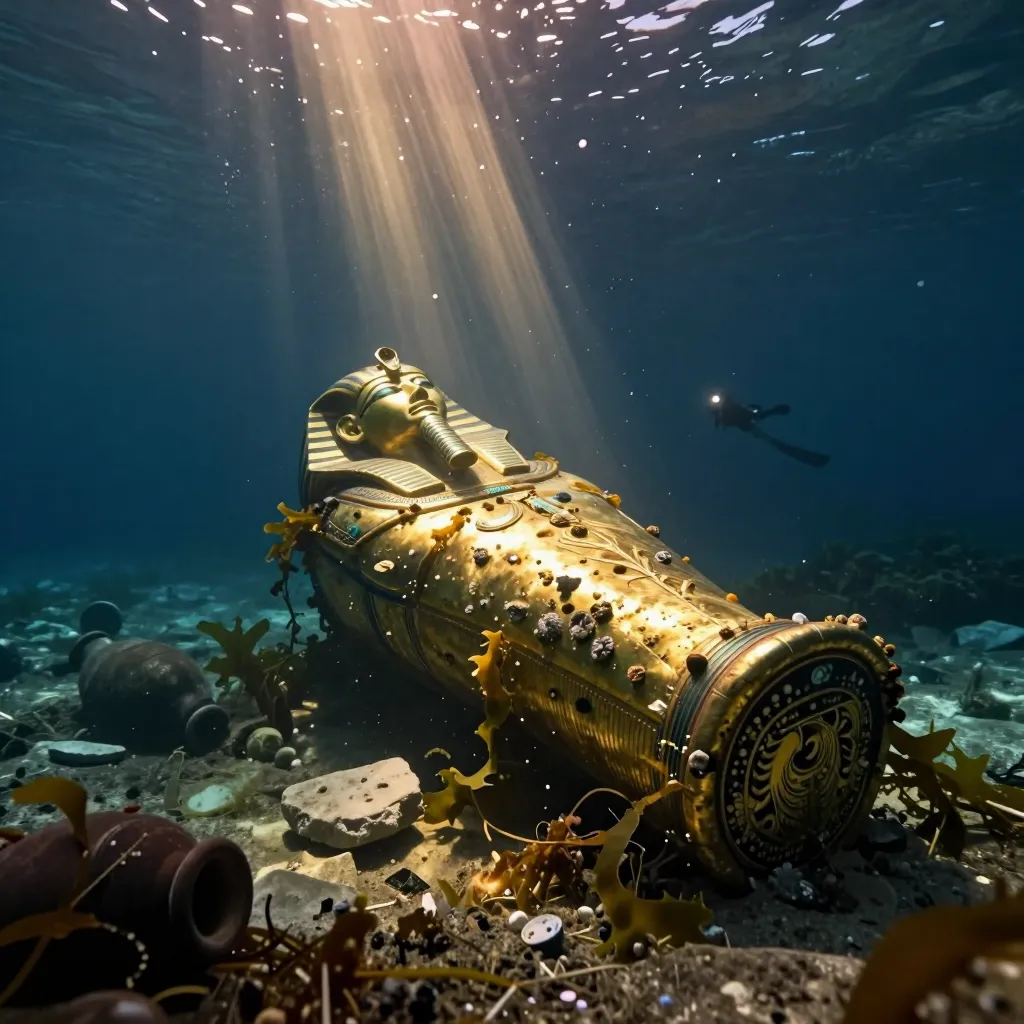
The Vanishing Tomb: Why Cleopatra’s Resting Place Remains a Mystery
After the Battle of Actium, Cleopatra and Mark Antony were interred in a grand mausoleum that vanished. This thrilling investigation dives into the earthquakes, tsunamis, and underwater archaeology keeping the Queen of the Nile’s final secret hidden beneath the sea.
The Vanishing Tomb: Why Cleopatra’s Resting Place Remains a Mystery
[cite_start]Cleopatra VII remains one of history’s most captivating enigmas—a brilliant, kohl-eyed queen who navigated the treacherous waters of power alongside the Roman Empire’s most formidable men, Julius Caesar and Mark Antony[cite: 193, 207]. [cite_start]Yet, despite her monumental life and the legendary circumstances of her death, the final resting place of Egypt’s last pharaoh has eluded discovery for over two millennia[cite: 193, 208].
The Final Stand of a Dynasty
The story of Cleopatra’s end is as dramatic as her reign. [cite_start]In 31 B.C., following a crushing defeat by Octavian’s forces at the Battle of Actium, the Queen and her Roman partner, Mark Antony, retreated to Alexandria[cite: 195]. [cite_start]Believing Cleopatra had already perished, Antony fell upon his own sword[cite: 196].
[cite_start]Facing the humiliation of being paraded through Rome as a captive, Cleopatra chose death by her own hand[cite: 195, 197]. [cite_start]While popular legend attributes her demise to the bite of a venomous asp hidden in a basket of figs, ancient chroniclers like Plutarch also suggested she might have used a concealed vial of poison[cite: 225].
Clues From the Ancient World
[cite_start]What we know of Cleopatra’s burial comes primarily from Roman writers, who often viewed her with a mix of fascination and deep-seated prejudice[cite: 209, 216]. [cite_start]According to Plutarch, the queen had commissioned a "surpassingly lofty and beautiful" mausoleum near a temple dedicated to Isis, her patron goddess[cite: 219, 230].
[cite_start]Ancient records indicate that Octavian allowed the couple to be buried together in this unfinished monument, honoring Cleopatra’s request that they be united in death[cite: 198, 224, 228]. [cite_start]Both were reportedly embalmed and interred in the same tomb, a site intended to be a royal treasury and a lasting monument to their legacy[cite: 219, 229].
The Sunken City
If such a grand mausoleum existed, why has it never been found? The answer lies in the shifting sands and rising tides of Alexandria. [cite_start]In A.D. 365, a catastrophic earthquake and tsunami devastated the city, claiming thousands of lives and dragging the ancient royal quarter into the depths of the Mediterranean[cite: 199, 234].
[cite_start]For centuries, the ruins of Cleopatra’s world lay buried under 20 feet of water and thick layers of sediment[cite: 235]. [cite_start]It wasn't until the 1990s that underwater archaeologists, led by Franck Goddio, began to map the submerged "Royal Harbor"[cite: 236, 237]. [cite_start]While they successfully identified sunken palaces and a temple dedicated to Isis—containing silver coins with Cleopatra’s likeness—the queen's tomb remained absent[cite: 246, 248].
The Hunt Continues
The search is not limited to the seabed. [cite_start]Some archaeologists have turned their attention inland to sites like Taposiris Magna, a temple complex located about 30 miles west of Alexandria[cite: 253]. [cite_start]Researchers have discovered tunnels, coins, and statues at this location, fueling theories that the queen may have been buried away from the city to protect her remains from Roman desecration[cite: 254].
[cite_start]However, many historians, including Jane Draycott of the University of Glasgow, remain skeptical of these alternative sites[cite: 201]. [cite_start]The consensus among many experts is that the mausoleum likely sits somewhere within the modern city of Alexandria or just off its coast, obscured by centuries of urban development and natural disasters[cite: 202, 251].
The mystery of Cleopatra’s tomb is a testament to the power of time to erase even the most significant monuments. [cite_start]Until a definitive discovery is made, the Queen of the Nile continues to guard her final secret, leaving us with only the haunting echoes of her extraordinary life[cite: 193, 204].