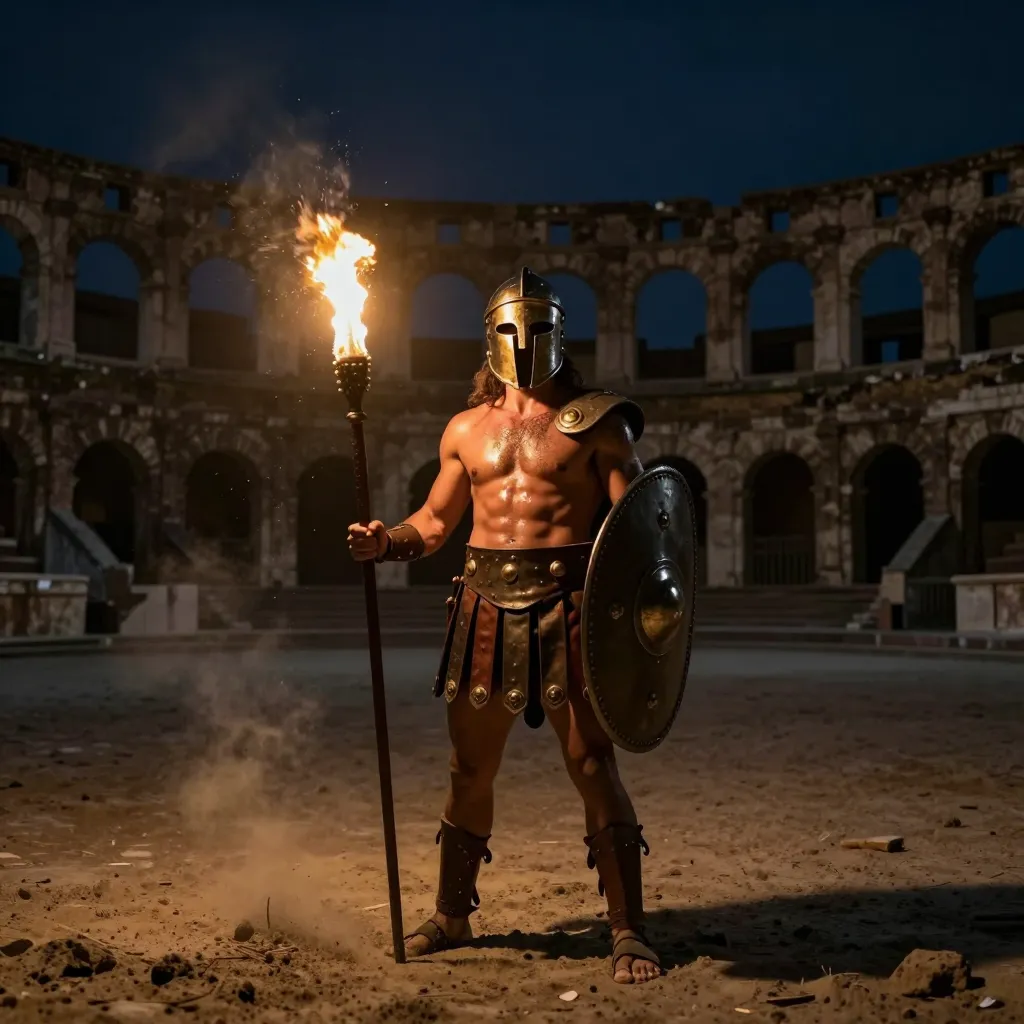
Legends of the Arena: 10 Gladiators Who Defined Ancient Rome
Step into the Colosseum to witness the thrilling true stories of 10 legendary gladiators. This collection explores the lives of fighters like Spartacus and Flamma, detailing their rise from slavery to becoming the athletic superstars and symbols of defiance in the Ancient Roman world.
Legends of the Arena: 10 Gladiators Who Defined Ancient Rome
In the heart of Ancient Rome, the colosseum was not merely a stadium but a theater of life and death. [cite_start]Gladiators—men often sold into slavery or bound by debt—rose to become the athletic superstars of their era[cite: 9, 10]. [cite_start]While many met a grim end in the dust of the arena, a select few achieved a level of fame that rivaled emperors, earning lavish gifts, thousands of supporters, and occasionally, the ultimate prize: their freedom[cite: 10, 11].
1. Spartacus: The Thracian Rebel
The name Spartacus remains synonymous with defiance. [cite_start]A Thracian soldier captured and sold into slavery, he was purchased by Lentulus Batiatus to be trained as a gladiator[cite: 46, 47]. [cite_start]In 73 BC, Spartacus led seventy fellow fighters in a violent breakout, eventually amassing an army of 70,000 freed slaves[cite: 48, 50]. [cite_start]For two years, he outmaneuvered the Roman Senate's legions until he was finally cornered and killed by Marcus Licinius Crassus in 71 BC[cite: 51, 52, 53].
2. Commodus: The Imperial Gladiator
[cite_start]Unlike most who fought out of necessity, Emperor Commodus entered the arena out of pure narcissism[cite: 38, 39]. [cite_start]Believing himself to be a reincarnation of Hercules, he frequently appeared in the arena, though the "battles" were largely staged[cite: 40]. [cite_start]He typically fought opponents armed only with wooden weapons or slaughtered tethered animals[cite: 41]. [cite_start]His behavior was seen as a disgrace to the empire, and his obsession with the arena eventually fueled the conspiracy that led to his assassination in AD 192[cite: 43, 45].
3. Flamma: The Man Who Refused Freedom
A Syrian slave, Flamma became one of the most prolific fighters in Roman history. [cite_start]Over a career that ended with his death at age thirty, he fought thirty-four times, securing twenty-one victories[cite: 34]. [cite_start]What set Flamma apart was his dedication to the craft: he was awarded the rudis (the wooden sword symbolizing freedom) four separate times[cite: 36, 37]. [cite_start]Each time, he refused it, choosing to remain a gladiator rather than live as a common citizen[cite: 37].
4. Crixus: The Spirit of Rebellion
[cite_start]A Gallic gladiator and the trusted lieutenant of Spartacus, Crixus was instrumental in the early success of the Third Servile War[cite: 29, 31]. [cite_start]While he helped defeat numerous Roman armies, he eventually split from Spartacus's main group to campaign through Southern Italy[cite: 32]. [cite_start]This strategic diversion allowed others to escape, but Crixus was eventually struck down by Roman legions before he could see the end of the rebellion[cite: 33].
5. Gannicus: The Celtic Powerhouse
[cite_start]Gannicus was a Celtic gladiator known for an incredibly athletic and aerial fighting style[cite: 27]. [cite_start]Often compared to Spartacus for his sheer technical skill, he was a distinct figure in the arena with his tanned skin, long blond hair, and a Nordic "invincibility" symbol tattooed on his body[cite: 26, 27, 28]. [cite_start]Like Crixus, he played a vital role in the slave uprisings that shook the Roman Republic[cite: 27].
6. Marcus Attilius: The Debt-Ridden Citizen
[cite_start]While most gladiators were slaves, Marcus Attilius was a free-born Roman citizen who volunteered for the arena to pay off massive personal debts[cite: 22]. [cite_start]Despite his lack of experience, he became an overnight sensation by defeating Hilarus—a champion who had won thirteen consecutive battles[cite: 23]. [cite_start]Attilius proved it wasn't a fluke by immediately defeating another veteran, Raecius Felix, who had twelve victories to his name[cite: 24].
7. Spiculus: The Emperor’s Favorite
[cite_start]Spiculus was a legendary fighter of the first century AD who gained the favor of Emperor Nero[cite: 19]. [cite_start]His victories were so impressive that Nero gifted him palaces and riches typically reserved for high-ranking officials[cite: 20]. [cite_start]Their bond was so strong that when Nero was eventually overthrown, he searched for Spiculus so he could die at the hands of the gladiator he admired; however, Spiculus could not be found, and Nero took his own life[cite: 21].
8 & 9. Priscus and Verus: The Eternal Rivals
[cite_start]In the first century AD, these two rivals participated in the inaugural fight at the Flavian Amphitheatre (the Colosseum)[cite: 16]. Their battle lasted for hours, with neither able to gain the upper hand. [cite_start]In a rare display of mutual respect, both men conceded at the same time[cite: 17]. [cite_start]Emperor Titus was so moved by their bravery that he granted them both the rudis simultaneously, allowing them to leave the arena together as free men[cite: 18].
10. Tetraites: The Murmillo of Pompeii
[cite_start]For centuries, Tetraites was known only through graffiti discovered in the ruins of Pompeii[cite: 12]. [cite_start]He fought in the murmillones style, equipped with a heavy rectangular shield and a crested helmet[cite: 13]. [cite_start]It wasn't until the late 20th century that historians realized the true scale of his fame, as pottery depicting his victories was discovered as far away as England and France, proving he was an international celebrity of the ancient world[cite: 14].