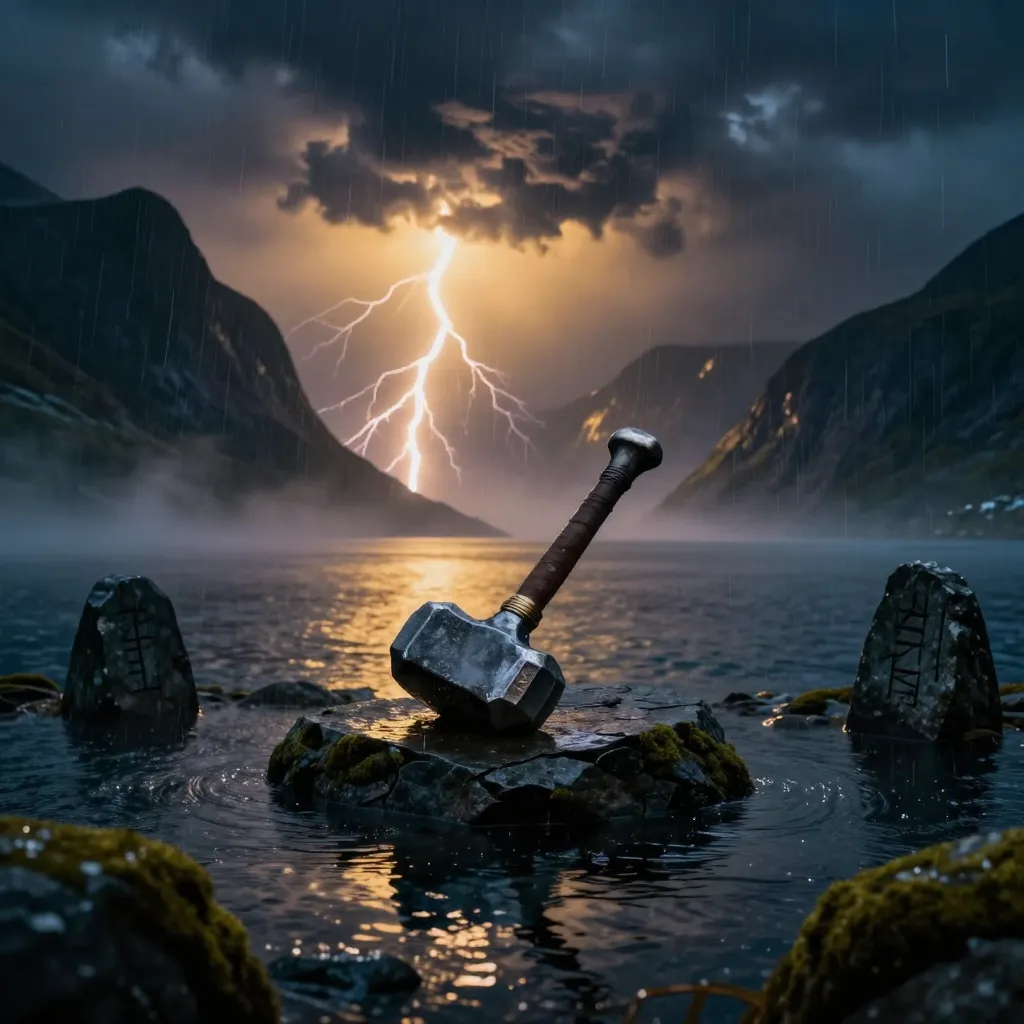
Thor: The Thunder God's Enduring Legacy in Norse Mythology
Thor, the thunder god of Norse mythology, protects Asgard with Mjöllnir and sanctifies rituals. His evolution from warrior deity to commoner's champion during the Viking Age highlights cultural resistance. Discover Thor's enduring impact on mythology and society.
Thor: The Thunder God's Enduring Legacy in Norse Mythology
In the vast tapestry of Norse mythology, few figures command the reverence and raw power embodied by Thor. Known to the ancient Germanic peoples as Þórr in Old Norse, Đunor in Old English, and Donar in Old High German, this thunder deity traces his etymological roots to the Proto-Germanic *Þunraz—literally "Thunder." Long before the Christianization of northern Europe, Thor stood as a central pillar of religious life among Germanic tribes, achieving his greatest prominence among Scandinavian populations during the twilight of the Viking Age.
The Archetype of the Honorable Warrior
Thor represents the quintessential warrior—loyal, honorable, and unyielding in his defense of cosmic order. As the primary guardian of the Aesir gods and their celestial stronghold, Asgard, he stands eternal watch against the chaotic forces of the giants. These colossal beings, while not universally malevolent, frequently threaten the stability of the divine realm and the mortal world alike.
The thunder god's physical prowess remains virtually unmatched among the pantheon. His courage and sense of duty are unshakeable, reinforced by mystical artifacts that amplify his already formidable abilities. The megingjarðar, an enchanted belt of strength, doubles his power when worn. Yet it is Mjöllnir—his legendary hammer whose name translates to "Lightning"—that defines his iconography. This weapon accompanies him nearly everywhere, serving as both instrument of destruction and sacred tool of blessing.
Ancient Scandinavians interpreted the natural world through Thor's mythology. Thunder represented the god himself, while lightning manifested as Mjöllnir striking down giants. The imagery of Thor traversing the heavens in a chariot drawn by goats served not as literal belief but as symbolic language expressing invisible cosmic truths that patterned the material world.
The Cosmic Adversary: Jormungand
Among Thor's many conflicts, none carries greater fatal significance than his enmity with Jormungand, the World Serpent. This massive sea dragon encircles Midgard—the realm of human civilization—lying coiled in the ocean depths. Their first legendary confrontation occurred during a fateful fishing expedition, when Thor nearly hauled the beast from its watery domain. Only the intervention of his giant companion, who severed the line out of terror, prevented catastrophe.
The Poetic and Prose Eddas foretell their final reckoning during Ragnarök, the apocalyptic dissolution of the cosmos. In this ultimate battle, Thor and Jormungand will destroy one another, marking one of mythology's most poignant mutual destructions. The serpent's venom will claim Thor's life even as his hammer crushes the dragon's skull.
Divine Lineage and the Giant Complex
Irony permeates Thor's character: the foremost defender of cosmic order against giant-kind is himself three-quarters giant. His father, the All-Father Odin, possesses half-giant ancestry, while his mother—variously identified as Jord (Earth), Hlöðyn, or Fjörgyn—comes entirely from giant stock. Such lineage was far from unusual among the Aesir, revealing the nuanced relationship between gods and giants. Theirs was a dynamic of tension and periodic conflict, certainly, but also intermarriage, complex alliances, and shared bloodlines that resist simplistic villainization.
The Sacred Art of Hallowing
Thor's influence extended far beyond battlefield glory into the sanctification of everyday life. His power to bless and protect made him the patron of those seeking security, comfort, and ritual consecration. Archaeological evidence abounds: numerous runic inscriptions invoke Thor to sanctify their words and purposes, while wedding ceremonies traditionally called upon his blessing.
The Þrymskviða—the famous tale of Thor disguised as a bride to recover his stolen hammer—preserves evidence of his role in marital rites. Early Icelandic settlers explicitly petitioned Thor to hallow their land before construction or agriculture commenced, establishing his integral role in colonization and cultivation.
Mjöllnir itself embodied this dual nature of destruction and consecration. The hammer could banish hostile forces through violence or through ritual purification—these were fundamentally the same act viewed from different perspectives. Wedding blessings were effected through Mjöllnir, as were the miraculous resurrections of Thor's goats. The god could slaughter and consume these animals, gather their bones within their hides, strike the bundle with his hammer, and restore them to perfect vitality—a myth encoding themes of sacrifice, death, and agricultural renewal.
Fertility, Agriculture, and Celestial Marriage
Beyond warfare, Thor profoundly influenced agricultural prosperity and fertility. As a sky deity, he governed the rain essential for crop growth. The eleventh-century chronicler Adam of Bremen recorded that "Thor, they say, presides over the air, which governs the thunder and lightning, the winds and rains, fair weather and crops."
His seldom-discussed wife, Sif, possesses hair of spun gold—an transparent metaphor for ripe grain fields. Their union exemplifies the "hierogamy" or sacred marriage common among Indo-European peoples, particularly the cosmic pairing of sky god and earth goddess. Through this divine sexual union, the land's fruitfulness and the people's prosperity were mystically generated.
Social Dynamics and Religious Evolution
Archaeological traces of Thor's veneration reach back to the Bronze Age, his cult transforming across centuries and geography. One constant remained: Thor's association with the second "function" in the tripartite social hierarchy theorized by scholars—a classification system organizing traditional European societies into rulers (sovereignty), warriors (military strength), and producers (agricultural fertility).
Thor maintained connections to both the second and third functions, but during the Viking Age—a period of remarkable social upheaval and innovation—his ties to agricultural and commoner concerns intensified. This evolution elevated him to preeminence among ordinary Scandinavians and Viking colonists, distinguishing him sharply from Odin's aristocratic cult.
The Odinic Contrast
Odin and Thor functioned as near-opposites within Norse religious practice. Where Odin attracted rulers, outcasts, and elite seekers pursuing ecstasy, knowledge, magical power, and creative agency, Thor embodied more accessible virtues. The Eddic poem Hárbarðsljóð captures their tension when Odin declares: "Odin's are the nobles who fall in battle, but Thor's are the thralls." In another significant episode from Gautreks Saga, Odin and Thor compete through blessings and curses upon the hero Starkaðr—Odin granting noble favor while Thor ensures commoner scorn.
Demographic shifts gradually merging warrior and agricultural classes throughout the Viking Age (c. 793-1000 CE) amplified Thor's prominence at Odin's expense. Late-period sources describe Thor as foremost among the Aesir—a statement that would have seemed absurd in earlier eras when Odin and his continental equivalents dominated Germanic religion.
Icelandic Devotion
This transformation achieved its most dramatic expression in Iceland, settled during the ninth century by farming colonists fleeing the oppressive rule of an Odin-worshipping Norwegian monarch. Icelandic sagas overflow with Thor veneration, while the Landnámabók—the "Book of Settlements"—reveals that roughly one-quarter of four thousand named settlers bore Thor's name or clear theophoric references within their own names.
Scholar E.O.G. Turville-Petre captured this phenomenon precisely: in these late Viking Age Icelandic sources, Thor appears "not only as the chief god of the settlers but also as patron and guardian of the settlement itself, of its stability and law."
Resistance and Cultural Identity
Thor's ascendancy during the Viking Age carried political and cultural dimensions beyond purely religious evolution. When Christianity penetrated Scandinavia and Viking colonies, initial tolerance characterized the encounter—pagans accepted the new god as they accepted any other. However, as Christian intolerance toward traditional practices became apparent, northern Europeans resisted cultural erasure.
Thor emerged as the natural defender of ancestral ways against foreign religious imperialism. This struggle manifested visibly in material culture: where Christians wore cross amulets, traditionalists adopted miniature Thor's hammers as pendant jewelry. Archaeological distributions of these hammer-amulets concentrate precisely in regions of strongest Christian influence, mapping the geography of religious resistance. Though ultimately unsuccessful, these preservation efforts drew strength from a divine patron who modeled the defense of traditional life against hostile invasion.
Conclusion
Thor's mythology endures as one of humanity's most compelling divine narratives—a god of thunder and lightning who sanctifies as readily as he destroys, who protects the cosmic order while embodying the chaotic bloodlines he opposes, who evolved from elite warrior deity to champion of common people resisting cultural extinction. In his contradictions and transformations, Thor reflects the complex societies that worshipped him, offering insights into Viking Age Scandinavia that resonate across the millennium separating their world from ours.