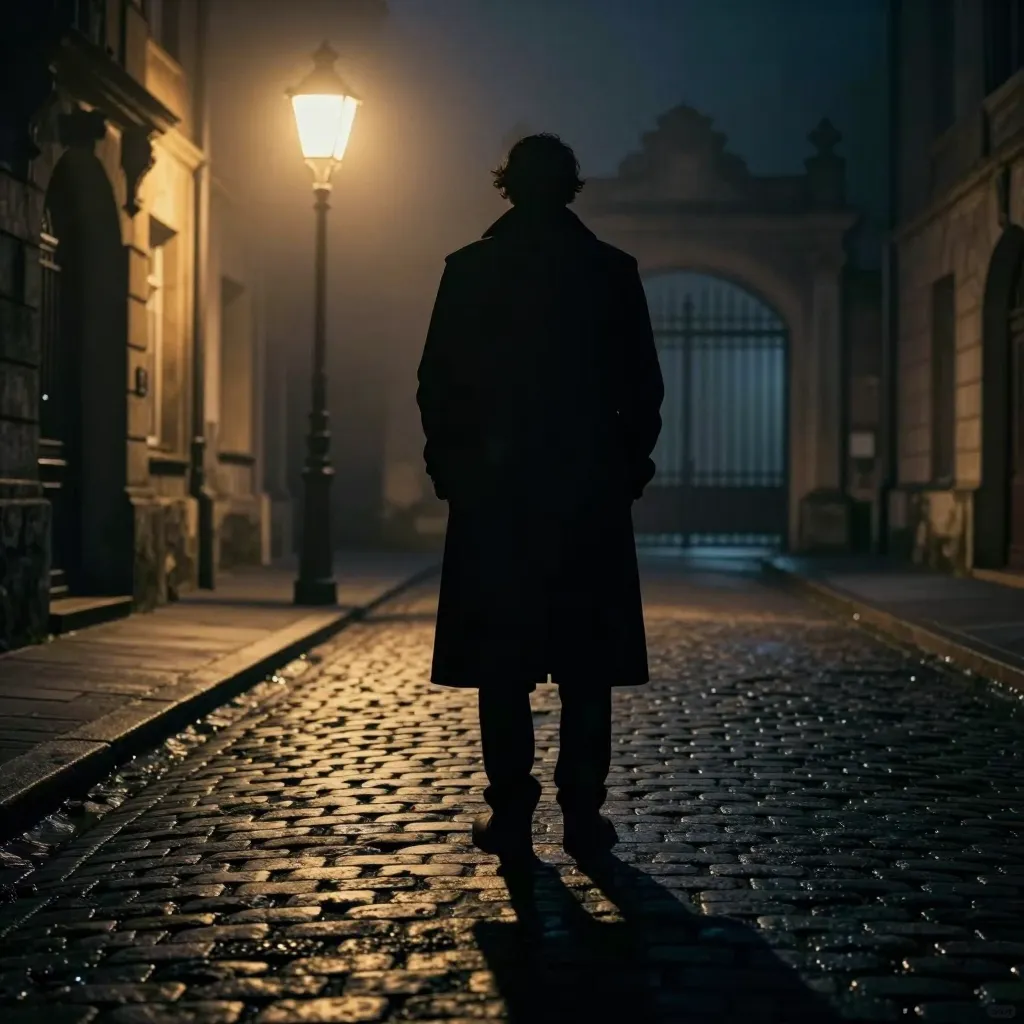
The Power of the Stranger: Mastering Suspense and Unsolved Mystery Plots
Explore the psychological impact of the unknown character in storytelling. Learn how to use the 'stranger' element to drive tension, fuel unsolved mysteries, and keep your readers questioning everything. Perfect for writers of true crime and suspense fiction.
When Strangers Collide: How Chance Encounters Become the Engine of Mystery
There is a peculiar tension in the way we relate to people we do not know. In one mode, the stranger is a figure of suspicion—someone to avoid on a dark street, whose knock at the door we do not answer, whose online presence we refuse to translate into physical reality without the armor of a public place. The stranger here is dangerous, unknowable, an outsider whose motives remain opaque. We are drawn to them, perhaps, but from a safe distance.
In another mode, we are utterly absorbed by strangers. We scroll through their lives for hours, watching them dance, argue, confess, grieve, and search for meaning. We follow their stories as if they were our own. We laugh at their jokes. We cry at their losses. We feel, somehow, that we know them—though they have never known us.
This duality is what makes the chance encounter so electrically charged with possibility. When fate throws two unknown lives together, anything can unfold. The stranger might become a savior or a threat. They might unlock a secret we have spent years burying. They might reveal, in a single conversation, something about ourselves we were not prepared to face. In the space of mystery and true crime, these collisions are rarely neutral. They are the ignition points of obsession, violence, revelation, and transformation.
Here are five novels that explore what happens when strangers cross paths—and how those moments ripple outward, sometimes for a moment, sometimes forever.
Tales of the City by Armistead Maupin
San Francisco in the 1970s was a city of seekers, runaways, and reinventions—a place where identities could be shed and rebuilt in the space of a single summer. At 28 Barbary Lane, a rambling apartment house presided over by the enigmatic Anna Madrigal, a group of young tenants arrives as strangers and slowly knits itself into something resembling family.
Mary Ann Singleton, fresh from the Midwest and determined to become a new version of herself. Michael "Mouse" Tolliver, navigating queer life with humor and heart. Mona Ramsey, drifting between causes and communes. Brian Hawkins, chasing pleasure and connection with equal intensity. None of them know each other when they arrive. None of them expect to stay.
What Maupin captures is the alchemy of proximity. Strangers, thrown together by nothing more than geography and timing, begin to function as each other's "logical family"—a chosen circle that replaces, or supplements, the biological one left behind. Mrs. Madrigal, with her kaftans and her cannabis and her carefully guarded past, becomes the gravitational center. The mystery of who she is—and what she is hiding—unfolds slowly, deepening the bonds rather than fracturing them.
The novel remains a landmark for its unapologetic normalization of queer lives in mainstream culture. But at its core, it is a study in how strangers become indispensable to one another, and how the stories we tell about ourselves change when we have an audience willing to listen.
How Not to Drown in a Glass of Water by Angie Cruz
Cara Romero is a middle-aged Dominican woman who has lost her factory job in the wreckage of the 2009 recession. Now she sits in a series of government-funded career counseling sessions, required to attend in order to qualify for benefits, and talks. She talks for hours. She talks about her childhood, her marriages, her children, her regrets, her small triumphs, her devastating losses.
The person listening is a career counselor whose face she never describes, whose name she never reveals. He—or she—is a function, a requirement, a stranger paid to sit in a chair and absorb another person's life. And yet, without this anonymous presence, Cara's story would remain untold.
The novel unfolds as twelve monologues, each one peeling back another layer of a life that is simultaneously ordinary and extraordinary. Cara's voice is funny, furious, resilient, and heartbreaking. She confesses things she might never tell a friend or family member—because the counselor is a stranger, and because the counselor cannot judge her without jeopardizing the professional distance required by the role.
There is a mystery here, though not the kind solved by detectives. The mystery is Cara herself: what she has survived, what she has sacrificed, what she still hopes for. The stranger becomes the vessel into which she pours everything, and the reader, eavesdropping on these sessions, becomes a stranger too—one who, by the end, knows Cara better than many of the people in her actual life.
Leave the World Behind by Rumaan Alam
The premise is simple and terrifying in its plausibility. Amanda and Clay, a white couple from Brooklyn, rent a luxury home on Long Island for a week of escape with their teenage children. They have just settled into the rhythm of vacation—wine, pool, sun, sex—when there is a knock at the door.
Standing there are Ruth and G.H., an older Black couple who own the house. They have fled New York City after a massive power outage, seeking refuge in the one place they know is safe. They have no way to prove they are who they say they are. Amanda and Clay have no way to verify their story. The internet is down. The phones are dead. The television shows only static. The world outside has gone silent, and inside the house, four adults and two children are trapped in a vacuum of uncertainty.
Alam uses this confined space to dissect how strangers read each other under duress. Race and class become lenses through which suspicion is filtered. Amanda cannot stop interrogating Ruth and G.H.'s credentials, their mannerisms, their right to be there. G.H. and Ruth, in turn, measure Amanda and Clay's entitlement, their panic, their competence in a crisis. No one is fully trustworthy. No one is fully safe.
The novel is a slow-burning thriller that asks uncomfortable questions about human nature when the social contract frays. What do we owe strangers in an emergency? How quickly do we retreat into tribalism when information disappears? The power of the novel lies in its refusal to provide easy answers. The strangers remain, in some essential way, strangers—and that ambiguity is the source of its dread.
Looker by Laura Sims
The Professor—she is never named—is unraveling. Her marriage has ended. Her fertility treatments have failed. Her academic career is hanging by a thread. She lives alone in a decaying apartment with only her ex-partner's cat for company, and she watches.
Her object of obsession is the Actress, a neighbor whose life appears, through the window, to be everything the Professor's is not. The Actress is beautiful, successful, apparently happy. She has a husband who adores her, children who are thriving, a home that is immaculate. The Professor does not know her. They have never spoken. But the Professor studies her with the intensity of an astronomer tracking a distant star.
What begins as voyeurism curdles into something darker. The Professor begins to insert herself into the Actress's orbit—attending her plays, lingering near her building, constructing elaborate fantasies about their potential friendship. The boundary between observer and participant dissolves. The stranger the Professor has invented in her mind becomes more real, more necessary, than the actual people in her life.
Sims constructs a portrait of urban alienation that is both specific and universal. Cities are dense with strangers living in intimate proximity, separated by nothing more than walls and windows. We see their lights, hear their arguments, watch their routines. We construct narratives about them without ever confirming a single detail. The Professor simply takes this ordinary habit to its logical, disturbing extreme—and in doing so, exposes how fragile the line is between curiosity and fixation.
Strangers on a Train by Patricia Highsmith
No novelist understood the malign potential of chance encounters better than Patricia Highsmith. Her 1950 classic remains the definitive exploration of how a single conversation between strangers can set in motion a machinery of violence that neither participant fully controls.
Guy Haines is a successful architect with a problem: his wife, Miriam, refuses to grant him a divorce, trapping him in a marriage he no longer wants. Bruno Antony is a charismatic sociopath with a different problem: his father controls the family fortune and shows no sign of dying. They meet on a train. Bruno proposes a solution. He will kill Miriam. Guy will kill Bruno's father. The crimes will be unconnected. The police will never trace them back to the actual beneficiaries. It is, Bruno insists, the perfect murder.
What follows is a descent into guilt, paranoia, and mutual destruction. Guy, who never explicitly agreed to the bargain, finds himself implicated anyway. Bruno, who thrives on chaos, becomes increasingly unhinged as he demands that Guy fulfill his end of the arrangement. The strangers are bound together by a shared secret that neither can escape, and the novel becomes a study in how quickly a chance encounter can transform into an inescapable partnership.
Highsmith's genius lies in her refusal to make either man entirely sympathetic or entirely monstrous. Guy is complicit in his own way—he wanted Miriam dead, even if he would not act on the desire. Bruno is repellent but also, in his own twisted fashion, honest about his nature. The novel asks whether we recognize something in strangers because they are foreign to us, or because they reveal truths about ourselves we prefer to ignore.
The Stranger as Mirror
These five novels approach the stranger from different angles—warmth, necessity, suspicion, obsession, violence—but they share a common recognition. The stranger is never entirely external. They are a screen onto which we project our fears, our desires, our unacknowledged selves. In crossing paths with someone unknown, we are forced to improvise a self we may not have known we possessed.
In the realm of mystery and the unexplained, this dynamic takes on added weight. The stranger who arrives without context is a blank slate, and blank slates invite speculation. Are they victim or perpetrator? Savior or threat? The answer often depends less on who they are than on who we are when we meet them.
The next time a stranger sits beside you on a train, knocks on your door, or catches your eye from a neighboring window, consider what story you are already telling about them—and what story they might be telling about you. The collision of two unknown lives is one of the oldest engines of narrative, and it remains potent because it is, at heart, a collision of two unknown selves.