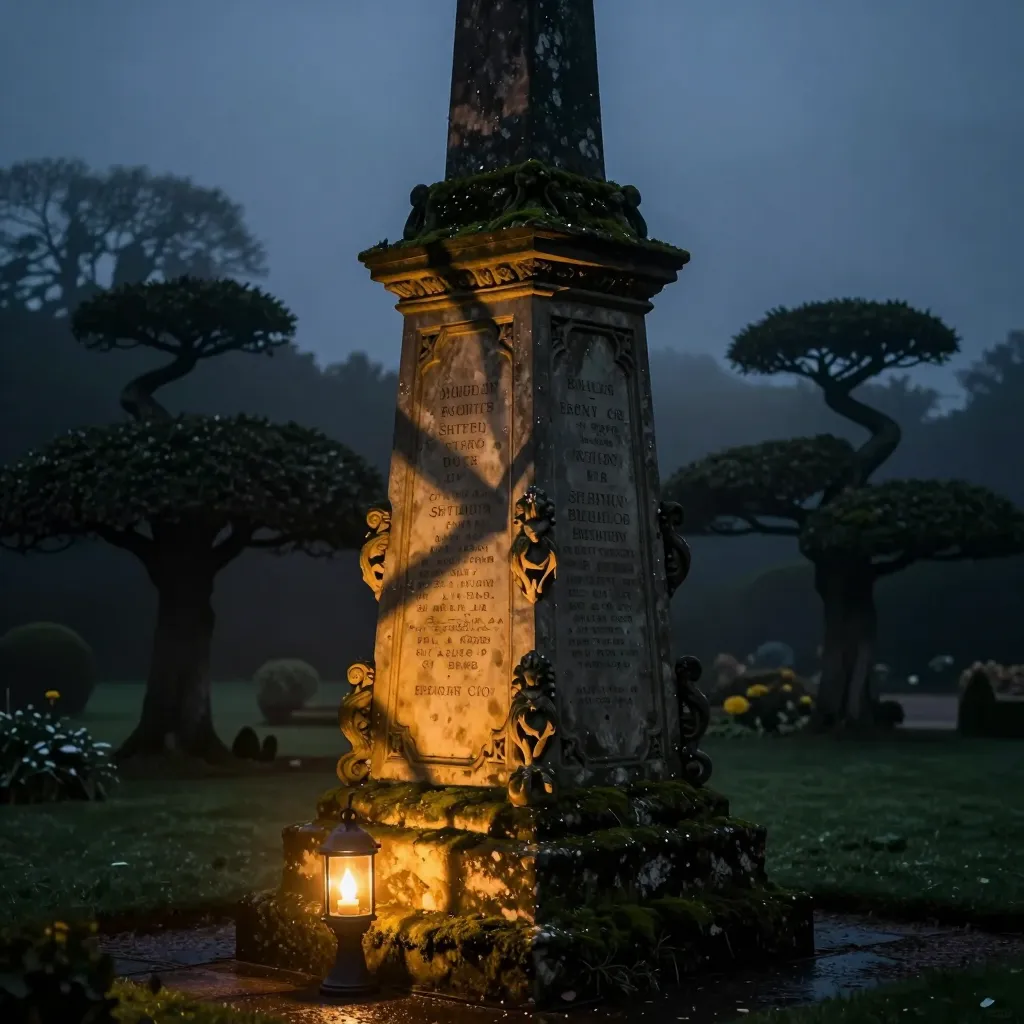
The Enigma of the Shugborough Inscription: An Unsolved Mystery
Dive into the eerie world of the Shugborough inscription, a mysterious code carved into stone that has baffled historians for centuries. Perfect for paranormal enthusiasts and mystery lovers seeking the truth behind England's most haunting unsolved puzzles.
The Shugborough Inscription: England's Most Stubborn Cipher
In the quiet grounds of Shugborough Hall, a Georgian estate in Staffordshire, stands a monument that has defied explanation for nearly three centuries. The Shepherd's Monument, erected sometime between 1748 and 1763, carries a ten-letter sequence that has drawn codebreakers, historians, and conspiracy theorists into its orbit—none of whom have managed to unlock its secret with any certainty.
The monument itself is an elegant stone structure commissioned by Thomas Anson, a British parliamentarian with a taste for classical art. At its center sits a marble relief reproducing Nicolas Poussin's painting The Shepherds of Arcadia, which depicts three shepherds and a woman gathered around a tomb in an idyllic pastoral landscape. Carved on that tomb in the painting—and replicated in the relief—are the Latin words Et in arcadia ego: "Even in Arcadia, I am," a memento mori reminding viewers that death exists even in paradise.
But beneath the relief, the monument bears its true mystery: eight letters arranged in a single line—O U O S V A V V—with two additional letters, D and M, positioned below at slightly lower level. No key survives. No contemporary document explains their meaning. The cipher has simply sat there, patient and silent, watching centuries pass.
A Puzzle That Outlived Its Makers
The monument's sculptor, Peter Scheemakers (sometimes rendered as Peter Schee), was a Flemish artist working in England during the height of the Georgian neoclassical revival. Thomas Anson, his patron, moved in intellectual circles fascinated by esoteric knowledge, classical mysteries, and the emerging field of antiquarian study. Whether the inscription was Anson's idea, Scheemakers', or someone else's entirely remains unknown.
What is known is that the cipher's reputation grew slowly, then suddenly. By the nineteenth century, it had attracted the attention of some of the era's most curious minds. Charles Darwin examined it. Charles Dickens studied it. Josiah Wedgwood, the industrialist and polymath, tried his hand at decoding it. All failed. The letters refused to yield their meaning, and the monument's fame as an unsolved puzzle solidified.
The Theories: From the Sacred to the Speculative
Over the centuries, dozens of interpretations have been proposed. None have been verified, but several have gained enough traction to become part of the monument's mythology.
The Dedication Theory In 1951, a researcher proposed that the letters form an acrostic Latin dedication: Optimae Uxoris Optimae Sororis Viduus Amantissimus Vovit Virtutibus—"Best of wives, best of sisters, a most devoted widower dedicates [this] to your virtues." This would connect the monument to Admiral George Anson, Thomas's brother, whose wife had died. The theory is emotionally resonant but linguistically strained, requiring the reader to accept unusual abbreviations and a highly specific personal context never documented elsewhere.
The Biblical Reading Another interpretation treats the letters as representing Orator Ut Omnia Sunt Vanitas Ait Vanitas Vanitatum—"Vanity of vanities, saith the preacher; all is vanity," from Ecclesiastes 12:8. This fits the memento mori theme of Et in arcadia ego and the monument's funerary atmosphere. Yet like the dedication theory, it demands that each letter stand for an entire word in a way that Latin acrostics rarely do.
The Topographical Solution Some have suggested the letters encode local geography: "Orgreave United with Overley and Shugborough, Viscount Anson Venables Vernon." This would make the inscription a kind of civic record, but it requires ignoring the monument's clearly personal or symbolic context in favor of administrative bookkeeping.
Numerological Approaches Several theorists have treated the letters as Roman numerals. D and M are straightforward: 500 and 1,000. The three Vs equal 15. One accounting produces 1515, though what that year signifies is unclear. Another system, using variant Roman numeral conventions, assigns values to every letter except U, yielding 1594—the birth year of Nicolas Poussin. A more elaborate calculation reaches 2,810, which enthusiasts have linked to the distance in miles between Shugborough and the Oak Island Money Pit in Nova Scotia, Canada, feeding into treasure-hunting mythology.
The Masonic and Grail Connections The inscription gained international notoriety through its appearance in The Holy Blood and the Holy Grail (1982) and Dan Brown's The Da Vinci Code (2003). Both books advanced the theory that Poussin was connected to the Priory of Sion, a supposed secret society guarding esoteric knowledge. Proponents argue that decoding the Shugborough cipher would reveal the location of the Holy Grail itself. Pierre Plantard, the twentieth-century figure who claimed to lead the Priory of Sion, adopted Et in arcadia ego as his family motto—though historians have thoroughly debunked the Priory as a modern fabrication rather than an ancient order.
Professional historians dismiss these Grail theories as "pseudohistory" and "utter fiction," noting that they rest on fabricated documents and forced interpretations. The connection between a Staffordshire monument and medieval Templar treasure has no documentary basis; it is a story that grew because the cipher's silence invited projection.
Alternative Linguistic Readings Some researchers have proposed phonetic decodings. The sequence OUSV, one theory suggests, could be pronounced as "losef," alluding to the Biblical Joseph. Another treats VV as the number 10 and rearranges the remaining letters into "DEVOUT MASON," feeding into longstanding (though unproven) speculation about Thomas Anson's possible Freemasonry.
The Roman Funerary Context More recently, linguistic experts have argued for a less sensational interpretation. The monument, they suggest, was designed within the tradition of Roman funerary architecture, where cryptic inscriptions and symbolic imagery were common. The cipher may not encode a hidden message at all in the treasure-hunt sense, but rather function as a classical allusion—perhaps a reference to a specific Roman text, a personal code between Anson and his intellectual circle, or simply an aesthetic choice meant to evoke ancient mystery. If so, its meaning may have been clear to a small group of contemporaries and deliberately opaque to everyone else.
The Monument's Enduring Power
What makes the Shugborough Inscription compelling is not any single theory, but the vacuum at its center. The letters are real, physical, carved in stone. Their meaning is not. That gap between evidence and explanation has made the monument a mirror: Grail seekers see Templar secrets; classicists see Roman revivalism; numerologists see mathematical patterns; romantics see a grieving husband's tribute.
The monument also occupies a strange position in the landscape of English heritage. Unlike Stonehenge or the Tower of London, it offers no official interpretation that satisfies. The National Trust, which manages Shugborough Hall, presents the cipher as an unsolved mystery—one of the few places in Britain where a major historic site openly admits that it does not know its own story.
Whether the inscription was ever meant to be decoded, or whether it was a private joke, a classical reference, or simply decorative gibberish, may never be established. Whoever commissioned it understood that stone outlasts memory. They created something that would outlive explanations, ensuring that future generations would stand before it with the same mixture of curiosity and frustration felt by Darwin and Dickens.
In the end, the Shepherd's Monument may be less about the answer than about the question itself—a permanent reminder that some mysteries endure not because they resist solution, but because they were designed to outlast the minds that created them.