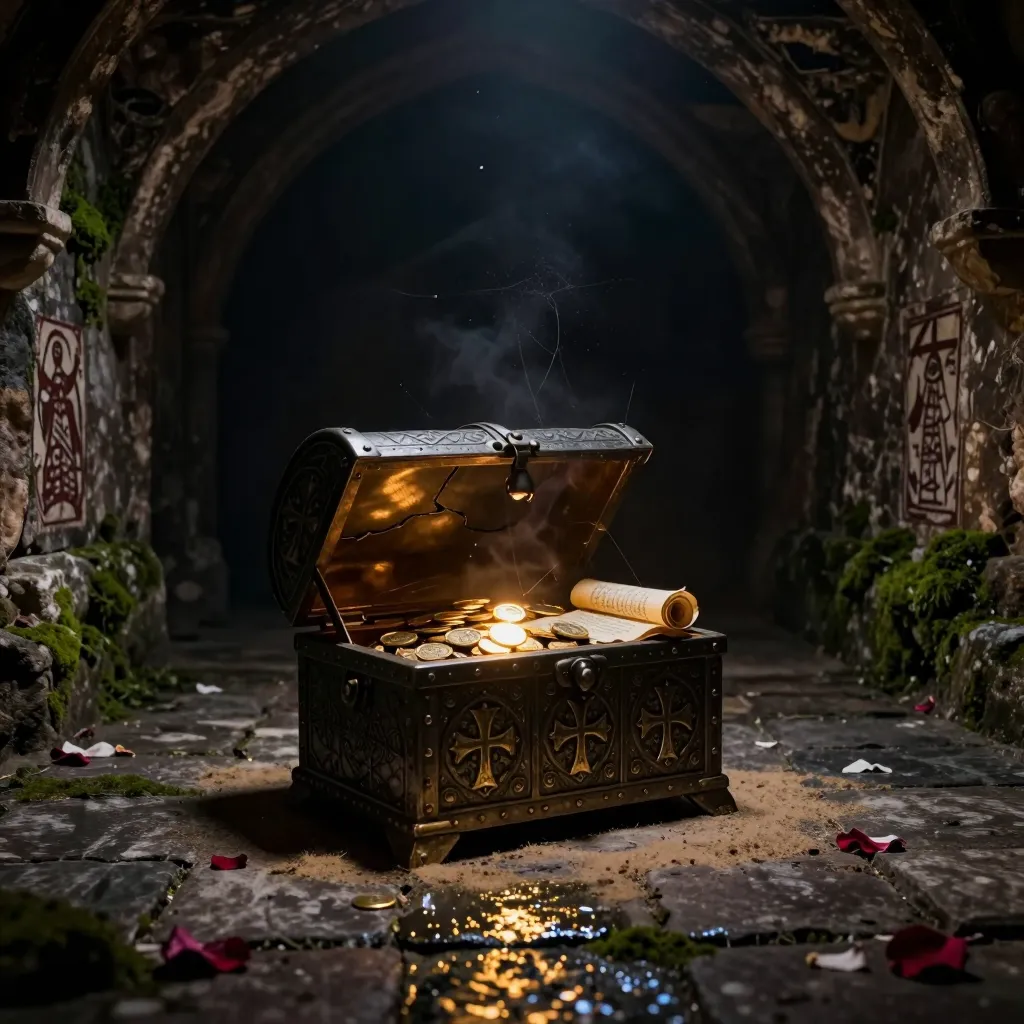
The Lost Fortune of the Knights Templar: History's Greatest Hidden Treasure
The Knights Templar amassed unimaginable wealth and sacred relics across medieval Europe, only to be betrayed by a debt-ridden king. Explore the chilling arrests, the legendary curse, and the seven-century mystery of their hidden treasure—from the Shroud of Turin to Oak Island's Money Pit.
The Lost Fortune of the Knights Templar: History's Greatest Hidden Treasure
The Warrior-Bankers of Medieval Europe
The Poor Fellow-Soldiers of Christ and of the Temple of Solomon—better known as the Knights Templar—stood as one of history's most paradoxical institutions. These monastic warriors combined the ferocity of elite soldiers with the shrewdness of international financiers, creating an empire of wealth that would ultimately seal their doom.
Founded in 1119 to protect Christian pilgrims traveling to the Holy Land, the order rapidly evolved beyond its military origins. While their knights earned renown on Crusader battlefields, a parallel infrastructure of administrators, farmers, and scribes built something unprecedented: a transnational financial network that stretched from London to Jerusalem.
The Templars established what historians recognize as Europe's first widespread banking system. Pilgrims could deposit funds at one preceptory and withdraw them at another, carrying only a letter of credit—a revolutionary concept in an era of bandit-ridden roads. Nobles entrusted the order with managing estates, collecting rents, and financing wars. Kings borrowed from them. Popes protected them.
This financial dominance rested on extraordinary privileges. Papal bulls granted the Templars exemption from taxation and tithes. Donations flooded in—land, gold, castles, and fighting men—from European aristocracy eager to secure spiritual merit. The order answered to no secular authority, creating a shadow economy that rivaled the treasuries of kingdoms.
The Shadow of Philip the Fair
By the early fourteenth century, the Templars' accumulated wealth had transformed from shield to target. Philip IV of France, called "the Fair" for his appearance rather than his conduct, faced mounting debts from prolonged warfare against England. The royal treasury lay empty. The Templar vaults, however, overflowed.
The king's solution combined legal cunning with ruthless efficiency. In 1305, Pope Clement V—installed through Philip's influence and widely regarded as his pawn—invited Templar Grand Master Jacques de Molay to France under pretense of discussing a merger with the rival Hospitaller order. De Molay arrived in early 1307, unaware that the trap had already been set.
Philip's strategy exploited a vulnerability within the order itself. Years earlier, an expelled Templar had made accusations regarding irregularities in the initiation ceremony—claims of heretical practices, idol worship, and blasphemous rituals. Whether these charges held substance remains debated; what mattered was their utility. Philip established a royal inquiry, not to discover truth, but to manufacture justification.
The operation unfolded with military precision. On Friday, October 13, 1307—later immortalized as an unlucky date—simultaneous arrests swept across France. Hundreds of Templars were seized, their properties confiscated, their assets frozen. Seven years of imprisonment, torture, and show trials followed.
On March 18, 1314, Jacques de Molay and three senior officers were burned at the stake in Paris as relapsed heretics. According to legend, the Grand Master summoned his final breath to curse both king and pope, predicting they would join him before year's end. Whether prophecy or coincidence, Clement V died within weeks, and Philip IV followed on November 29, 1314—less than a year after de Molay's execution, never having fully enjoyed his seized fortune.
The Relics That May Have Vanished
The Templar treasure transcends mere material wealth. Historical records and persistent legends suggest the order accumulated sacred objects during their century-long presence in the Holy Land—artifacts that, if authentic, would represent some of Christianity's most explosive relics.
The charge of idolatry provides the most tantalizing clue. Accusers claimed Templars worshipped a mysterious "bearded man" during secret ceremonies. A recently examined account from the Vatican Secret Archives describes the initiation of Arnaut Sabbatier, a young French recruit. According to this testimony, Sabbatier was presented with "a long piece of linen on which was impressed the figure of a man," instructed to worship it and "kiss the feet three times."
This description bears striking resemblance to the Shroud of Turin—the bloodstained burial cloth bearing the image of a crucified man. Carbon dating debates continue to swirl around the shroud, but historical documentation places it in Templar possession during the fourteenth century, before its reappearance in France decades later. If the Templars indeed held this artifact, its survival of Philip's purge suggests deliberate concealment.
Beyond the shroud, speculation encompasses objects of almost mythical status: the Treasure of Solomon, the Ark of the Covenant, the Holy Grail itself. Some theories propose the Templars discovered lost teachings of Jesus during excavations beneath Jerusalem's Temple Mount. Others whisper of a preserved head—variously identified as John the Baptist or, in more radical interpretations, a mummified relic of Christ.
Whether these objects existed within Templar vaults, or whether they represent later mythologizing, remains unprovable. The order's obsessive secrecy surrounding their rituals and treasures created a vacuum that centuries of imagination have eagerly filled.
The Geography of Disappearance
If portions of the Templar fortune escaped Philip's grasp, where did they go? The question has launched expeditions, funded excavations, and inspired countless theories—each more elaborate than the last.
Scotland emerges as the most historically grounded candidate. When Pope Clement V dissolved the order in 1312, Scotland's excommunicated king, Robert the Bruce, operated outside papal authority. Scottish nobles with Templar connections offered refuge. Rosslyn Chapel, constructed 150 years later by the Sinclair family—descendants of documented Templar sympathizers—contains carvings that enthusiasts interpret as coded maps. Corn and aloe plants native to the Americas appear among its stone decorations, fueling speculation that Templar fleets reached the New World centuries before Columbus.
Across the Atlantic, Oak Island in Nova Scotia has consumed millions in treasure-hunting investment. The so-called "Money Pit," discovered in 1795, presents an engineered shaft of layered logs and stone that has defied every attempt to excavate it. Theories connecting this structure to Templar engineering range from plausible to fantastical, yet the island's anomalous features resist simple explanation.
Bornholm, a remote Danish island in the Baltic Sea, offers another concentration of Templar-era churches built with unusual geometric precision. Researchers have identified patterns suggesting astronomical alignments and possible encoded messages—though whether these represent deliberate concealment or coincidence remains contested.
Less exotic possibilities exist. Some historians argue that Philip successfully seized the bulk of Templar wealth, distributing properties to the Hospitallers and absorbing liquid assets into the French treasury. The "lost treasure" may represent nothing more than the portion Philip failed to locate—significant, certainly, but hardly the supernatural hoard of legend.
The Enduring Obsession
Seven centuries after de Molay's execution, the Templar treasure maintains its grip on the imagination. The reasons extend beyond mere gold.
The Templars represent a perfect historical mystery: an organization of immense power, destroyed with suspicious speed, leaving behind deliberate secrecy and tantalizing fragments of evidence. Their story contains all the elements of compelling narrative—betrayal, heresy, possible supernatural relics, and a fortune that vanished without definitive trace.
Modern investigations continue to surface new evidence. Ground-penetrating radar surveys at Templar sites reveal unexplained underground chambers. Document discoveries in European archives periodically revise our understanding of the order's final days. Each finding rekindles hope that the ultimate secret remains undisturbed, waiting beneath soil or stone.
The treasure's true nature may never be resolved. Perhaps it consisted primarily of financial instruments and property deeds—wealth that Philip largely captured. Perhaps sacred relics were smuggled to Scotland or beyond, their locations carried to graves by the last surviving knights. Perhaps the most valuable Templar legacy was never material at all, but knowledge: maps, manuscripts, or philosophical traditions preserved against the destruction that consumed their guardians.
What remains certain is that the Knights Templar built something extraordinary—an institution that merged spiritual devotion with economic innovation, that operated across borders and cultures at a time when such connectivity was rare, and that protected its secrets with a discipline that has outlasted empires. Whether their physical treasure survives somewhere in the shadows of history, or whether it dissolved into the accounts of kings and the legends of centuries, their story endures as one of humanity's great unsolved enigmas.
The flame that consumed Jacques de Molay on a Paris scaffold failed to illuminate what his order truly possessed. In that deliberate darkness, the treasure of the Templars continues its seven-century concealment—waiting, perhaps, for the right combination of luck, technology, and persistence to finally surrender its secrets.