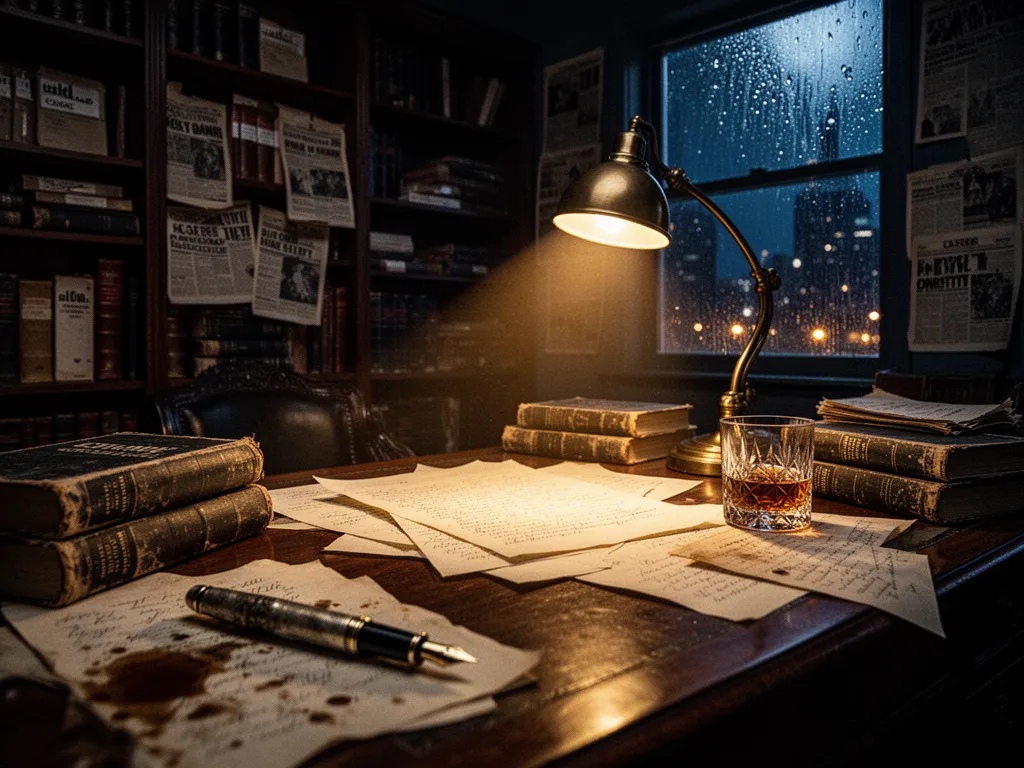
The State of Crime Fiction: How Modern Writers Are Redefining the Genre
Top crime writers explore the genre's shift from simple escapism to deep social confrontation. This analysis covers how authors are navigating institutional instability, technological threats, and the need to find hope within the darkness of modern true crime and mystery narratives.
The State of Crime Fiction: A Genre Under Pressure
Crime fiction stands at a crossroads. Once a reliable refuge for readers seeking order amid chaos, the genre now wrestles with its own identity in an era where justice feels increasingly abstract, technology outpaces imagination, and the very definition of "crime" grows murkier by the day. What does it mean to write about solved mysteries when real-world atrocities go unpunished? How does a genre built on closure survive in a world that refuses to offer it?
This examination draws from the perspectives of dozens of crime writers—Edgar nominees, Grand Masters, and emerging voices—to explore how the genre is evolving, what it owes its readers, and where it might be headed.
The Purpose of Crime Fiction in an Age of Uncertainty
The question of why crime fiction matters has never been more urgent. Writers across the spectrum offer sharply divergent answers, revealing a genre in philosophical tension with itself.
Some argue for escape. In an overwhelming world, the contained narrative of a mystery—where problems have solutions and chaos finds resolution—provides necessary relief. The fictional county where murders are solved and communities restored offers a temporary sanctuary from headlines that refuse to resolve.
Others reject comfort entirely. A growing contingent sees crime fiction not as escape but as confrontation. The genre's traditional promise—that order will be restored, that perpetrators will face consequences—feels hollow when powerful figures operate above the law while protesters and journalists face imprisonment. For these writers, the value lies not in restored order but in witnessing resistance. The true heroism is not solving the crime but refusing to accept that the crime should have happened at all.
A third position occupies the middle ground: entertainment as its own justification, yet entertainment that cannot help but carry political weight. Every character's ethical choices, every portrayal of institutional power, every decision about whose story gets told—these are inherently political acts, whether the writer intends them or not. The politics may be subtle, woven into the fabric of character and setting rather than delivered as commentary, but they persist.
The most provocative voices argue that crime fiction has always been subversive beneath its conservative reputation. A genre that makes readers skeptical of respected pillars of community, that exposes the violence lurking behind polished facades, carries revolutionary potential disguised as puzzle-solving. The cozy mystery with its village poisonings becomes social satire; the hardboiled detective novel becomes an indictment of systemic corruption.
The Evolving Definition of Crime
Perhaps nothing destabilizes the genre more than the current erosion of "crime" as a stable category. When legality itself becomes a tool of the powerful—bent, stretched, and selectively enforced—the traditional morality of crime fiction falters.
Writers note that the most devastating criminality often wears a suit and operates through policy. Yet fiction still gravitates toward individual transgression: the single murder, the isolated theft, the lone predator. The challenge becomes how to address structural violence without abandoning the intimate scale that makes stories compelling. Some solve this through allegory, letting dystopian or horror frameworks carry political weight. Others place "villainous" or morally gray characters in protagonist roles, forcing readers to question who deserves empathy and who commits true harm at scale.
The cozy mystery faces its own crisis of relevance. When editors demand that characters not be "bogged down with reality," the tension between escapism and authenticity becomes explicit. Can a genre that promises comfort survive when its readers live in the very turmoil it seeks to exclude? Or does that turmoil make the promise of comfort more necessary than ever?
What Writers Read: The Canon and Its Discontents
Ask crime writers about their foundational texts, and patterns emerge—along with surprising deviations.
Agatha Christie dominates, but not always for the expected reasons. Her work appears both as nostalgic comfort and as technical masterclass. The twist ending of The Murder of Roger Ackroyd remains a benchmark of narrative deception, while And Then There Were None represents for many the purest expression of mystery as puzzle. Yet some writers now read Christie cynically, seeing in her work a defense against chaos that feels increasingly like denial.
The hardboiled tradition offers an alternative lineage. Dashiell Hammett's Red Harvest—with its nameless operative manipulating warring gangs in a corrupt mining town—reads as a study in moral ambiguity. The Continental Op does "pretty morally ambiguous stuff," and the body count mounts not despite his intervention but because of it. For writers drawn to darkness, Hammett demonstrates that crime fiction can abandon redemption entirely.
More recent works compete for canonical status. Scott Turow's Presumed Innocent redefined the legal thriller while achieving literary recognition. Walter Mosley's Devil in a Blue Dress introduced Easy Rawlins, a reluctant hero navigating midcentury Los Angeles's racial terrain. Thomas Harris's Red Dragon and Truman Capote's In Cold Blood (straddling true crime and novel) proved that crime writing could achieve visceral terror and compassionate depth simultaneously.
The recommendations reveal generational shifts. Older writers cite Elmore Leonard, John D. MacDonald, and the early Spenser novels. Younger voices gravitate toward Gillian Flynn's Sharp Objects, Tana French's psychological procedurals, and crossover works that blend crime with horror or fantasy. The "classic" itself becomes contested territory.
Subgenres and Their Philosophies
How writers define their corner of the genre exposes deeper assumptions about what crime fiction should do.
Noir carries the heaviest philosophical weight. Purists define it through existential doom: characters driven by greed, lust, or alienation, spiraling toward inevitable ruin. The noir protagonist who crosses a moral line—commits murder, betrays trust, acts from cowardice—cannot escape consequences even if they survive physically. The world is not nihilistic; the protagonist's worldview is. The fascination lies in watching someone realize, too late, that their private highway to hell has no exit.
The mystery proper—puzzle-focused, fair-play, often amateur-sleuth-driven—represents a different contract with the reader. Here, the world is fundamentally legible. Clues exist to be found, alibis to be broken, justice to be achieved by those the official system fails. The amateur sleuth, typically marginalized by gender, age, or social status, embodies faith in individual agency against institutional inertia.
The thriller accelerates the stakes. Survival—physical, moral, or both—becomes immediate. The protagonist hunted rather than hunting transforms the reader's relationship to information: every revelation brings danger rather than clarity.
True crime operates in parallel, with its own ethics and aesthetics. The best works—Capote's In Cold Blood, Ann Rule's The Stranger Beside Me—use real violence to examine cultural and moral breakdown rather than simply solving puzzles. Yet the genre's popularity raises uncomfortable questions about consumption, about turning actual suffering into narrative satisfaction.
Emerging subgenres blur boundaries. Horror-mystery hybrids, locked-room thrillers with supernatural elements, cozy mysteries addressing social issues—the walls between categories grow porous. What remains constant is the genre's preoccupation with power: who holds it, who abuses it, how the powerless might resist.
The Threats Ahead
Crime writers identify several existential challenges, some external to the genre, some self-inflicted.
Artificial intelligence provokes the most passionate responses. Writers describe AI-generated content as inherently derivative, plagiarism by another name—systems trained on stolen human creativity, reassembling without understanding. The fear is not that machines will match human invention but that audiences will stop caring about the difference. If listeners already accept AI-generated music, will readers accept AI-generated mysteries? The call for clear labeling and consumer rejection reflects a belief that the battle must be fought at the point of consumption, not production.
Market consolidation threatens diversity of voice. As publishing grows risk-averse, editors retreat toward safe bets and proven formulas. The result, writers warn, mirrors what streaming platforms did to film: derivative, predictable, disposable content produced quickly and cheaply. The "mid-list"—books that may not break out immediately but build audiences over time—faces extinction. Series dropped before finding their footing, authors abandoned before reaching maturity. The patience that allowed iconic detectives to develop readership over multiple volumes has evaporated.
Technology itself creates narrative challenges. Facial recognition, geolocation, AI-powered surveillance—tools that change how crimes are committed, investigated, and solved. Writers struggle to keep pace, knowing that a novel's cutting-edge tech may be obsolete before publication. The locked-room mystery, dependent on physical constraints, faces particular pressure in an age of ubiquitous connection.
Attention economics reshape reader expectations. The genre competes with shorter, video-driven content for minds literally being rewired toward different cognitive patterns. The slow build, the careful accumulation of detail, the delayed gratification of the well-crafted reveal—these demand a patience that grows scarcer.
Reality's encroachment may be the subtlest threat. When institutional crime exceeds imagination, when daily headlines outpace fictional atrocity, what remains for the crime writer to invent? The challenge becomes not making darkness believable but making hope believable within darkness.
The Defense of the Genre
Despite these pressures, writers articulate a resilient case for crime fiction's continued necessity.
The genre builds empathy through forced perspective. By requiring readers to inhabit investigators, victims, and sometimes perpetrators, it cultivates understanding across boundaries that politics seeks to harden. Stories bring people together; politics tears them apart.
It offers controlled confrontation with darkness. Within the pages, outcomes remain manageable. Justice, however imperfect, arrives. The chaos that overwhelms in daily life becomes, in fiction, material that can be processed, examined, survived. This is not denial but management—a safe space to experience fear, tension, and uncertainty with the promise of resolution.
It preserves the act of witness. When real-world violence becomes abstract through scale—thousands slaughtered daily, millions displaced—the single fictional death regains weight. Crime fiction insists on the value of individual life, on the significance of one person standing up to say: this is not right.
It captures what is human beneath the political. Writers across the spectrum agree that their ultimate obligation is not to ideology but to the "crooked timber of humanity"—the flawed, contradictory, surprising ways people actually behave when pushed to extremes. The best crime fiction illuminates this complexity rather than reducing it to type.
Where the Genre Goes
The future of crime fiction likely lies in its contradictions rather than their resolution. Escapism and engagement, comfort and confrontation, tradition and innovation—these tensions have always defined the genre and will continue to do so.
What changes is the weight each carries. In an age of political turmoil, the purely escapist mystery feels increasingly like denial; the purely political one risks becoming the lecture that fiction should never be. The writers who thrive will be those who navigate between—who use the pleasures of plot, character, and atmosphere to smuggle in harder questions, who make readers feel before they think, who trust that the human condition, examined honestly, is political enough.
The crime novel's enduring power lies in its adaptability. From Victorian parlors to noir alleyways, from cozy villages to global conspiracies, it has always found ways to make contemporary anxieties narratively manageable. Whether it can do the same for our current age of institutional collapse, technological acceleration, and attention fragmentation remains the open question that the genre itself, in its best examples, would insist on investigating rather than resolving.
The case is not closed. It may never be.