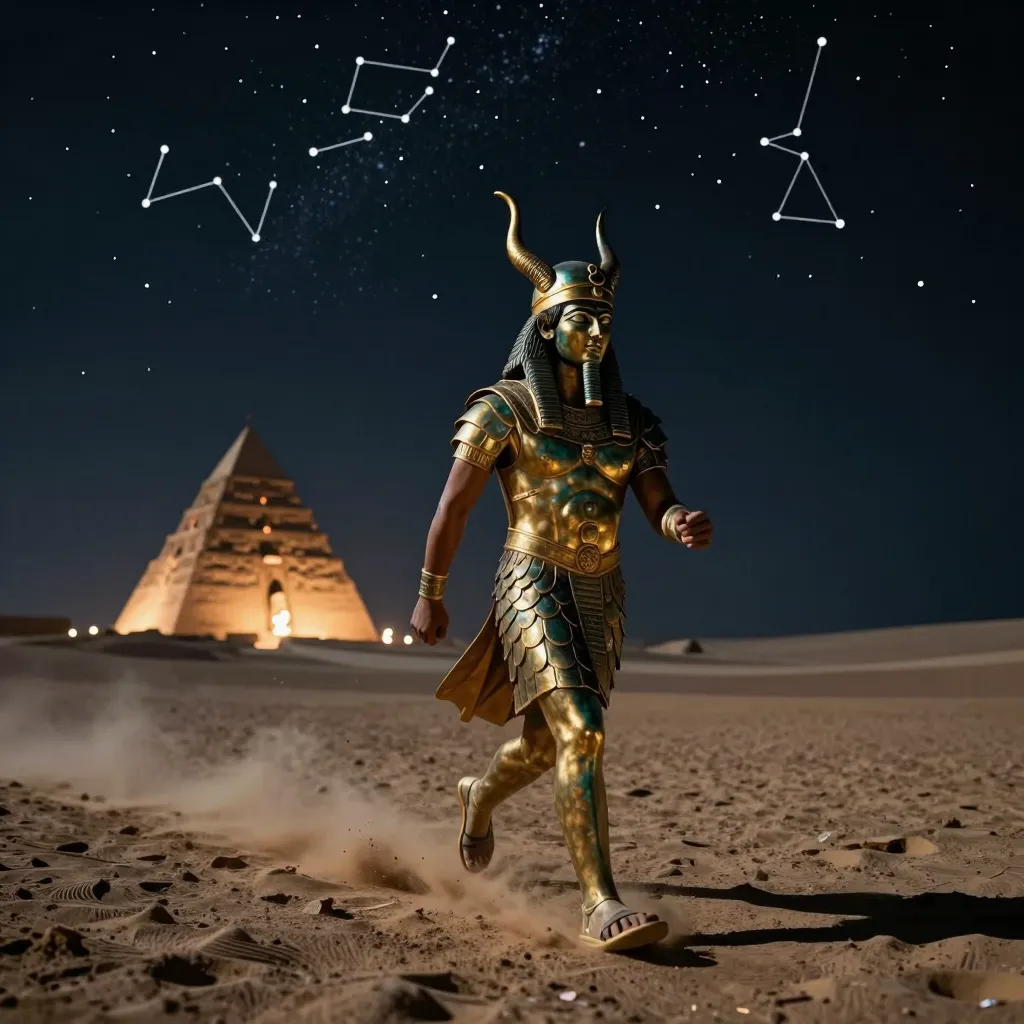
Shulgi of Ur: The Sumerian God-King’s Legendary 200-Mile Marathon
Explore the miracle of Shulgi of Ur, the Sumerian king who allegedly ran 200 miles between Nippur and Ur during a violent storm. This blend of history and hagiography examines his quest for immortality through superhuman endurance and his legacy as a living god in the ancient world.
The Divine Speed of Shulgi: Sumer’s God-King and the 200-Mile Run
[cite_start]In the ancient sands of Mesopotamia, where the lines between history and legend often blur, few figures command as much mystical presence as Shulgi of Ur (reign c. 2094–2046 BCE)[cite: 168]. [cite_start]As the second king of the Third Dynasty of Ur, Shulgi did not merely seek to rule a kingdom; he sought to transcend the mortal coil and establish himself as a living god[cite: 173]. [cite_start]At the heart of this divine transformation lies a feat of near-superhuman endurance: a 200-mile (321.8 km) run completed in a single day through a raging storm[cite: 168, 184].
A Legacy Carved in Myth
Shulgi’s reign was defined by an intensive campaign of self-deification and propaganda. [cite_start]He claimed descent from the same divine lineage as the legendary hero Gilgamesh, identifying as the son of the goddess Ninsun[cite: 188, 242]. [cite_start]To cement his status among the pantheon, he either wrote or commissioned A Praise Poem of Shulgi (also known as Shulgi A), a lyrical composition that portrays him as a "mighty man" and a "fierce lion"[cite: 168, 169, 239].
The poem serves as a liturgical bridge between the physical and the metaphysical, casting Shulgi’s political and athletic achievements as divine mandates. [cite_start]By aligning himself with deities like Anu, Enlil, and Inanna, Shulgi ensured his name would be "established for distant days" and never "fall into oblivion"[cite: 169, 188, 194].
The Miracle of the Single-Day Run
[cite_start]The central mystery of Shulgi’s legend is his journey between the holy cities of Nippur and Ur[cite: 168]. [cite_start]According to the text, Shulgi ran from Nippur to Ur—a distance of 100 miles—officiated at a religious festival, and then ran back to Nippur the same day to preside over a second festival[cite: 184, 185].
The journey was not a simple stroll; the poem describes a dramatic celestial upheaval:
- [cite_start]A Perfect Storm: As Shulgi ran, a "storm shrieked" and the four winds howled at one another[cite: 265, 266].
- [cite_start]Divine Resilience: Despite lightning, thunder, and hailstones "drumming" on his back, the king remained "un-terrified," galloping "like an ass in the desert" to reach his destination before sunset[cite: 268, 269, 270, 273].
This 200-mile round trip was framed as a miracle. [cite_start]For the Sumerians, this was not just a display of athleticism but proof of Shulgi’s divine nature—a king who could outpace the sun and master the elements[cite: 184, 185, 273].
The King as a Cult Hero
Shulgi’s efforts to be remembered were remarkably successful. He transformed the social and cultural fabric of Sumer to reflect his greatness:
- [cite_start]The Decad: His praise poem was so highly regarded that it became part of the "Decad," a group of ten essential works that every advanced scribal student was required to master before graduation[cite: 174].
- [cite_start]Infrastructure of Power: He built new roads, established roadside inns, and planted gardens, creating a literal path for his legend to travel[cite: 180, 251, 252].
- [cite_start]Standardization: He unified his kingdom by standardizing weights, measures, and the calendar, ensuring the entire realm operated under his singular vision[cite: 182].
History vs. Hagiography
Modern scholars continue to debate the reality of Shulgi’s 200-mile run. [cite_start]While early researchers dismissed the feat as pure fiction, recent perspectives suggest it may have been physically possible, citing modern ultra-marathoners who have covered similar distances in comparable timeframes[cite: 283, 284, 285].
Regardless of the physical reality, the mythic weight of the run was absolute. [cite_start]In the Sumerian consciousness, years were dated by this event: "The Year When the King Made the Round Trip Between Ur and Nippur in One Day"[cite: 287]. [cite_start]By weaving his athletic prowess into the sacred literature of the edubba (scribal schools), Shulgi achieved the immortality he craved, remaining a figure of awe for over four millennia[cite: 174, 287].