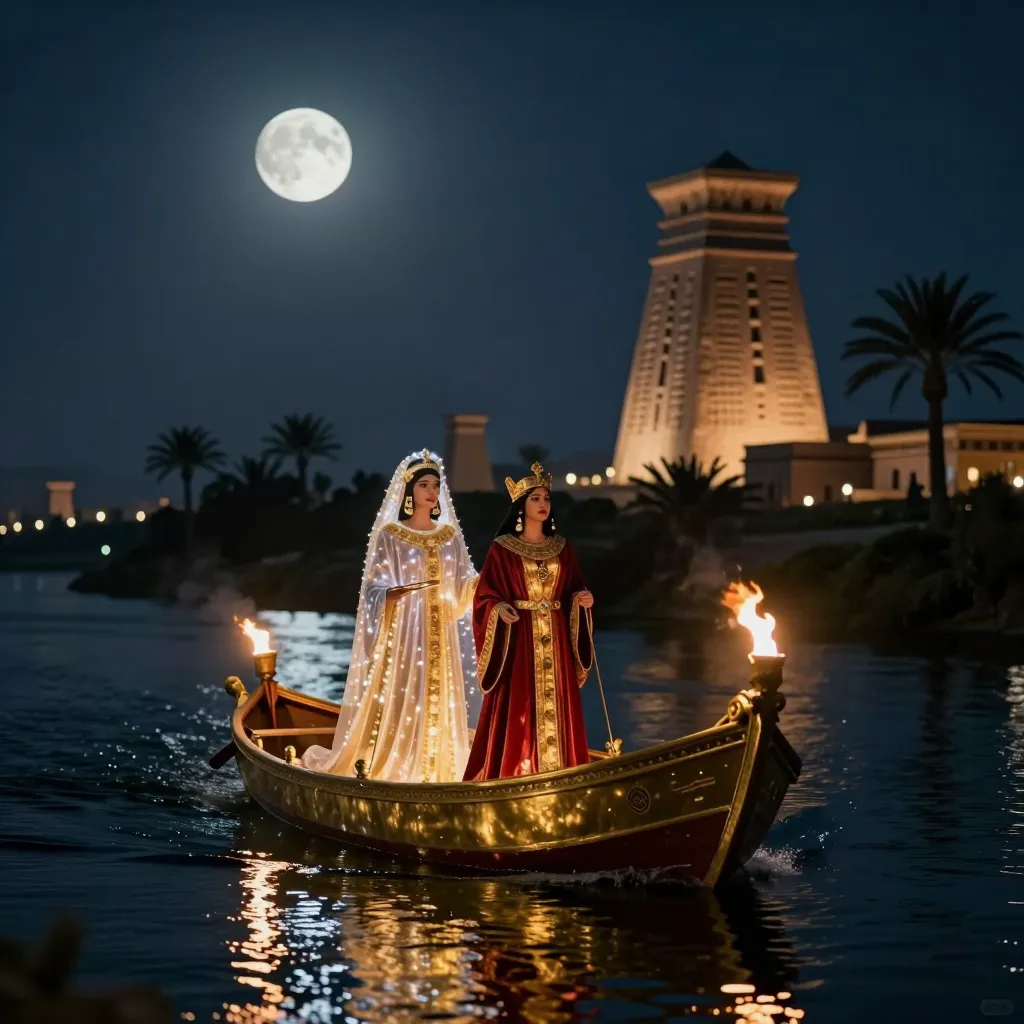
Shulgi and Ninlil's Barge: A Divine Sumerian Mythic Poem
Dive into the mystical waters of Mesopotamia with an analysis of the poem celebrating Shulgi and Ninlil's barge. This deep dive explores divine unions, Sumerian ritualism, and the poetic beauty of ancient myth for history lovers and mythology enthusiasts alike.
The Divine Voyage: Shulgi and the Sacred Barge of Ninlil
[cite_start]In the heart of ancient Mesopotamia, during the era known as the Sumerian Renaissance, a king’s power was not merely a matter of military might, but of divine favor[cite: 179, 180]. [cite_start]The poem known as Shulgi and Ninlil’s Barge (or Shulgi R) serves as a vivid window into this mystical world, where the boundaries between the earthly and the celestial were bridged by elaborate rituals and sacred craftsmanship[cite: 168, 177].
The Sacred Vessel of the Goddess
[cite_start]The poem, dated to the reign of Shulgi of Ur (r. 2094 – 2046 BCE), commemorates a specific historical event: the construction and ritual "caulking" of a ceremonial barge for the goddess Ninlil[cite: 168, 172]. [cite_start]In Sumerian mythology, Ninlil was the consort of Enlil, the powerful sky god, and a figure of immense prestige who held the power to determine fates[cite: 168, 173, 200].
The text employs rich, atmospheric imagery to describe the barge, transforming a wooden vessel into a cosmic entity:
- [cite_start]The Structure: Its punting poles are likened to sleeping dragons, and its side-planks are compared to a stairway leading to a mountain spring[cite: 250, 252].
- [cite_start]The Ornamentation: A golden sun-disc fastened to the boat radiates like brilliant moonlight, while its rudder is envisioned as a giant fish navigating the deep[cite: 254, 258].
- [cite_start]The Divine Blueprint: The poem asserts that the god Enki assigned the "quay of abundance" to the boat's fate, while Shulgi, the "faithful provider," oversaw its creation to ensure it was breathtaking to behold[cite: 244, 246].
The Pilgrimage to Tummal
[cite_start]The narrative arc of the poem follows a ritual journey from the sacred city of Nippur—the primary cult center of Enlil—to the nearby site of Tummal[cite: 172, 174]. [cite_start]This voyage was not a simple transport of cargo, but a "ceremonial progress" involving the statues of the deities[cite: 189, 191].
[cite_start]As the barge enters the Tigris, it is accompanied by a divine entourage[cite: 266]. [cite_start]The warrior god Ninurta is described as leading the way, ensuring the ferryboat stays true to its course[cite: 268]. [cite_start]The journey culminates in a nocturnal banquet at Tummal, where the gods—including Enlil, Ninlil, and their ancestors—feast in abundance while decreeing the fate of the king[cite: 172, 277, 278].
Mythology as Political Stability
[cite_start]For the kings of the Ur III Dynasty, these mythological observances were vital for maintaining the "Sumerian Renaissance"[cite: 175, 180]. [cite_start]By publicly officiating these festivals, Shulgi reinforced his role as a pious shepherd and role model for his subjects[cite: 183, 192].
The poem concludes with a powerful blessing from Ninlil. [cite_start]Pleased by the beauty of her vessel and the honor of the festival, she looks upon Shulgi with "joyful eyes" and promises to prolong his reign, steadying the foundation of his throne[cite: 201, 285].
Discovery and Legacy
[cite_start]Discovered in the mid-19th century among the ruins of Nippur, the fractured cuneiform tablets of Shulgi R likely served as educational texts in ancient scribal schools[cite: 177]. [cite_start]Today, it remains a cornerstone of Mesopotamian literature, illustrating the ancient belief that the stability of the human world relied entirely on the meticulously maintained happiness of the gods[cite: 178, 291].
Ancient Celestial Correspondences in the Poem
| Barge Element | Mythological/Natural Symbol |
|---|---|
| Reed-mats | [cite_start]Daylight spreading over holy settlements [cite: 248] |
| Banner | [cite_start]A woodland of cypress trees providing shade [cite: 255] |
| Tow-rope | [cite_start]The gliding deity Nirah extended over the land [cite: 260] |
| Mooring pole | [cite_start]The heavenly bond [cite: 261] |
| Small mats | [cite_start]The evening sky illuminated by stars [cite: 256] |