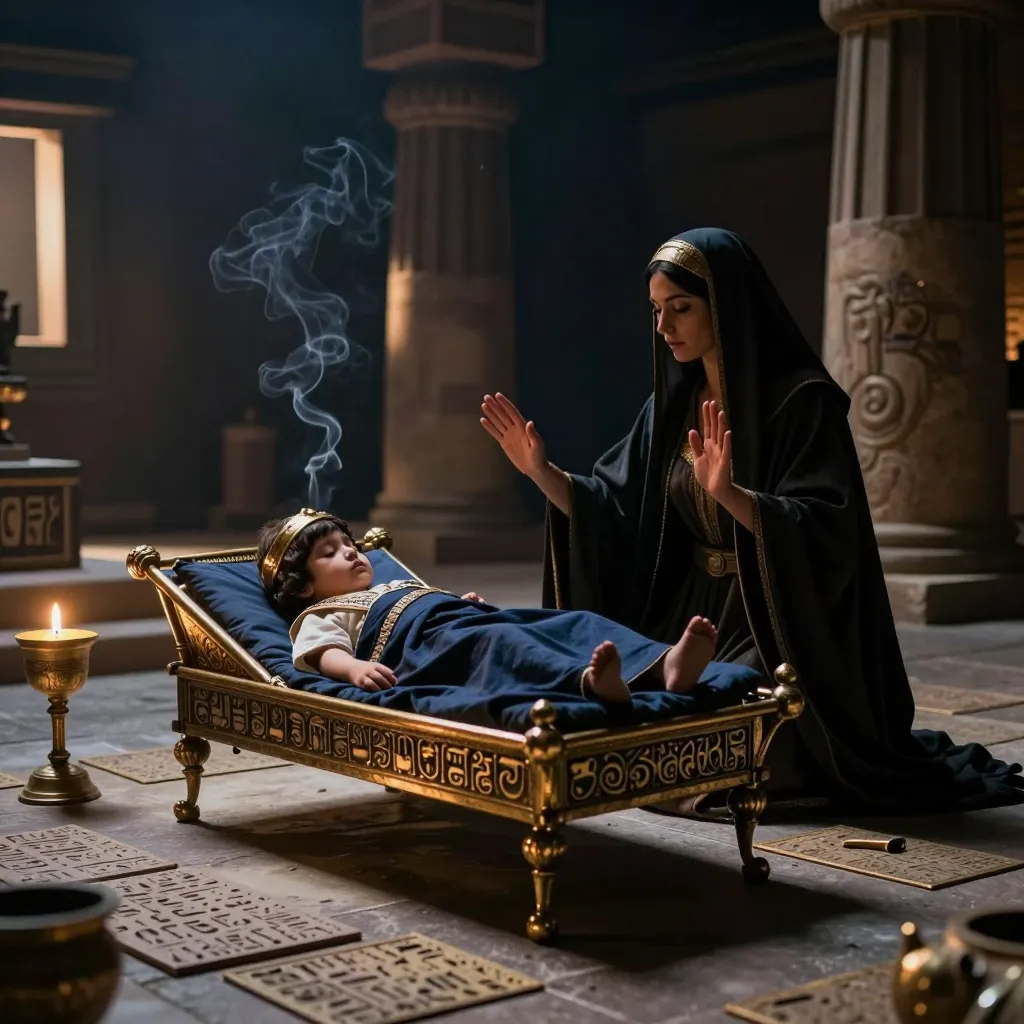
Echoes of the Cradle: Mythology and Magic in the Shulgi Lullaby
Explore the Lullaby for a Son of Shulgi, a rare artifact blending domestic intimacy with Mesopotamian mythology. Learn how Queen Taram-Uram used nature metaphors and personified sleep to secure the destiny of her royal heir 4,000 years ago.
Echoes from the Cradle: The Mystery of the Shulgi Lullaby
Deep within the archives of the Sumerian Renaissance—a period of cultural rebirth in ancient Mesopotamia—lies a text that defies the typical grandeur of royal inscriptions and hymns to the divine. Known as the Lullaby for a Son of Shulgi, this composition offers a rare, intimate glimpse into the domestic life of the Third Dynasty of Ur (c. 2094–2046 BCE). Unlike the epic tales of Gilgamesh or the stoic legal codes of the era, this work captures a singular, haunting moment: a mother’s attempt to charm her child into a restorative slumber.
A Royal Lineage and a Mother’s Plea
[cite_start]The lullaby dates to the reign of King Shulgi of Ur, a monarch celebrated for his patronage of the arts and his efforts to expand literacy across Sumer[cite: 157, 172]. [cite_start]While Shulgi was often the subject of elaborate praise poems, this piece shifts the focus to his household[cite: 173, 174]. [cite_start]Although the text does not explicitly name the singer or the infant, scholars suggest the speaker is likely Queen Taram-Uram, addressing her eldest son and future king, Amar-Suen[cite: 180, 181].
[cite_start]The poem is structured around the ururu-chant, a rhythmic Sumerian vocalization intended to encourage growth and tranquility[cite: 186, 187]. It follows a traditional format of repetition, using nature-based metaphors to wish for the child’s strength:
- [cite_start]Sturdiness: The child is compared to the irina-tree, wished to have roots as deep and foundations as strong as the earth itself[cite: 239].
- [cite_start]Vitality: The mother envisions her son spreading his influence like the branches of a flourishing sakir-plant[cite: 239].
The Personification of Sleep
In the mythological landscape of Sumer, even the act of resting was governed by unseen forces. [cite_start]The lullaby personifies Sleep as an entity that must be beckoned and negotiated with[cite: 165]. [cite_start]The mother calls upon Sleep to "settle its hand" upon the child’s "sparkling eyes" and to silence the "murmuring tongue" that prevents the boy from finding peace[cite: 242].
To entice this state of rest, the mother offers symbolic bribes. [cite_start]She speaks of filling the lap of Sleep with emmer grain and preparing "miniature cheeses"—a delicacy described as the "healer of mankind"—suggesting that the child may have been suffering from an illness that required divine or medicinal intervention[cite: 188, 242].
Shadow and Incantation: The "Man of the Wall"
[cite_start]The poem takes a darker, more enigmatic turn in its middle sections, moving from gentle wishes to what some scholars interpret as a "magical conjuring"[cite: 187]. [cite_start]The mother describes a state of restlessness and silence, gazing at the stars while the crescent moon shines upon her[cite: 249].
She invokes startling, macabre imagery to describe the potential consequences of the child’s illness, perhaps as a way to ward off death through a reverse incantation:
- [cite_start]The Mourners: She envisions the child being mourned not just by humans, but by the creatures of the room—the lizard, the fly, and the gecko[cite: 189, 251].
- [cite_start]The Man of the Wall: An obscure figure, the "man of the wall," is mentioned as shedding tears, a reference that may allude to spirits or deities associated with the threshold between life and death[cite: 190, 250].
[cite_start]By articulating these fears, the mother effectively banishes them, returning to a vision of a flourishing future[cite: 190].
Destiny and the Goddess of Grain
As the lullaby concludes, the focus shifts from the nursery to the throne. [cite_start]The mother envisions her son’s adulthood—his marriage, the birth of his own children, and his eventual rise to power[cite: 245, 247]. [cite_start]She invokes Ashnan (also known as Ezina-Kusu), the goddess of grain, to act as the boy’s ally and ensure his prosperity[cite: 194, 254].
[cite_start]The final fragments of the text take on a more political tone, typical of the era’s concerns with the Gutian "dogs"—hostile neighbors who frequently threatened Sumerian borders[cite: 195, 196]. [cite_start]The mother urges her son to seize the enemy and stand as a protector of the holy cities of Ur and Uruk[cite: 194].
A Timeless Artifact
[cite_start]Discovered in the mid-19th century and translated in the 1950s, the Lullaby for a Son of Shulgi remains a unique artifact of the Ancient Near East[cite: 164, 168]. [cite_start]While most Mesopotamian literature was designed for the temple or the court, this poem preserves a vulnerable, human connection that has remained unchanged for over 4,000 years[cite: 160, 271]. It serves as a reminder that even in the height of the Sumerian Renaissance, the most profound mysteries were often found in the simple, quiet struggle to keep a child safe and sound.