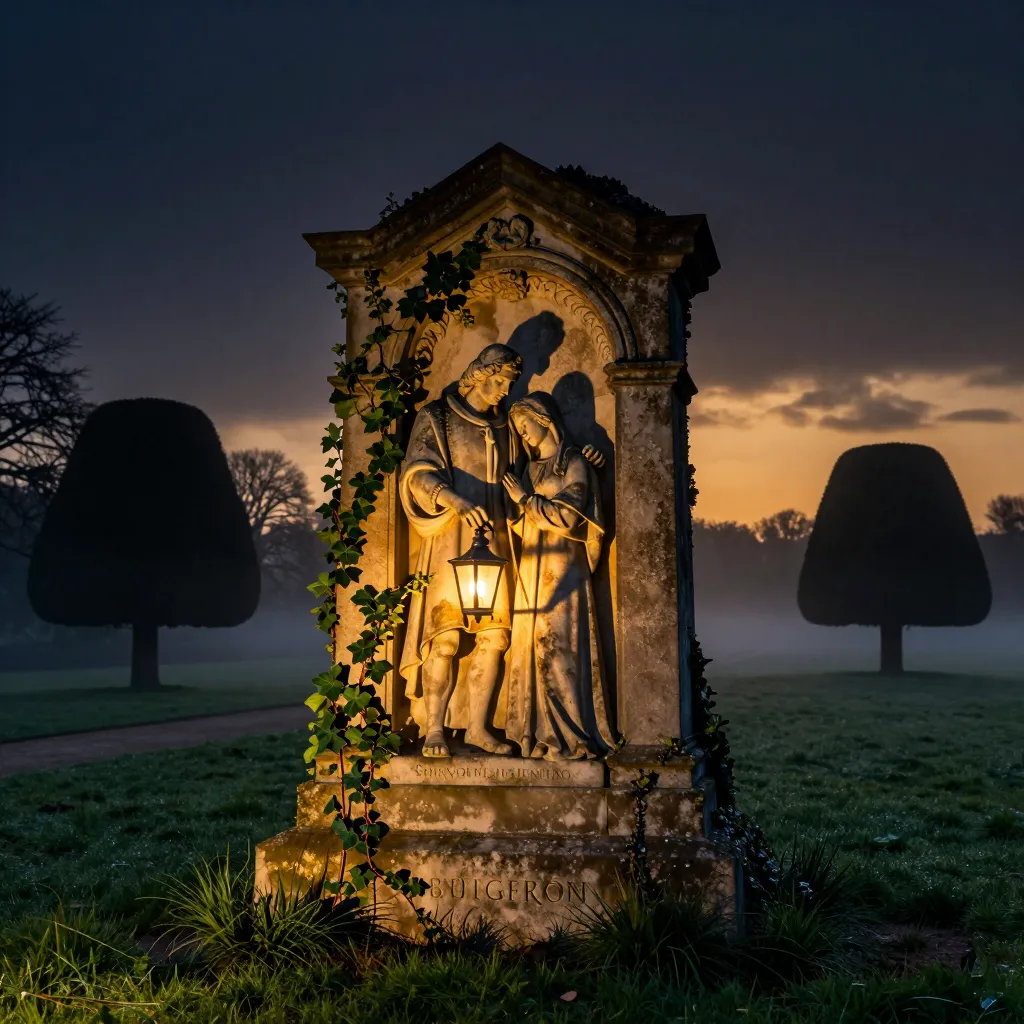
Beyond the Shepherds: Decoding Shugborough Hall's 250-Year-Old Monument Mystery
Deep in Staffordshire stands Shugborough Hall's Shepherd's Monument, bearing the cryptic inscription O·U·O·S·V·A·V·V. For over 250 years, historians and treasure hunters have chased theories from Holy Grail legends to Baconian ciphers. This article unpacks the monument's layered wordplay, geometric secrets, and the haunting personal tribute that may finally explain the unsolvable.
The Cryptic Legacy of Shugborough Hall
Deep within the pastoral landscape of Staffordshire, England, stands Shugborough Hall—an estate that guards one of the world's most enduring intellectual puzzles. [cite_start]At the heart of its grounds lies the Shepherd’s Monument, an 18th-century stone structure that has baffled historians, cryptographers, and treasure hunters for centuries[cite: 4]. [cite_start]While the monument itself is a work of classical beauty, it is the cryptic, ten-letter inscription carved beneath a relief of Nicolas Poussin’s The Arcadian Shepherds that draws the curious to this site[cite: 4, 5].
[cite_start]The sequence—O·U·O·S·V·A·V·V bookended by the letters D and M—remains a tantalizing enigma[cite: 3, 19]. [cite_start]In the world of the unexplained, this "Shugborough Code" is often whispered alongside legends of the Holy Grail, Templar secrets, and hidden bloodlines[cite: 9].
The Art of the Hidden Message
To understand the monument, one must understand the era of its creation. [cite_start]Between the 17th and 19th centuries, the British aristocracy shared a profound obsession with wordplay[cite: 11]. [cite_start]Anagrams—the practice of rearranging letters to create new meanings—were more than just a pastime; they were a sophisticated tool for masking revolutionary ideas and secret knowledge[cite: 12, 13].
History is filled with thinkers who utilized such veils:
- [cite_start]Sir Francis Bacon: Used wordplay to shroud his philosophical insights[cite: 13].
- [cite_start]Galileo Galilei: Concealed his discovery of Saturn’s rings through anagrams to protect his work[cite: 14].
- [cite_start]Robert Hooke: Published the formulation of "Hooke’s Law" as an anagram in 1676, only revealing the solution—Ut Pondus sic Tensio—two years later[cite: 15, 16, 17].
[cite_start]The Shugborough inscription is believed to be an extension of this tradition, an intellectual playground for the elite who commissioned it[cite: 11].
Deciphering the Stones
The mystery of the monument is not tied to a single answer but rather to layers of historical and linguistic possibilities. [cite_start]Recent interpretations of the DOUOSVAVVM sequence suggest that the letters are not a random string, but a complex puzzle involving multi-tier wordplay[cite: 5, 18].
| Method | Interpretation & Significance |
|---|---|
| Linguistic Anagrams | [cite_start]Some theories suggest moving letters between the "top tier" and "bottom tier" of the inscription[cite: 19]. [cite_start]For instance, extracting "USA" and placing it between the "D" and "M" creates Dusam—an archaic Slavic term for "soul" or "spirit"[cite: 19, 20]. |
| Baconian Influence | [cite_start]Another solution views the inscription as a Baconian-inspired anagram of Et In Arcadia Ego[cite: 7]. [cite_start]This points toward primordial deities: Deai (goddesses), Gaia (the Earth goddess), and Ceto (a sea goddess)[cite: 7]. |
| Geometric Design | [cite_start]Beyond the letters, the physical layout of the monument may be a geometric construct representing the planet Saturn, potentially identifying Thomas Wright of Durham as the architect[cite: 6]. |
A Memorial in Code
[cite_start]While many hope the monument leads to Spanish gold or the Holy Grail, the truth may be more personal[cite: 9]. [cite_start]The references to goddesses and "souls" likely serve as a sophisticated dedication[cite: 8]. [cite_start]The inscription was likely authored by Thomas Anson, who commissioned the monument as a tribute to his brother, Admiral George Anson[cite: 8].
[cite_start]By pairing the term dušam (soul) with the Latin adsum (I am present), the code creates a hauntingly beautiful sentiment: the spirit of the departed remains[cite: 20, 21]. [cite_start]The Shepherd’s Monument stands not just as a stone structure, but as a testament to the enduring human desire to hide profound truths in plain sight, waiting for the right mind to unlock them[cite: 11].