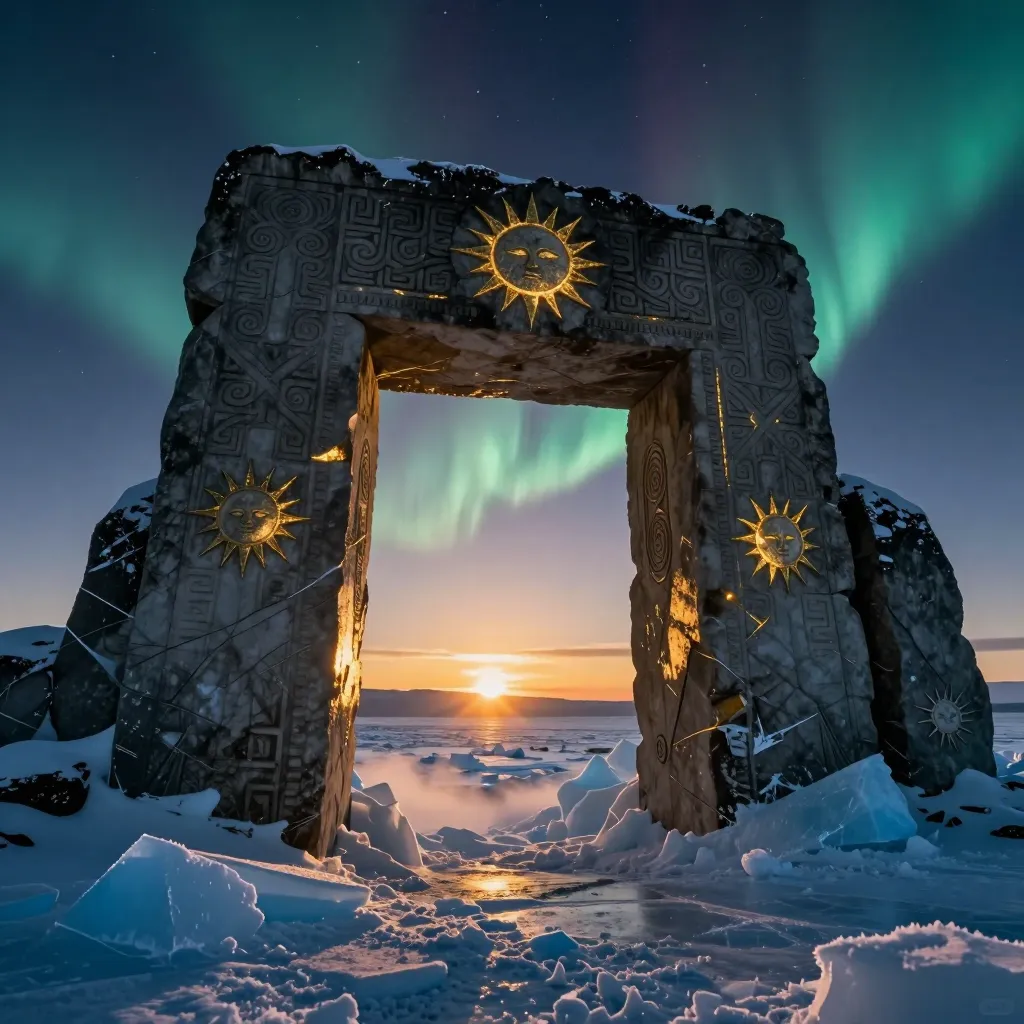
Hyperborea: The Mysterious Lost Civilization of the Ancient Arctic
From Mercator’s bizarre polar maps to massive megaliths on the Kola Peninsula, discover why researchers believe a sophisticated civilization once thrived in a tropical Arctic. This investigation explores archaeological anomalies and climate shifts that hint at a lost prehistoric paradise.
The Hyperborean Enigma: Searching for a Lost Arctic Utopia
For millennia, whispers of a paradise at the top of the world have haunted the fringes of history. Known to the ancient Greeks as Hyperborea—the land "beyond the North Wind"—this realm was described not as a frozen wasteland, but as a sun-drenched utopia. While mainstream science views it as a poetic myth, a growing collection of archaeological anomalies and cartographic mysteries suggests that a sophisticated civilization may have once flourished where today there is only ice.
The Land of Eternal Light
In classical mythology, Hyperborea was the sacred refuge of Apollo, the god of light and prophecy. Ancient texts described a race of giants who lived for a thousand years, free from the ravages of disease, war, and old age. Unlike the harsh winters known to the Mediterranean, this northern realm supposedly enjoyed eternal spring and six months of continuous daylight.
While these accounts seem fantastical, they contain curious geographical details:
* The Midnight Sun: Writers like Pliny the Elder and Herodotus described a polar environment with constant sunlight, a phenomenon they could likely only know through inherited records or rare travel.
* Sacred Offerings: The Hyperboreans were said to send mysterious gifts wrapped in wheat straw to the island of Delos, suggesting a tangible, albeit distant, connection between the Arctic and the Mediterranean.
* Inherited Memory: Some researchers suggest these myths are not inventions but "cultural fingerprints"—memories of a pre-glacial civilization forced to migrate south when the climate shifted.
Megaliths and Labyrinths: Evidence in the Russian North
The search for physical evidence of Hyperborea has led explorers to the remote Kola Peninsula and the White Sea region of Russia. This desolate landscape contains several baffling structures that challenge the standard historical timeline:
* Precision Stone Slabs: Expeditions in the late 1990s reported finding massive, geometrically precise stone blocks stacked in ways that suggest artificial construction rather than natural erosion. Some of these megaliths are estimated to weigh hundreds of tons.
* Arctic Labyrinths: The Solovetsky Islands are home to complex stone spirals. These patterns are eerily similar to those found in Scandinavia and the Mediterranean, hinting at a shared cultural origin or a forgotten maritime network.
* Shamanic Echoes: Local legends and the presence of these stone works suggest the region was a significant spiritual hub long before the rise of known civilizations.
The Cartographic Mystery: Mercator’s Four Islands
One of the most persistent pieces of evidence for an Arctic continent comes from the Renaissance. The 1569 world map by Gerardus Mercator, the era’s most renowned cartographer, depicts the North Pole as a massive landmass divided into four distinct islands by four rushing rivers.
At the center of this landmass sat a "black magnetic rock". Mercator claimed his work was based on ancient, now-lost source maps. While modern bathymetric surveys do not show these four symmetrical islands, they have revealed massive underwater features like the Lomonosov Ridge. This raises a chilling possibility: could Mercator’s maps be a surviving record of the Arctic as it appeared before it was submerged by rising seas or buried under kilometers of ice?
A Tropical Arctic? The Science of Climate Shifts
The idea of a habitable North Pole is not entirely without scientific merit; it is a matter of chronology. Paleoclimatological data confirms that the Arctic has not always been a frozen desert:
* The Eocene Epoch: Millions of years ago, the region had a tropical climate, complete with palm trees and ancient reptiles.
* The Holocene Climatic Optimum: Roughly 5,000 to 9,000 years ago, the northern latitudes were significantly warmer than they are today.
While this "warming window" was far more recent than the Eocene, it provides a plausible timeframe for early human populations to have developed sophisticated cultures in the north. If a highly advanced society thrived during this period, a sudden cataclysm—such as a rapid polar shift or a comet impact—could have "flash-frozen" their civilization, leaving only myths and megaliths behind.
As the polar ice caps continue to recede in the 21st century, the secrets of the Kola Peninsula and the Arctic floor may finally emerge. Whether Hyperborea was a spiritual metaphor or a physical reality, the anomalies buried in the ice continue to beckon those who believe history is much older and stranger than we have been told.