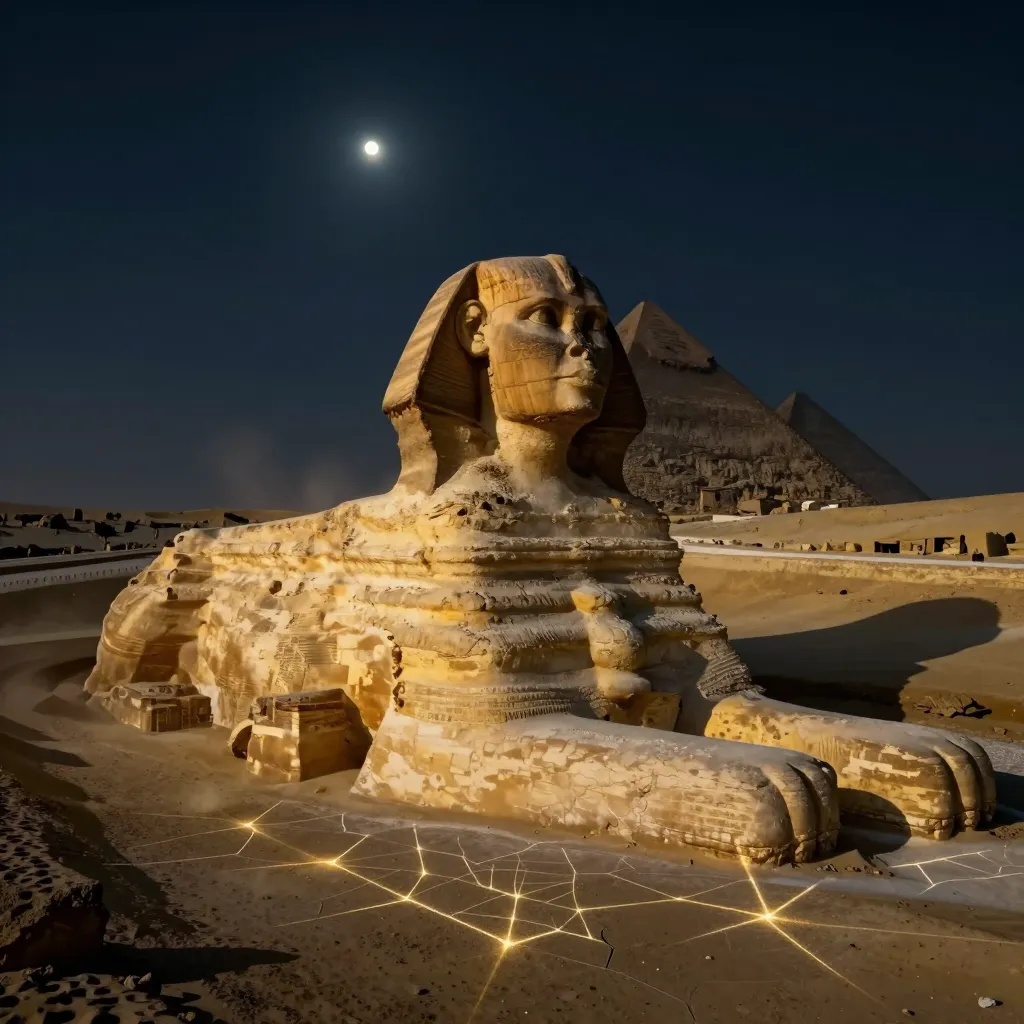
Second Sphinx Buried Beneath Giza? Radar Discovery Divides Archaeologists
Italian researchers using ground-penetrating radar claim to have detected a second Sphinx buried beneath the existing monument on the Giza Plateau. The discovery, based on geometric symmetry and radar anomalies, has divided the archaeological community. Critics demand physical excavation before validating what could be one of history's most staggering revelations.
A Second Sphinx Hidden Beneath Giza? The Radar Discovery Dividing Archaeology
In the shadow of the Great Pyramid, where the desert meets millennia of silence, a provocative claim has surfaced that could rewrite the oldest chapter of human civilization. Italian researchers using ground-penetrating radar believe they have detected not just chambers, but an entire second Sphinx buried beneath the existing monument on the Giza Plateau—a discovery that, if validated, would rank among the most staggering archaeological revelations in history.
The Geometric Cipher in the Sand
The research, led by Filippo Biondi and his team, rests on a deceptively simple premise: ancient Egyptian architects worked in perfect symmetry. By drawing geometric lines from the three pyramids toward the Great Sphinx, Biondi's team identified a mirrored location directly beneath the current monument where radar signals suggest a second, identical structure lies entombed in bedrock.
"We are finding precise geometrical correlation, 100 percent of correlation, in this symmetry," Biondi stated during a recent podcast appearance, expressing roughly 80 percent confidence in the findings. The researchers describe their detection as part of a broader network of "megastructures" hidden underground—a vast subterranean complex previously hinted at in their earlier surveys.
The methodology hinges on the belief that Giza's architects encoded mathematical perfection into the plateau's layout. If the pyramids and Sphinx form a deliberate geometric design, then the absence of a counterpart to the Sphinx becomes a statistical anomaly. The team's radar data, they argue, fills that void.
Echoes from the Dream Stele
Long before modern technology scanned the limestone beneath our feet, ancient Egyptians may have left their own clue. The Dream Stele—a granite slab erected between the paws of the Great Sphinx during the reign of Thutmose IV—depicts two sphinx-like figures facing one another. For over a century, Egyptologists have debated whether this imagery represents a literal twin monument or mere symbolic duality: the balance between horizon and underworld, or the merging of solar and lunar cycles.
The twin-sphinx motif appears elsewhere in Egyptian art, typically representing the eastern and western horizons—Aker, the double lion god who guarded the passage of the sun through the underworld. But the Dream Stele's specific placement at Giza has fueled persistent speculation among alternative researchers that a physical second Sphinx once stood across the Nile, or perhaps remains concealed where Biondi's team now claims to have found it.
The Skepticism Beneath the Surface
The archaeological community has greeted these claims with pronounced caution. Biondi's team faced significant criticism last year when they announced preliminary findings of an extensive underground complex near the pyramids. Critics argued that ground-penetrating radar—while invaluable for detecting density variations—cannot definitively distinguish between carved chambers, natural fissures, and compacted sediment layers without physical excavation.
Radar tomography interprets reflected electromagnetic waves. In limestone bedrock riddled with natural cavities and ancient quarry tunnels, false positives are not merely possible—they are expected. Seasoned geophysicists emphasize that "anomalies" require ground-truthing: core samples, excavation trenches, or at minimum, independent verification using complementary technologies like electrical resistivity or seismic refraction.
The history of Giza is littered with sensational claims that dissolved under scrutiny. From hidden chambers in the Great Pyramid proclaimed by various projects over decades to alleged secret tunnels beneath the Sphinx's paws, the plateau seems to attract both genuine scientific inquiry and premature declarations. The difference lies in peer review and reproducibility—standards that Biondi's current findings have not yet met.
What a Second Sphinx Would Mean
If excavation were to confirm a second Sphinx buried beneath the first, the implications would cascade through multiple disciplines. Architecturally, it would demonstrate a level of subterranean engineering previously unknown in the Old Kingdom, suggesting the plateau's builders conceived of Giza as a three-dimensional sacred landscape rather than merely a surface necropolis.
Chronologically, the burial context could provide fresh material for radiocarbon dating and stratigraphic analysis, potentially refining or challenging current timelines for the Sphinx's construction—a topic already fraught with debate between orthodox Egyptologists placing it around 2500 BCE and geological researchers arguing for significantly older origins based on water erosion patterns.
Symbolically, a buried twin would reshape our understanding of ancient Egyptian cosmography. The Sphinx traditionally represents Hor-em-akhet, "Horus of the Horizon," a solar guardian facing east toward the rising sun. A subterranean counterpart might embody the nocturnal journey through the Duat, the underworld traversed by the sun god Ra each night. The plateau would emerge not merely as a tomb complex but as a physical map of the Egyptian universe.
The Weight of Extraordinary Claims
The principle guiding responsible archaeology remains unchanged: extraordinary claims require extraordinary evidence. Ground-penetrating radar offers tantalizing first glimpses, but it cannot substitute for the slow, methodical work of excavation and analysis. The Giza Plateau, protected as a UNESCO World Heritage site, permits no casual digging; any physical investigation would require extensive permitting through Egypt's Ministry of Tourism and Antiquities, international collaboration, and significant funding.
Until such verification occurs, the second Sphinx remains a compelling hypothesis—one that bridges ancient mythology and modern technology, but one that dwells in the liminal space between possibility and proof. The Dream Stele's carved twins continue to gaze at one another in granite silence, perhaps guarding a secret still locked in the bedrock, or perhaps merely echoing a symbolic duality that existed only in the minds of those who carved them.
For now, the sands of Giza hold their counsel. And archaeology, disciplined by centuries of false alarms and rewarded by genuine wonders, waits with the patience that the desert itself demands.