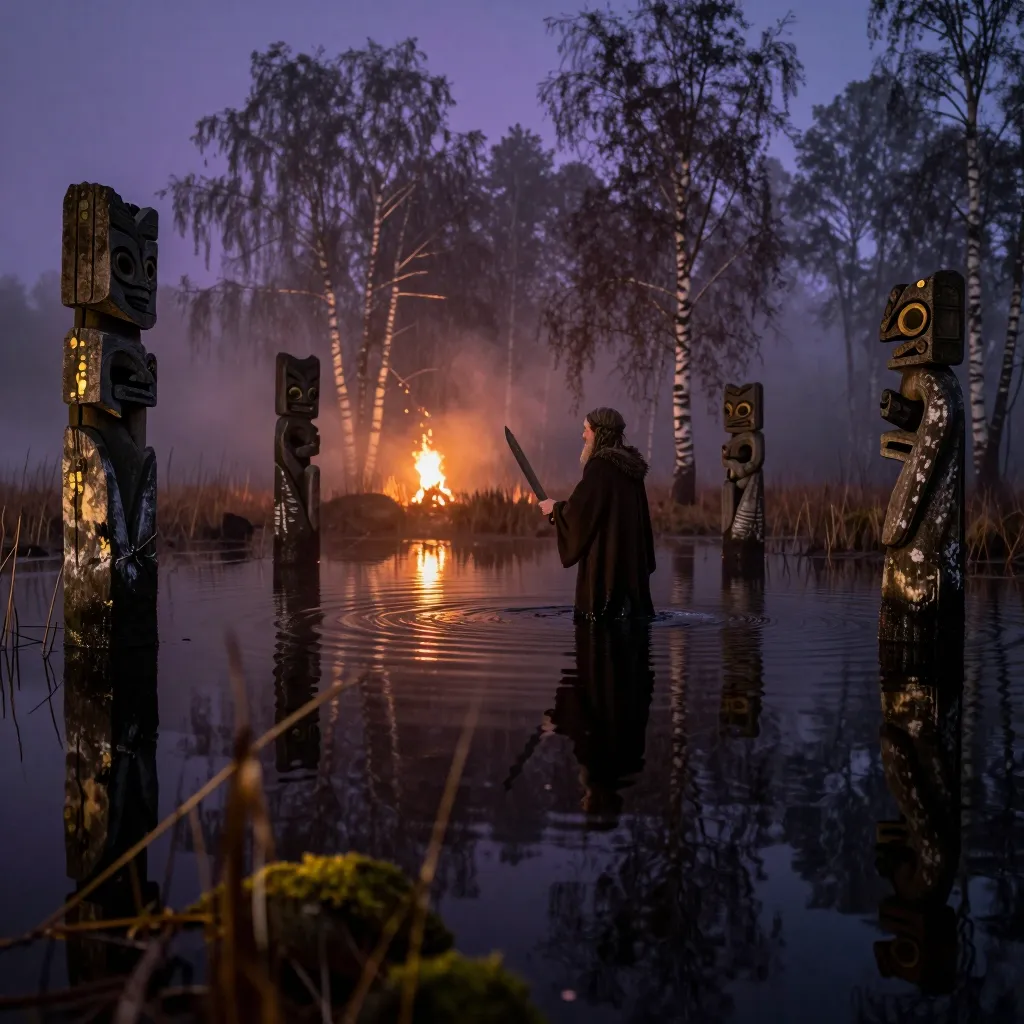
Sacred Bogs & Shadow Kings: Mythology Before the Viking Age Dawned
Explore the mystical Iron Age Scandinavia, a shadowy realm of tribal warfare, sacred bogs, and the earliest whispers of myths that would become Norse sagas. Delve into a time when powerful chieftains offered ships to unknown gods, and warrior aristocracies forged their legends through blood and sacrifice, long before the Viking Age truly dawned. Uncover the spiritual foundations that shaped the future sea-kings.
The Shadow World Before the Vikings
Long before dragon-prowed ships struck terror across Europe, Scandinavia existed in a twilight realm between prehistory and legend. The lands of mist and forest were not yet the homeland of sea-kings, but rather a crucible of tribal warfare, sacred bogs, and the first whispered stories that would one day become the Norse sagas.
The Iron Age Legacy
In the centuries following the collapse of Roman influence, Scandinavia remained largely untouched by the great migrations sweeping across continental Europe. While Goths, Vandals, and Lombards spilled southward through the forests of Germania, the northern peninsula became a reservoir of older ways—a place from which warriors departed, not one that received them.
Archaeology reveals a society still bound to its Iron Age roots. The landscape was dotted with fortified settlements, their earthworks testimony to constant low-level warfare between competing tribes. Warrior aristocracies maintained their status through raiding, a practice so endemic that some coastal regions became virtually uninhabited. The sword and the spear were not merely tools of war but instruments of social advancement.
The Scandinavians of this era were not a unified people but a patchwork of tribes—Geats in southern Sweden, Svear around the great lakes, Danes consolidating in Jutland, and countless smaller groups whose names have faded into the mists. Each tribe maintained its own sacred groves, its own chieftains, its own oral traditions of heroes and monsters.
The Cult of the Bog
Perhaps nothing illuminates the spiritual darkness of this period more vividly than the votive offerings cast into Scandinavian wetlands. These were not simple deposits but deliberate, ritual acts—hundreds of swords, spears, and shields surrendered to the murky depths, along with the most precious offering of all: ships.
The Nydam finds in Jutland remain the most spectacular evidence of these practices. Here, archaeologists uncovered not merely weapons but entire vessels—clinker-built ships with the graceful lines that would later characterize Viking longships. These were not crude dugouts but sophisticated craft, their planks shaped by fire and axe, their seams caulked with wool and tar. The technology that would one day carry warriors to England and Byzantium was already present, being offered up to gods whose names we can only guess.
The bogs served as boundaries between worlds. What was cast into them passed from the realm of men into the domain of powers older and more terrible than any earthly king. The sheer quantity of martial equipment suggests a society where warfare was not merely common but sacred—a perpetual cycle of raiding and sacrifice that bound the community to forces beyond mortal understanding.
The First Sea Wolves
Water defined Scandinavian existence. The peninsula's fractured coastline, its archipelagos and fjords and inland waterways, made the ship more practical than the cart, the oar more natural than the plough. Piracy emerged not as aberration but as extension of this maritime identity.
By the late third century, northern raiders were already striking beyond their homelands. The Heruls of Jutland joined Saxon fleets in assaults on Roman shores, carrying home plunder that would be weighed against the demands of their gods. A century later, the Geatish king Hygelac—perhaps the first Scandinavian ruler known by name—led his warriors against the Franks along the lower Rhine. His death in battle around 528 was recorded by Gregory of Tours and immortalized in the Old English epic Beowulf, a poem that preserves glimpses of a heroic age already fading when it was composed.
These were not yet the coordinated invasions of the Viking Age but something more primal: individual war-bands led by charismatic chieftains, driven by the need for wealth, reputation, and the favor of fate. The distinction between trader and raider, so clear to later chroniclers, barely existed. A man might sail south with goods to sell and return with goods taken by force, and no contradiction was perceived.
The Rise of Sacred Kingship
The centuries between the fall of Rome and the dawn of the Viking era witnessed the slow crystallization of power. Tribes merged or were absorbed; alliances became permanent; temporary war-leaders transformed into hereditary kings. By around 750, several distinct kingdoms had emerged from the tribal chaos.
In Vestfold, the western heartland of Norway, burial mounds at Borre rose above the landscape like artificial hills, each containing the remains of rulers who commanded sufficient wealth and authority to shape the earth itself. These were not merely graves but statements of cosmic order—the king buried with his weapons, his ships, sometimes his servants, establishing his claim to status in the world beyond death.
The Svear of Uppland constructed their own monument to sacred power at Vendel and Valsgärde, where ship-burials contained warriors laid out with magnificent helmets and weapons. The craftsmanship of these grave goods—interlaced beasts, gripping beasts, the stylized animals that would evolve into Viking art—speaks of workshops serving elite patrons, of artistic traditions already centuries old.
Most enigmatic is the trading settlement at Helgö, near Lake Mälaren. Here, in what would become Swedish territory, merchants maintained connections reaching far beyond northern Europe. The most startling discovery from this site is a small bronze statuette of the Buddha, crafted in northern India around 600 CE. How it traveled from the Ganges to the Baltic remains one of the period's great mysteries—whether through Russian rivers, Byzantine intermediaries, or some forgotten network of traders crossing the steppes. Its presence suggests that even in this shadowy age, Scandinavia was not as isolated as later writers assumed.
The Danevirke and the First Denmark
The most tangible evidence of emerging state power comes from Jutland, where the Danes were consolidating their dominance over southern Scandinavia. Around 737, an enormous earthen rampart—the Danevirke—was thrown across the peninsula's narrow neck, a statement of territorial ambition and defensive necessity. Its construction required coordinated labor on a scale impossible for any tribal chieftain; only a king commanding widespread authority could marshal such resources.
A decade earlier, a canal had been cut across the island of Samsø, regulating passage through the Danish straits. Together with the fortified trading settlement at Ribe—founded with deliberate planning around the same period—these projects reveal a polity already thinking in terms of borders, trade routes, and strategic defense.
Ribe itself offers a window into this transforming world. The settlement produced evidence of large-scale leatherworking, suggesting the export of hides to the Frankish kingdoms to the south. Frisian coins circulated through its markets, evidence of connections to the broader European economy. The cattle dung found in extraordinary quantities hints at the seasonal gatherings that transformed trading places into something more: sites of assembly, of lawgiving, of religious ceremony.
It was to this Denmark, still pagan and proud, that the Anglo-Saxon missionary Willibrord traveled around 725, seeking to convert the north. He met a king named Angantyr—perhaps the earliest Danish ruler attested in contemporary sources—and found him resistant to the new faith. The meeting symbolizes a frontier between worlds: the expanding Christian civilization of the south, with its written records and bureaucratic churches, encountering the oral culture of the north, where power still rested on personal charisma and the favor of gods who demanded blood.
The Gathering Darkness
The Scandinavia of 750 CE was not yet the world of the sagas, but its elements were assembling. The ship-burials, the sacred groves, the warrior aristocracies, the emerging kingdoms—all would be inherited, transformed, and mythologized by the generations that followed. The raids that had struck Roman shores would expand in scale and ambition until they reshaped Europe. The gods who received the offerings at Nydam would receive their own temples at Uppsala, their own myths at the hands of poets who transformed historical memory into timeless narrative.
What emerged in the centuries before the Viking raids was not merely a political transformation but a cosmological one. The tribal world, with its local deities and shifting alliances, was giving way to something more centralized, more hierarchical, more dangerous. The kings who commanded the construction of Danevirke would eventually command fleets that crossed the Atlantic. The warriors buried at Vendel would find their descendants sacking Paris and Constantinople.
The shadow world was ending. The age of the sea-kings was about to begin.