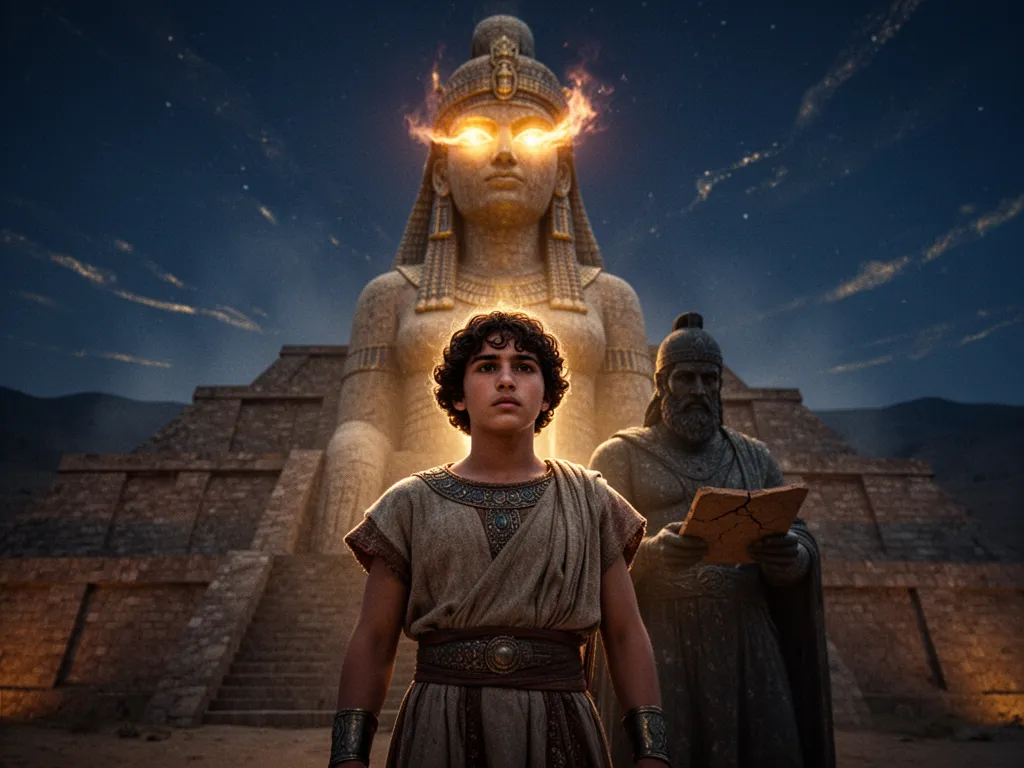
Sargon and Ur-Zababa: Divine Betrayal and the Rise of Akkad's First Emperor
Delve into the Mesopotamian legend of Sargon of Akkad and King Ur-Zababa. This tale of divine interference, blood-soaked visions, and a 'death letter' reveals how the goddess Inanna shifted the tides of power to forge the world’s first empire through betrayal and destiny.
Sargon and Ur-Zababa: A Mesopotamian Tale of Divine Betrayal
Long before the first stones of Babylon rose, a whisper traveled along the Euphrates: the gods were shifting their favor. The clay tablets that survive—cracked, salt-flecked, and sun-baked—tell the story in fragments, yet the outline is unmistakable. A young cupbearer named Sargon, low-born but heaven-marked, is thrust against the reigning king of Kish, Ur-Zababa. What follows is not mere palace intrigue, but a cosmic changing of the guard, scripted in dreams and sealed in blood-metallic visions.
The Dream That Toppled a Throne
Ur-Zababa, proud restorer of Kish’s walls, awakens one night with his heart drumming like a war-drum. In the dim oil-light he sees it again: a river thick as molten bronze, and within it his own body dissolving. The same night, Sargon—still loyal, still carrying wine jars across the courtyard—groans in his sleep. Inanna, lady of sunrise and battlefield, towers over him, her height “from sky to earth.” She grips Ur-Zababa by the hair and drowns him in the crimson tide. When morning comes, neither man speaks of the dream, yet both feel the palace floor tilt beneath their feet.
Divine Interference at the Temple Gate
Ur-Zababa’s fear crystallizes into a plot as precise as cuneiform wedges. He dispatches Sargon to the E-sikil, the fated foundry where bronze gods are born, carrying a polished mirror for the head-smith. Hidden orders travel ahead: hurl the messenger into the molten vat, let the mirror swallow him whole. Sargon approaches the gate, but Inanna steps from the shadows, veiled in night. “Blood clings to you,” she warns. “No polluted foot may cross this threshold.” The smith waits, the furnace roars, yet the cupbearer turns back alive. Ur-Zababa tastes iron in his mouth; the gods have vetoed his murder.
The Clay Letter of Death
Writing is young; envelopes do not yet exist. Ur-Zababa rolls a soft clay tablet, presses his stylus deep, and dries the message in the sun. It instructs Lugalzagesi, king of Uruk, to kill the bearer—Sargon—and so seal a treaty. The sealed tablet is placed in Sargon’s unsuspecting hands. He sets out along the reed-lined canals, unaware that he carries his own death sentence. Yet Lugalzagesi, whether dazzled by the envoy’s confidence or warned by the same dreams that stalk kings, breaks the seal, reads the order—and refuses. Instead, he allies with Sargon, turning the blade back toward Kish.
The Cycle of Usurpation
History knows what the poem only hints: Sargon will indeed cast down both Ur-Zababa and Lugalzagesi, welding Sumer and Akkad into the world’s first empire. But the tablets add a darker footnote. Section C—scarred and half-lost—suggests Sargon later steals into Lugalzagesi’s household, sharing the queen’s bed while the king sleeps. Whether this is seduction or strategy, the outcome is the same: another ruler blind to the writing on the wall, another throne eclipsed. The pattern repeats like a drumbeat: dream, betrayal, river of blood, new king.
Echoes Across a Millennium
By the 7th century BCE, when Assyrian scribes copy the tale in the lamp-lit scriptorium of Nineveh, Sargon’s name has become a title meaning “Legitimate King.” Two later Assyrian monarchs will adopt it, hoping to siphon a little of that ancient charisma. The story itself—once perhaps court propaganda—has mutated into folklore, recited by bards who never saw the Euphrates. They linger on the moment when a gardener’s adopted son feels the gods’ gaze settle on him like molten gold, and they shiver at the thought that destiny can arrive as quietly as a dream.
Reading the Omens Today
Modern eyes see a matrix of mythic motifs: the hero of humble birth, the jealous king, the protective goddess, the death-letter, the river of blood. Yet beneath the folktale varnish lies a theological statement: kingship is not hereditary, but contractual. When the great gods Anu and Enlil revoke their sanction, no wall is thick enough, no bronze mirror bright enough, to save the monarch. Inanna’s river still flows; it simply chooses new banks.
The tablets fall silent before the final scene, but the lesson is intact. Power in Mesopotamia was always borrowed—loaned by heaven, collected in nightmares. Sargon walked away from the foundry gate because a goddess blocked his path; Ur-Zababa lost his throne the moment he tried to chain fate with a clay letter. In the land between rivers, destiny wrote in disappearing ink, visible only when the next dreamer awoke.