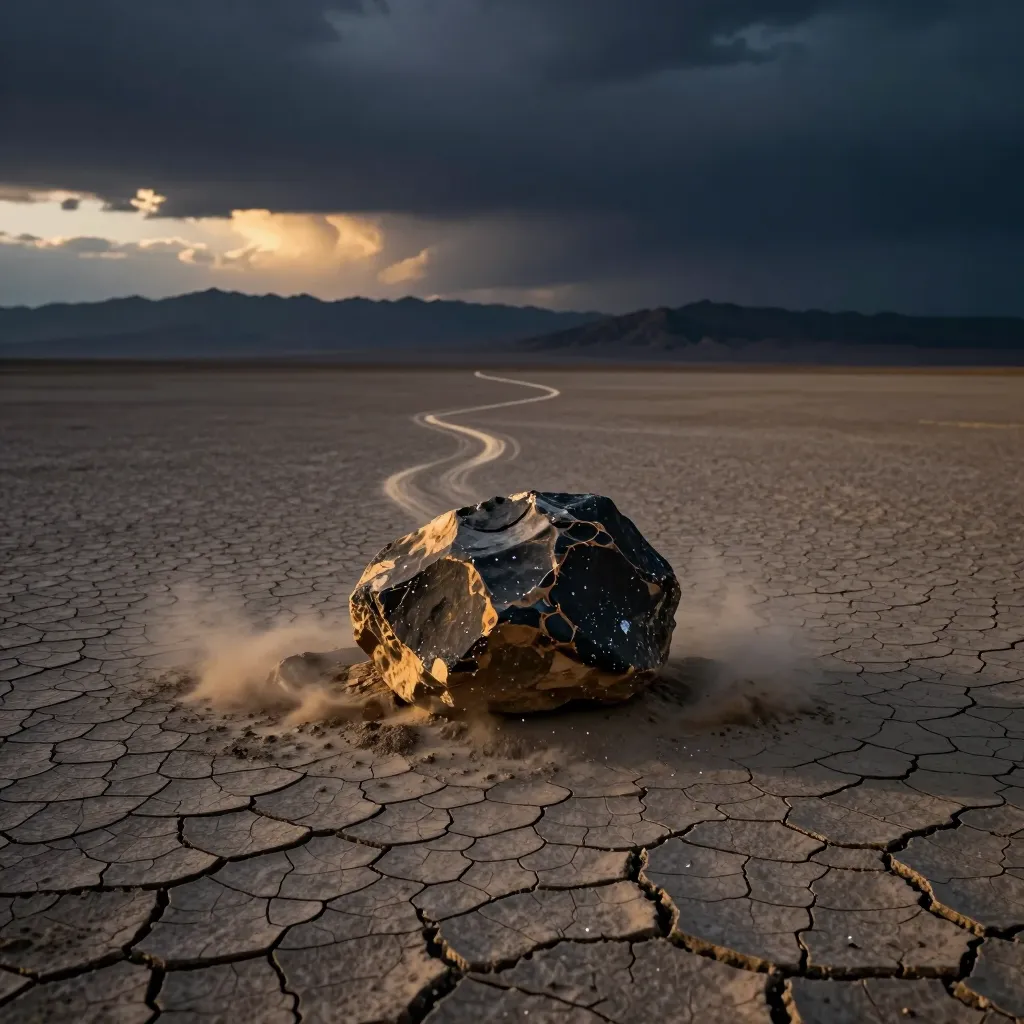
Leave No Stone Unturned: Racetrack Playa Moving Rocks Mystery
Explore Racetrack Playa's weird wonder where massive stones glide solo across cracked desert mud, etching bizarre paths that fueled supernatural legends for a century. Scientists debunked myths with GPS proof: thin ice sheets on shallow water act as sails, nudged by light winds in perfect rare conditions. Ideal for fans of haunted-like natural enigmas blending science and spook.
The Sailing Stones of Racetrack Playa: Death Valley's Moving Rock Mystery
Deep within the sun-scorched expanse of Death Valley, California, lies a dried lakebed where rocks move on their own. They leave long, winding trails across the cracked mud as if some unseen hand dragged them across the desert floor. For nearly a century, the sailing stones of Racetrack Playa defied every attempt at explanation, transforming from geological curiosity into one of America's most enduring natural mysteries.
A Desert of Moving Monoliths
Racetrack Playa stretches across a remote basin surrounded by mountains, its surface a mosaic of dried mud baked by relentless heat. Scattered across this barren landscape are stones—some no larger than a fist, others massive boulders weighing hundreds of kilograms. The mystery isn't their presence; it's their movement.
Each stone sits at the end of a track, a groove carved into the playa surface that can extend for hundreds of meters. These trails twist and turn, sometimes running parallel, sometimes intersecting, occasionally showing stones that appear to have collided and changed direction. The paths suggest deliberate motion, yet no human, animal, or vehicle leaves them. The rocks simply… sail.
The phenomenon earned these boulders their evocative names: sailing stones, sliding rocks, wandering stones. While similar moving rocks have been documented in other parts of the world, none have achieved the legendary status of Death Valley's wandering monoliths.
The Century of Speculation
Scientists first documented the moving stones in the early 1900s, and for decades, the mystery only deepened. No one ever witnessed the rocks in motion. Time-lapse photography was primitive, GPS technology nonexistent. Researchers arrived to find stones shifted from their previous positions, fresh trails marking their ghostly passage, but the mechanism remained invisible.
The vacuum of explanation invited imagination. Local legends whispered of magnetic fields pulling the stones toward hidden ore deposits. Others proposed supernatural forces—energy vortices, ancient curses, or the work of extraterrestrial visitors drawn to this desolate basin. Some visitors swore the rocks possessed consciousness, choosing their paths with deliberate intent.
More grounded hypotheses emerged from the scientific community, though each carried flaws. In 1948, geologists Jim McAllister and Allen Agnew proposed that dust devils—those swirling columns of desert wind—combined with intermittent flooding to push the stones across slick mud. When tested four years later using aircraft propellers to simulate fierce winds over a soaked lakebed section, the results proved inconclusive. The winds required to move the heaviest stones seemed impossibly strong for the gentle dust devils typical to the region.
Ice presented another compelling theory. During the early 1970s, geologists Robert Sharp and Dwight Carey launched a meticulous study, visiting twice yearly to track thirty specific stones. They planted wooden stakes around their subjects, reasoning that if ice sheets pushed the rocks, the frozen water would bind to the stakes and halt the stones' progress. Yet even with this obstacle, some rocks continued their slow migration, slipping past the barriers as if the ice theory couldn't fully contain them.
The NASA Connection
The breakthrough began with an unlikely source: a planetary scientist studying weather patterns for space exploration. In 2006, Ralph Lorenz installed miniature weather stations across Death Valley for a NASA project when he first encountered the sailing stones legend. His expertise in extraterrestrial environments—specifically how ice behaves on other worlds—provided a fresh perspective.
Lorenz discovered documented cases of ice buoyancy moving rocks in Arctic tidal zones, where frozen seawater lifted boulders and carried them along beaches. He wondered if a similar mechanism, adapted to desert conditions, might explain the Racetrack Playa phenomenon.
Working with his team, Lorenz noticed peculiar details in the stone trails. Some paths showed stones that appeared to have struck another rock and rebounded, changing trajectory as if bouncing off an invisible cushion. This suggested the moving stones weren't simply grinding directly against mud, but perhaps riding atop something—something that could both float them and cushion impacts.
He devised an elegant experiment: place a small stone in a container of water, freeze it so ice formed a collar around the rock, then flip it so the ice-shielded portion faced upward while the bare stone bottom rested on a sandy tray. When gentle wind blew against the ice collar, the stone glided smoothly, carving a trail in the sand below.
The physics worked for smaller stones, but the massive boulders—some exceeding 300 kilograms—still resisted explanation. Lorenz had illuminated part of the mechanism, yet the complete solution required more than laboratory simulations. It demanded observation of the actual phenomenon, something no researcher had achieved in nearly a hundred years of study.
The Lucky Witnesses
In 2011, Richard and James Norris, working alongside Lorenz, launched what they expected to be a decade-long waiting game. They fitted fifteen rocks with motion-activated GPS units and established a high-resolution weather station to capture the precise conditions surrounding any movement.
The scientific consensus suggested patience measured in years, perhaps decades. Some stones had remained stationary for ten years or longer. The researchers anticipated a long vigil.
Instead, fortune intervened. In 2013, conditions aligned with almost supernatural precision. The team arrived to find the playa transformed—not into the familiar cracked desert floor, but into a shallow lake barely three inches deep. A thin sheet of water covered the ancient lakebed, and above it floated fragile panes of ice.
Then, against all probability, the rocks began to move.
The researchers watched as sunlight warmed the frozen surface, breaking the ice into large floating panels. Light winds—barely perceptible to human senses—pushed these ice sheets across the shallow water. The floating ice acted as sails, but more critically, as distribution panels. When ice sheets contacted stones, the force spread across broad surfaces rather than concentrating at single points. This distributed pressure allowed gentle winds to mobilize rocks that would resist direct blowing.
The stones, partially buoyant in the thin water layer, slid through soft mud with minimal friction. Ice collars around smaller rocks reduced ground contact further. Multiple stones moved simultaneously, sometimes in parallel, sometimes diverging as ice sheets fragmented and drifted along different wind currents.
The mystery that had endured since the early twentieth century finally yielded to direct observation. The sailing stones weren't sailing at all, in the nautical sense—they were ice-skating, pushed by frozen panels across a temporary desert ice rink that formed and dissolved within days.
The Perfect Storm of Stillness
The solution reveals why the phenomenon remained hidden for so long. The required conditions are extraordinarily specific: precise water depth (enough to lubricate and float ice, not enough to submerge stones completely), temperature fluctuations that freeze water overnight then partially thaw it by day, and gentle sustained winds rather than violent gusts.
Too much water submerges the stones entirely; too little prevents ice formation. Strong winds break the ice into unusable fragments; dead calm leaves sheets motionless. The rocks move slowly—perhaps meters per minute—making direct observation unlikely unless researchers happen to be present during these brief windows of perfect conditions.
Death Valley's extreme aridity means these windows are rare. The playa may flood and freeze suitable for stone movement only once every several years. The 2013 observation represented a convergence of patience, technology, and remarkable luck.
The Legacy of the Wandering Rocks
Today, the sailing stones of Racetrack Playa stand as testament to how nature conceals its mechanisms behind apparent impossibility. What seemed to demand supernatural explanation—rocks moving independently across a desert floor—resolved into elegant physics: ice, water, wind, and friction interacting in precise balance.
Yet the stones retain their mystique. The trails remain, some fresh, some decades old, a historical record written in mud. Visitors still trek to this remote basin, hoping to witness the phenomenon personally, though the odds of being present during movement remain vanishingly small.
The mystery's resolution didn't diminish Racetrack Playa's strangeness—it enhanced it. We now understand how the stones move, but the when remains unpredictable, governed by weather patterns as capricious as any ancient deity. The desert still decides which stones walk, and when, and where their paths will lead.
In the end, the sailing stones teach that the most profound mysteries often hide not in the absence of natural law, but in its rarest conjunctions—those moments when ordinary elements align to produce extraordinary effects, leaving us to wonder whether we witnessed geology or magic.