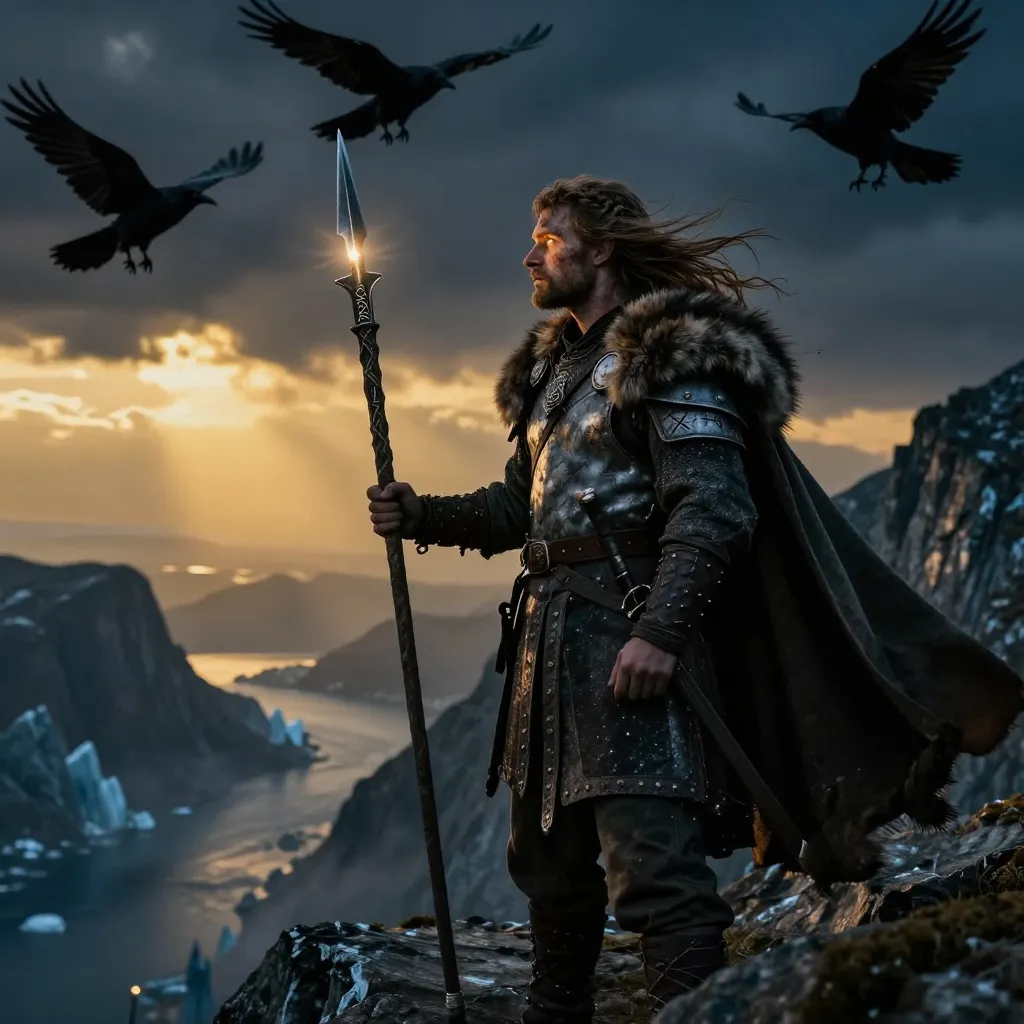
Odin: The One-Eyed God of Wisdom, War and Death
Odin stands as the complex Norse god of wisdom, war and death, who sacrifices his eye for cosmic knowledge and hangs on Yggdrasil to master the runes. This alluring figure fascinates scholars of mythology, historians exploring ancient Norse culture, and anyone intrigued by divine contradictions. His enduring power lies in embodying the terrifying beauty of transformation through sacrifice.
Odin: The One-Eyed King of Ecstasy and Shadow
Among the vast pantheon of Norse deities, none commands such fearful reverence and unsettling fascination as Odin. Known across Germanic lands by names both whispered and shouted—Óðinn in Old Norse, Woden to the Anglo-Saxons, Wotan to the German tribes—this god embodies the thin line between divine inspiration and maddening fury. His very name derives from óðr, that untranslatable storm of ecstatic passion that drives warriors to frenzy, poets to verse, and seekers into the dark.
The Many Masks of the Wanderer
To understand Odin is to grasp contradiction itself. He sits enthroned in glittering Asgard as chieftain of the Aesir gods, yet spends endless nights wandering alone through mist-shrouded forests and frozen wastes. He grants victory to kings and champions, yet extends his shadowed hand to outcasts and murderers fleeing society's judgment. He speaks only in riddling poetry, yet his silence before the cosmic mysteries he seeks is absolute.
This is no benevolent father-god of comfortable worship. The Norse knew him as Óðinn, "Master of Ecstasy"—a title that captures his essential nature. The historian Adam of Bremen, writing in the eleventh century, rendered the name simply as "The Furious," and in this fury lies both his power and his terror. For Odin's ecstasy is not gentle inspiration but the raw, uncontrolled force that tears through the boundaries of ordinary consciousness.
The Price of Wisdom
What distinguishes Odin from other wisdom-seekers in world mythology is his willingness to pay any price for knowledge. Where other gods might demand sacrifice from their followers, Odin demands it from himself.
The most visible mark of his obsession hangs empty in his skull: the socket where his right eye once sat, traded to the giant Mimir for a single draught from the well of cosmic wisdom. The eye that remains gleams with terrible, penetrating sight, while the void beside it reminds all who meet his gaze that understanding demands mutilation.
Yet this was merely prelude. In an act that echoes shamanic initiation rites across the northern world, Odin hung himself from the world-tree Yggdrasil, pierced by his own spear, suspended between the nine realms for nine days and nights without food or drink. Death hovered close, and through death's threshold he passed—not to die, but to seize the runes themselves. These were no mere letters but living forces, each symbol containing secrets of creation and destruction, fate and transformation.
"Then I was fertilized and grew wise;
From a word to a word I was led to a word,
From a work to a work I was led to a work."
The poem's imagery is deliberate and disturbing. In a culture that measured masculinity by battlefield prowess, Odin speaks of being "fertilized," of growing through receptive surrender rather than dominant conquest. This gender ambiguity runs through his character like a dark river.
The Shaman's Path
Odin's spiritual practices placed him beyond the boundaries of acceptable male behavior in Viking society. As foremost practitioner of seidr—the prophetic magic associated with spinning fate's threads—he adopted techniques and postures deemed effeminate. The Danish historian Saxo Grammaticus records that Odin was once banished from Asgard for ten years, his fellow gods unwilling to bear the scandal of his "woman's work" and "stage-tricks."
But Odin cared nothing for such shame. His eight-legged horse Sleipnir carries him across dimensions as shamans travel in trance. His ravens Hugin (Thought) and Munin (Memory) fly daily through all worlds, returning to whisper secrets in his ears. His wolves Geri and Freki prowl at his side. These are not merely pets but extensions of his fragmented self, familiar spirits that enable his perpetual dissociation from single, limited consciousness.
In the Ynglinga Saga, we learn that Odin could send his spirit traveling while his body lay seemingly dead or sleeping, venturing to distant lands on errands of investigation or seduction. The poem "Baldr's Dreams" captures this power vividly: riding Sleipnir to Hel's underworld realm, Odin raises a dead seeress to learn his beloved son's fate, speaking with the corpse in verse while living valkyries wait in the shadows.
The War God Who Despises Honor
Modern depictions often sanitize Odin as a noble commander, but the sources reveal something more disturbing. Unlike Tyr, the god of honorable combat, or Thor, the straightforward protector, Odin delights in the chaos of battle itself. He incites peaceful folk to slaughter with what can only be called sinister glee, caring nothing for the justice of any cause.
The berserkers—warriors who worked themselves into ecstatic, animalistic fury before combat—claimed his patronage. These were not disciplined soldiers but possessed beings, channeling the same óðr that defined their god. Through ritual identification with wolves and bears, they achieved temporary dissolution of human boundaries, becoming extensions of Odin's own ferocious nature.
Yet Odin does not bless indiscriminately. His favor falls upon the exceptional, the cunning, the ruthless—whether they sit on thrones or hide in wilderness exile. The great heroes Starkaðr and the Volsung clan enjoyed his protection, but so did notorious outlaws like Egill Skallagrímsson, whose poetry flowed as freely as the blood on his hands. For Odin, the distinction between king and criminal matters less than the presence of that fierce will-to-power that recognizes no external limitation.
Lord of the Slain
Roman observers, attempting to map Germanic gods onto their own pantheon, consistently identified Odin with Mercury rather than Mars. This was significant: they recognized that his dominion over death outweighed even his association with war. As psychopomp—guide of souls between worlds—he commands forces more fundamental than battlefield victory.
Valhalla, his hall of the honored dead, receives half those slain in combat, chosen by his valkyries from the corpses. The other half go to Freya, suggesting that Odin's realm represents not simple afterlife reward but continued service in his cosmic army. For he knows what few others admit: Ragnarök approaches, the final battle where he must face the monstrous wolf Fenrir, and even he cannot escape death.
This knowledge drives his relentless recruitment. He practices necromancy, speaking with corpses to learn secrets hidden from the living. He receives human sacrifice by spear and noose—methods echoing his own self-sacrifice on Yggdrasil. Warriors would throw spears over enemy ranks, dedicating them to Odin with the chilling cry: "Odin owns you all!"
The Breath at Creation's Heart
One of his countless names is Allfather (Alfaðir), father of gods and ancestor of royal lines across northern Europe. Yet he is simultaneously Aesir and Vanir and giant—his mother Bestla among the primordial frost-giants, his complex nature transcending any single category.
An Old Norse poem identifies him with önd itself: the breath of life. This is perhaps the deepest key to his mystery. Where Thor manifests in thunder's overwhelming power, Odin moves through inspiration—that invisible force animating speech, poetry, battle-fury, and magical trance. Without his vivifying presence, existence would remain inert matter.
The Norse understood their gods as vital forces holding reality together. If this is so, then Odin is the vital force of vital forces, the ecstatic current running beneath all specific manifestations. His ceaseless wandering, his self-mutilation in pursuit of wisdom, his indifference to conventional morality—all express an absolute commitment to consciousness expansion, to pushing beyond every boundary however sacred.
To follow Odin is to embrace transformation without guarantee of safety, to value knowledge above comfort, and to recognize that the most profound mysteries often wear terrifying faces. In the midnight halls of Asgard, where the one-eyed god waits between his wanderings, the fire never dies—but neither do the shadows ever fully retreat.