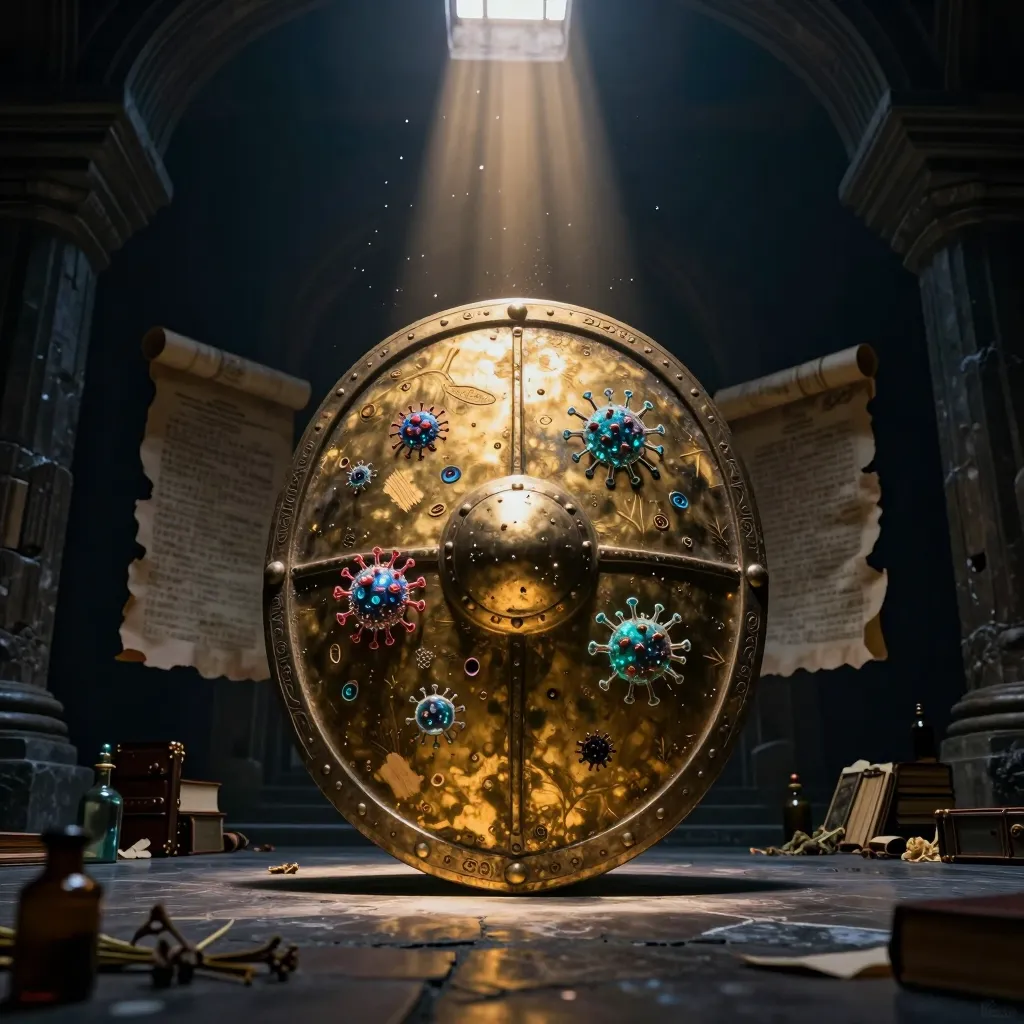
The Immortal Shield: A Mythic History of How Vaccination Saved Humanity
Explore the epic saga of vaccination, from the secretive variolation rituals of the Silk Road to the modern magic of mRNA. This article reveals how humans transformed from victims of invisible demons into masters of their own biological destiny through observation and scientific courage.
The Immortal Shield: How Vaccination Rewrote the Fate of Humanity
Long before laboratories and microscopes, before the white coats of modern medicine, humanity waged an invisible war against forces it could neither see nor comprehend. Disease arrived like vengeful spirits—sudden, merciless, and seemingly divine in their cruelty. Smallpox scarred faces and claimed villages. Rabies turned beloved animals into agents of death. Polio trapped children in iron prisons. Yet woven through this darkness is one of humanity's most extraordinary myths of triumph: the story of vaccination—a tale not of gods descending to save mortals, but of mortals learning to steal fire from the very demons that hunted them.
The Ancient Whisper of Protection
The earliest glimmers of this knowledge emerged from the shadows of antiquity, shrouded in the kind of mystery that would feel at home in the oldest myths. Somewhere in China, around the turn of the first millennium, a Buddhist monk—or perhaps a lineage of healers whose names were lost to time—discovered a dangerous, paradoxical truth: survival itself could be taught. The method was crude, almost ritualistic. Scabs from the afflicted were dried, ground to powder, and blown into the nostrils of the healthy, or rubbed into deliberate scratches on the skin. This was variolation—a word that sounds like an incantation, and in many ways, it was.
The practice traveled like a secret along the Silk Road, finding its way to India, across the vastness of Africa, and eventually to the courts of the Ottoman Empire. By the 16th century, it was whispered about in Constantinople—a folk magic that somehow worked, even if no one could explain why. Lady Mary Wortley Montagu, wife of the British ambassador to the Ottoman Empire, witnessed the ritual in 1717 and arranged for her own children to undergo it. She had survived smallpox herself, bearing its scars like stigmata, and had watched her brother die from it. When her children emerged unscathed, she became an evangelist for the procedure, though her efforts were met with the same skepticism that greets all who claim to have seen beyond the veil.
Across the ocean, Cotton Mather in Boston learned of the practice from an enslaved man named Onesimus. In 1721, during a smallpox outbreak that gripped the city like a fever dream, Mather and physician Zabdiel Boylston inoculated Mather's son and two enslaved individuals. The backlash was immediate and violent—some claimed the procedure defied God's will, that disease was righteous punishment for sin. Boylston was threatened with hanging. Yet the numbers told a different story: among the inoculated, survival rates soared compared to those who contracted the disease naturally. Even George Washington, facing the decimation of his revolutionary army by smallpox, would eventually mandate inoculation for his troops—a commander recognizing that myth and superstition were poor weapons against biological reality.
The Cow and the Crucible
If variolation was humanity's first spell against disease, Edward Jenner transformed it into science. The English physician noticed something that others had observed but never fully understood: milkmaids who contracted cowpox—a mild disease from cattle—seemed immune to smallpox's ravages. The connection seemed almost mythic, as if the humble cow bestowed a protective blessing upon those who tended it.
On May 14, 1796, Jenner tested this theory with the kind of audacity that defines both heroes and madmen in mythology. He scraped pus from a cowpox sore on milkmaid Sarah Nelmes and inoculated eight-year-old James Phipps. The boy fell ill with cowpox but recovered. Weeks later, Jenner exposed him to smallpox—the very demon that had haunted humanity for millennia. James did not sicken. The protective spirit held.
Jenner called his procedure "vaccination," from vacca, the Latin word for cow. It was a name that acknowledged the humble, almost magical origin of this new shield. Where variolation had been a dangerous gamble, vaccination was a controlled invocation—teaching the body's defenses to recognize and repel an enemy without requiring the body to first endure the enemy's full assault.
Taming the Invisible Beasts
The 19th century brought new monsters and new myth-makers. Louis Pasteur, the French biologist whose name would become synonymous with the germ theory of disease, turned his attention to rabies—a disease so terrifying it seemed almost supernatural. Transmitted through the bite of mad animals, rabies was universally fatal once symptoms appeared, transforming its victims into frenzied shadows of themselves.
In 1885, a nine-year-old boy named Joseph Meister was brought to Pasteur, having been mauled by a rabid dog. Pasteur had developed a vaccine from weakened rabies virus—an attenuated form of the beast, stripped of its killing power but retaining its recognizable shape. He injected the boy. Joseph lived. It was as if Pasteur had captured the demon, broken it, and turned it into a guardian spirit.
This era also saw the discovery of antibodies—molecular sentinels produced by the immune system to neutralize invaders. Scientists learned to harvest these antibodies from infected animals, creating antitoxins that could provide immediate, if temporary, protection. The process was imperfect, sometimes dangerous, but it represented humanity's growing ability to manipulate the invisible forces that governed life and death. In response to tragedies caused by contaminated antitoxins, the United States established the Food and Drug Administration—a sentinel institution designed to ensure that humanity's new weapons against disease did not turn against their wielders.
The invention of the electron microscope in the 1930s finally allowed scientists to gaze directly upon the viral demons they had been fighting blindly for centuries. No longer did they need to wait and watch as disease unfolded its terrible narrative in human bodies. They could see the enemy, study its structure, and craft vaccines with precision that earlier generations could only dream of.
The Arsenal Expands
With each passing decade, the shield grew broader, the protection more comprehensive. The 20th century became an age of vaccine heroes, each discovery adding another chapter to humanity's epic of survival.
Whooping Cough (1912): The bacterium Bordetella pertussis attacked the respiratory system with a violence that earned it its common name—the "whooping" sound of children struggling to breathe. Jules Bordet and Octave Gengou at the Pasteur Institute in Brussels developed a vaccine that not only saved countless young lives but also led to the discovery of adjuvants—substances like aluminum salts that amplify the immune response, making vaccines more potent and longer-lasting.
Diphtheria (1924): This bacterial toxin struck at the nervous system, creating a pseudomembrane in the throat that could suffocate its victims. Emile Roux and Alexandre Yersin at the Institut Pasteur pioneered antitoxin therapy using horses as living factories for antibodies. Gaston Ramon later refined this into the first true diphtheria vaccine and created the first combined vaccine—protecting against both diphtheria and tetanus simultaneously, a forerunner of the modern DTP vaccine.
Tetanus (1890): Known as "lockjaw" for its most terrifying symptom, this nervous system infection entered through wounds and killed up to 20% of those afflicted. German scientist Emil von Behring's discovery of the tetanus antitoxin earned him the first Nobel Prize in Physiology or Medicine. The modern DTaP vaccine now protects children under seven, while older individuals receive the Td booster.
Influenza (1945): The 1918 flu pandemic had demonstrated influenza's capacity for mass destruction, killing more people than the Great War that preceded it. British scientists Wilson Smith, C.H. Andrewes, and P.P. Laidlaw identified the true viral nature of influenza in the early 1930s. Military personnel received the first vaccinations before the vaccine became available to the general public in 1945. The challenge of influenza's mutating strains requires annual vigilance—a seasonal ritual of protection against a shape-shifting foe.
Polio (1955): Few diseases captured the public imagination with the same horror as poliomyelitis. Images of children confined to iron lungs, of Franklin D. Roosevelt bracing his paralyzed legs, haunted the collective consciousness. Jonas Salk developed the inactivated polio vaccine, tested on 1.8 million children in one of history's largest clinical trials. Albert Sabin followed with an oral vaccine—sugar cubes carrying weakened virus that could be swallowed rather than injected. Together, they virtually eliminated polio from Europe and the Americas, turning a disease that had killed and crippled millions into a fading nightmare.
Measles (1963): This ancient contagion, dating back to the 9th century, spread with the efficiency of a curse—through air, through touch, through contaminated surfaces. Thomas Peebles isolated the virus from a young schoolboy named David Edmonston during a 1954 outbreak. John Enders cultivated it, and by 1963, a vaccine emerged. Measles, which had caused encephalitis, pneumonia, and death in countless children, began its retreat.
Mumps (1968) and German Measles (1969): Maurice Hilleman, perhaps the most prolific vaccine creator in history, developed the mumps vaccine using virus collected from his own daughter. In 1971, these were combined with the measles vaccine into the MMR shot—a triple shield administered to children worldwide. German measles, or rubella, while mild in children, posed devastating risks to unborn children when pregnant women contracted it. Its vaccine completed a triumvirate of protection.
COVID-19 (2020): The emergence of SARS-CoV-2 in late 2019 plunged the world into a pandemic that felt almost mythic in its scale and disruption. Yet science responded with unprecedented speed. Decades of research into messenger RNA—first synthesized by researchers at Harvard in 1984, later explored as a vaccine platform in the 1990s—culminated in emergency use authorization for mRNA vaccines from Pfizer-BioNTech and Moderna. These vaccines taught human cells to produce a fragment of the virus, training the immune system without exposing it to the actual pathogen. It was a new kind of magic—one written in the language of genetic code.
The Quest for Eradication
By the late 1940s, vaccine production had reached sufficient scale to contemplate a goal that once seemed the province of gods rather than mortals: the complete elimination of a disease from the human population. The World Health Organization launched its smallpox eradication campaign in 1967, targeting a disease that still infected 10-15 million people annually, killing nearly a third of them.
The campaign was a global epic, fought not with swords but with bifurcated needles and freeze-dried vaccine. Health workers traveled to the most remote corners of the earth, sometimes facing suspicion, sometimes violence, always the relentless logistical challenge of maintaining the cold chain that kept the vaccine viable. In 1980, the WHO declared smallpox eradicated—the first and, to date, only human disease completely eliminated through human effort. It was a victory against a killer that had claimed pharaohs and peasants alike for three thousand years.
Central to vaccination's power is the concept of herd immunity—a kind of collective magical protection. When enough of a population is vaccinated, the disease cannot find sufficient hosts to sustain itself. The chain of transmission breaks. Those who cannot be vaccinated—the immunocompromised, the allergic, the very young—are shielded not by their own defenses but by the immunity of the community around them. The virus, denied replication, fades into silence.
Yet this protection is fragile. In developing nations, poverty and logistical barriers leave millions of children unvaccinated—not from lack of available vaccines, but from lack of access. The Global Alliance for Vaccines and Immunization, established in 2000 with support from foundations and global institutions, has worked to lower prices and expand access. Death rates have fallen, but complete eradication of other diseases remains elusive.
The Shadows of Doubt
No epic is complete without its trials and temptations, and vaccination's story is no exception. In 1998, the British medical journal The Lancet published a paper by Andrew Wakefield claiming a link between the MMR vaccine and autism. The claim spread like a dark prophecy, feeding on parental fears and the human tendency to seek hidden causes for inexplicable tragedies. Investigations eventually revealed that Wakefield had manipulated his data, that his research was fraudulent. The Lancet retracted the paper in 2010; Wakefield lost his medical license. But the damage was done—a modern myth of harm that persists despite overwhelming scientific evidence to the contrary.
Religious objections have stymied polio eradication in Nigeria, Pakistan, and Afghanistan, where vaccinators have faced threats and violence. In the United States, exemptions based on personal belief have led to resurgences of diseases once thought vanquished—measles outbreaks in 2024 served as grim reminders that protection, once lost, must be earned again.
The Horizon
Today, vaccination stands as one of humanity's greatest achievements—a testament to our ability to observe, to question, and to ultimately master the invisible forces that shape our fate. It prevents an estimated 3 million child deaths annually, though 2 million more still die from vaccine-preventable diseases. It reduces healthcare costs, maintains workforce productivity, and extends the shield of herd immunity to the most vulnerable among us.
The future promises new wonders. Needle-free vaccines delivered through skin patches or nasal sprays may eliminate the fear that keeps some from protection. Research into universal influenza vaccines aims to conquer the shape-shifting nature of that virus. mRNA technology, proven in the crucible of COVID-19, opens doors to rapid responses against emerging threats. Artificial intelligence accelerates vaccine development, predicting viral structures and optimizing candidates with a speed no human mind could match.
From the dried scabs of ancient China to the genetic code of modern laboratories, vaccination represents humanity's refusal to accept disease as destiny. It is our own mythology of survival—not handed down from Olympus, but forged in observation, experimentation, and the relentless pursuit of knowledge. The demons have not disappeared, but we have learned, at last, to make ourselves immune to their worst.