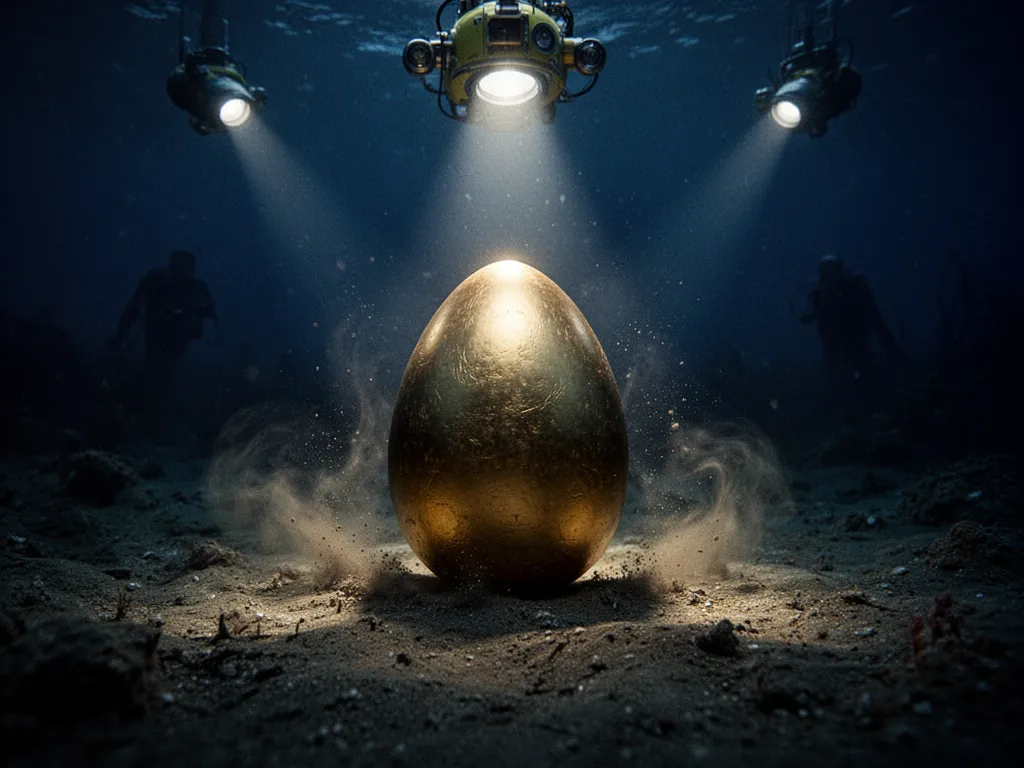
The Mystery of the Strange Deep-Sea Golden Egg is Finally Solved
After years of speculation regarding a strange, golden object found in the deep sea, researchers have uncovered the truth. Discover the fascinating biological reality behind this enigmatic deep-sea phenomenon and what it means for marine science.
The Mystery of the Golden Orb Found Miles Beneath the Pacific
In the crushing darkness of the deep ocean, where sunlight has never reached and pressure would crush a human instantly, a remotely operated vehicle gliding two miles below the surface off the Alaskan coast captured something that would baffle scientists for nearly two years. A smooth, golden sphere resting on the seabed—about the size of a softball, glowing faintly amber against the black sediment like a misplaced egg from some impossible creature.
The discovery came during a 2023 expedition by the National Oceanic and Atmospheric Administration, part of an ongoing effort to map and understand the least-explored environment on Earth. The object was unlike anything the team had encountered. Its surface appeared thin and membranous, almost skin-like, with a strange slit or opening that immediately sparked speculation. "Something tried to get in... or to get out," one researcher noted at the time, capturing the eerie ambiguity that would define the mystery.
For months, the specimen sat in laboratory storage, defying classification. Routine analysis failed. Genetic sequencing produced ambiguous results. The orb resisted the standard protocols that marine biologists use to categorize deep-sea finds, forcing researchers to assemble an interdisciplinary team spanning morphology, genetics, bioinformatics, and deep-sea ecology.
"We work on hundreds of different samples," explained Allen Collins, a zoologist directing the NOAA Fisheries' National Systematics Laboratory. "I suspected that our routine processes would clarify the mystery. But this turned into a special case that required focused efforts and expertise of several different individuals."
The breakthrough came through painstaking cross-referencing of the orb's cellular structure and genetic markers with known deep-sea species. The answer, when it finally arrived, was both scientifically fascinating and unexpectedly mundane: the golden orb was not an egg at all, but a mass of dead cells shed from the base of Relicanthus daphneae, a giant deep-sea anemone that anchors itself to the ocean floor and can grow to impressive sizes.
These anemones, adapted to the extreme pressures and frigid temperatures of the abyssal zone, occasionally slough off cellular material that becomes sealed in a tough, keratin-like membrane. Over time, this biological debris hardens into the smooth, egg-like formations that had so perplexed the research team. The slit that suggested something had emerged or entered was likely the natural point where the tissue detached from the anemone's stalk.
The case highlights how much of the deep ocean remains genuinely unknown to science. More than eighty percent of the seafloor is unmapped, and new species are discovered on virtually every expedition. Yet even when something appears utterly alien, it often traces back to life forms we are only beginning to understand—creatures that have evolved in isolation for millions of years, developing biological processes that look like something from another world.
For the researchers involved, solving the mystery of the golden orb was less a conclusion than a reminder. The deep sea still holds countless objects, phenomena, and organisms that will defy immediate explanation. Some will remain mysteries far longer than two years. And a few, perhaps, may never be solved at all.