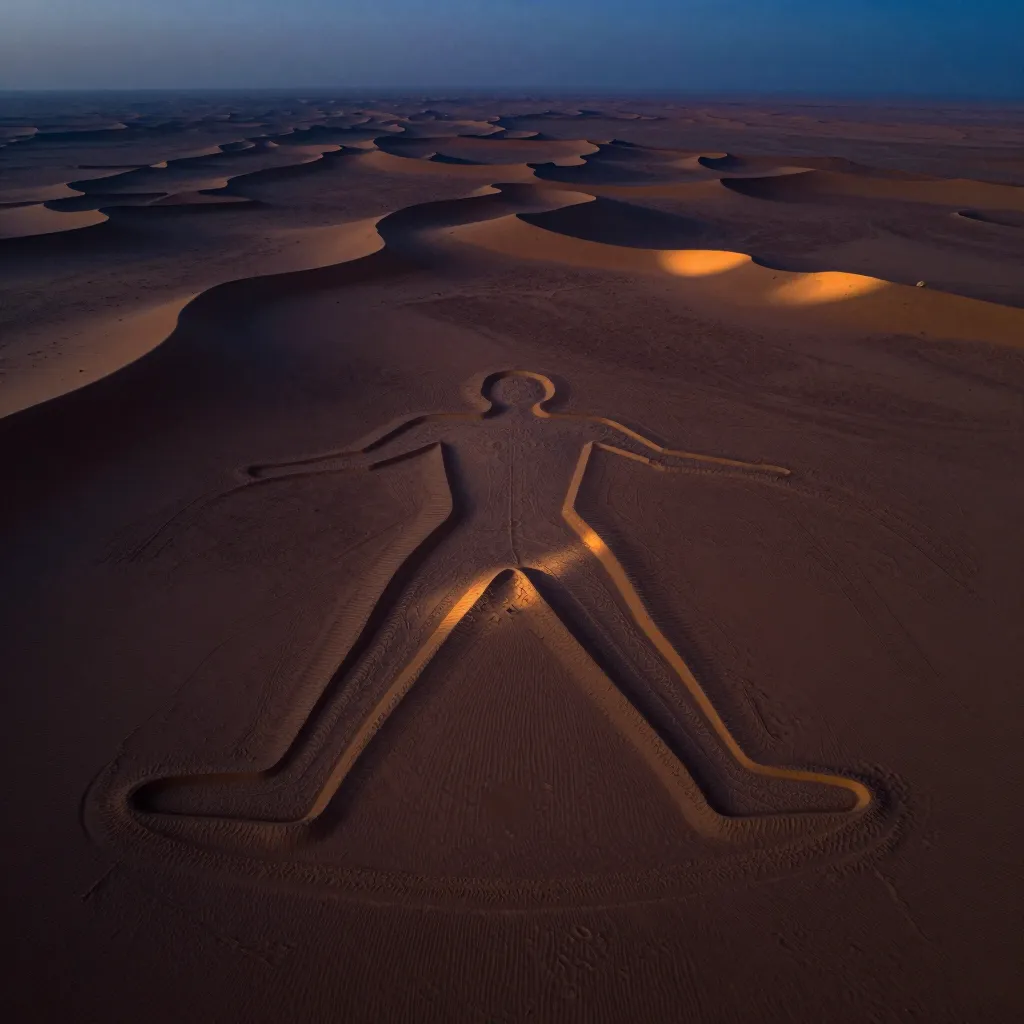
The Mysterious Marree Man: Australia's 4km Desert Giant Nobody Claimed
Deep in South Australia's desert, a 4.2km human figure materialized overnight in 1998 with no tire tracks or witnesses. Anonymous letters, an American flag, and references to the Waco siege only deepened the mystery. Despite police investigations, no creator ever came forward, making the Marree Man one of the world's most haunting unsolved enigmas.
The Marree Man: Australia's Enigmatic Desert Giant
Deep in the sun-scorched expanse of South Australia's outback, where the horizon stretches into eternity and silence is the only constant, lies one of the most perplexing modern mysteries on Earth. Carved into the arid earth near the remote township of Marree, a colossal figure stands as a silent sentinel over a landscape that keeps its secrets well. This is the Marree Man—a geoglyph so vast it can be seen from orbit, yet so enigmatic that no one has ever stepped forward to claim its creation.
Discovery from the Sky
On June 26, 1998, charter pilot Trevor Wright was navigating the skies between Marree and Coober Pedy when something extraordinary caught his eye. Below him, etched into the ochre desert floor, was the unmistakable outline of a human figure—a hunter, poised with a throwing stick, captured in a moment of ancient motion. The figure measured an astonishing 4.2 kilometers in height, with a perimeter spanning 15 by 28 kilometers. The lines were up to 35 meters wide and carved approximately 30 centimeters deep into the earth.
What made this discovery truly remarkable was not merely the scale, but the impossibility of its construction. Surveyors estimated that creating such a monument would have required heavy machinery—likely a bulldozer—and weeks of labor under the relentless outback sun. Yet in a region where the nearest settlement housed barely sixty souls, where every vehicle raises a dust trail visible for miles, no one had seen or heard anything. No tire tracks led to the site. No footprints marked the ground. A thorough police investigation yielded nothing but questions.
Cryptic Messages from the Void
In the weeks following the discovery, anonymous press releases began arriving at media outlets, each one deepening the mystery rather than illuminating it. The letters contained peculiar inconsistencies that suggested a foreign hand: measurements were given in imperial units—miles, yards, and inches—despite Australia's exclusive use of the metric system. The text referenced the "Queensland Barrier Reef" and "local Indigenous Territories," phrases that rang hollow to Australian ears, sounding more like translations from a distant observer than local knowledge.
At the site itself, investigators discovered a small pit containing objects that seemed deliberately placed to confound. A satellite photograph of the completed geoglyph lay alongside a jar holding a small American flag. Most unsettling was a note referencing the Branch Davidians, the cult whose compound near Waco, Texas, had been raided in 1993, resulting in the deaths of David Koresh and eighty-two followers. The connection between a Texas cult and an Australian desert remained, and remains, utterly inexplicable.
Months later, in January 1999, officials found a plaque buried near the figure's nose: an American flag imprinted with the Olympic rings and a passage from H.H. Finlayson's The Red Centre: "In honour of the land they once knew. His attainments in these pursuits are extraordinary; a constant source of wonderment and admiration." The quote described Aboriginal hunters using throwing sticks to hunt wallabies—imagery that mirrored the geoglyph itself. Whether these clues represented genuine breadcrumbs or elaborate misdirection, no one could determine.
Theories in the Dust
The isolated community of Marree buzzed with speculation. Some locals suspected a nearby scenic flight operator had orchestrated the creation as an elaborate tourism stunt—and indeed, charter planes soon found themselves booked solid with passengers eager to witness the desert giant from above. Others whispered of extraterrestrial involvement, or suggested the figure served as a pointed message to politician Pauline Hanson regarding her controversial statements about Aboriginal Australians.
The most compelling theory pointed to Bardius Goldberg, an Australian artist who had reportedly expressed fascination with creating artwork visible from space. When questioned, Goldberg neither confirmed nor denied his involvement. He took whatever truth he possessed to his grave, leaving the theory forever unproven.
Fading Lines, Enduring Mystery
For years, the Marree Man stood as an unlikely icon, drawing the curious to a region few would otherwise visit. But the outback is patient and unforgiving. Natural erosion slowly wore away the carved lines, and by 2013, NASA's Landsat 8 satellite could barely discern the figure's outline. The secret of its birth seemed destined to vanish with the geoglyph itself.
In response, locals launched a preservation effort. Over five days, workers used GPS coordinates and a construction grader to carve new wind grooves into the ancient lines. The hope is that vegetation will eventually grow within these furrows, transforming the Marree Man from a figure of carved earth into a living green giant—an enduring mystery written not in stone, but in life itself.
Today, the figure remains inaccessible to the general public, resting on Native Title lands that predate and outlast its brief existence. Whether the work of an anonymous artist, a collective prank, or something stranger still, the Marree Man continues to watch over the desert in silence—a modern enigma carved into ancient land, reminding us that even in an age of surveillance and satellites, some mysteries remain stubbornly, beautifully unsolved.