The 1996 Everest Disaster: How a Dream Became a Chilling Survival Struggle
Explore the gripping account of the 1996 Mount Everest tragedy, where commercial expeditions faced a catastrophic blizzard. Discover how bottlenecks, oxygen deprivation, and a sudden storm turned the world's highest peak into a site of unprecedented loss and haunting survival stories.
The Cataclysm on Everest: Unraveling the Mysteries of the 1996 Disaster
The Himalayas hold secrets veiled in ancient ice and formidable peaks, none more captivating and perilous than Mount Everest. For decades, its summit stood as an elusive dream, conquered only by the most skilled and audacious mountaineers. Yet, in May 1996, the world's highest mountain unveiled its chilling, untamed power in a tragedy that would forever alter the perception of high-altitude climbing and leave an indelible mark on those who survived its wrath. This fateful event, which claimed eight lives in a single 24-hour period, stands as a stark testament to the mountain's raw might and the fine line between triumph and terror in the "Death Zone."
Everest's Shifting Landscape: From Exploration to Expeditions
Before the mid-1980s, scaling Everest was an endeavor reserved for elite alpinists, often part of national expeditions. Edmund Hillary and Tenzing Norgay's historic first ascent in 1953 inaugurated an era of heroic exploration. However, the discovery of the "Yak Route" up the mountain's southeast ridge introduced a less technical, though still incredibly dangerous, path to the summit. This, coupled with the successful guided ascent of a wealthy amateur in 1985, marked a pivotal shift. The allure of Everest began to transform, opening its frozen gates to commercial ventures.
Suddenly, the once-unthinkable feat became a purchasable dream for individuals with sufficient wealth and determination. Commercial guiding companies emerged, promising to shepherd paying clients to the roof of the world. While this democratized access to the formidable peak, it also introduced unprecedented challenges: overcrowding and an increasing number of less-experienced climbers reliant on their guides.
The Perilous Crowds: Bottlenecks in the Death Zone
Mount Everest's summit is accessible only during a narrow weather window in May, just before the monsoon season descends. This brief calm offers a crucial opportunity, but it also creates a perilous bottleneck. In 1996, a significant number of expeditions converged, with multiple teams aiming for the summit on the same day. This congestion, particularly at critical points like the Hillary Step, resulted in dangerous delays.
Climbers found themselves queuing at altitudes exceeding 28,000 feet, burning precious oxygen and energy while exposed to the elements. This region, famously dubbed the "Death Zone" (above 26,000 feet or 8,000 meters), is an environment where the human body begins to shut down. The air contains only a third of the oxygen found at sea level, leading to impaired judgment, extreme fatigue, and the onset of cerebral or pulmonary edema. Every minute spent here is a gamble against time and the body's diminishing capacity for survival.
Seasoned guides, like Rob Hall of Adventure Consultants and Scott Fischer of Mountain Madness, who led many of the climbers in 1996, understood the critical importance of a "turnaround time." This strict deadline dictated that climbers must abandon their summit push and begin their descent by a certain hour, regardless of their proximity to the peak. Disregarding this rule meant risking running out of oxygen, succumbing to exhaustion, or being caught in Everest's notoriously unpredictable weather. Yet, the fervent desire to reach the summit, after months of preparation and immense financial investment, often overrides rational judgment in these extreme conditions.
May 10, 1996: A Storm Descends
On the evening of May 9, 1996, three expeditions, including those led by Hall and Fischer, set out from Camp IV on the South Col for their final summit push. The initial hours of May 10 dawned clear, fostering a false sense of security. However, as the morning progressed, critical delays plagued the ascent. Fixed ropes were not in place at crucial sections, forcing climbers to wait and expend valuable energy and oxygen. Many climbers reached the summit far later than the planned 2 p.m. turnaround time, some as late as 3:30 p.m.
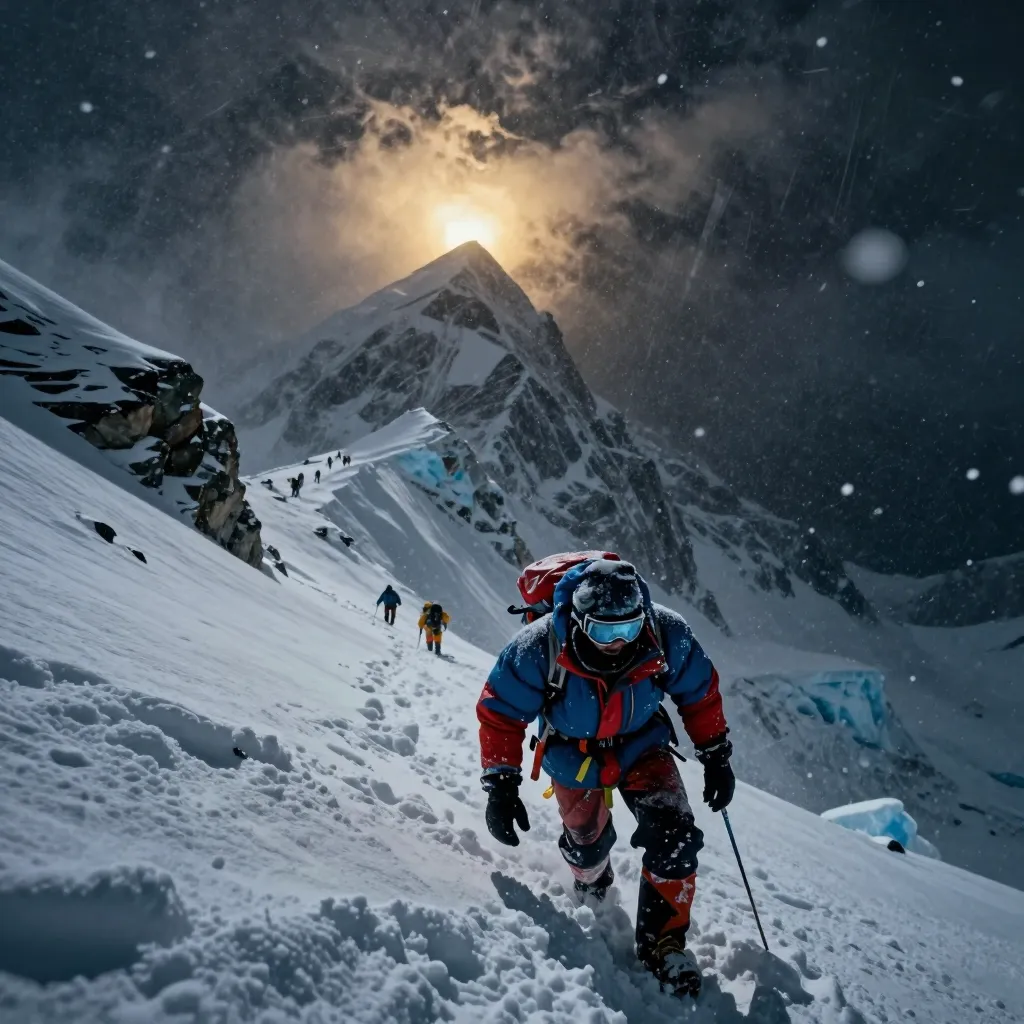
As the afternoon wore on, a colossal storm front, seemingly appearing from nowhere, swept over the mountain. What began as light snow rapidly escalated into a ferocious blizzard with hurricane-force winds and near-zero visibility. Climbers, already exhausted and oxygen-deprived from their delayed ascent and time in the Death Zone, found themselves disoriented and fighting for survival against an invisible, brutal foe.
The descent became a desperate struggle. Oxygen tanks ran empty, and the icy winds stripped away all sense of direction. Small groups became separated, their movements agonizingly slow. In the ensuing chaos, tragic decisions were made under duress. Climbers, suffering from extreme frostbite and delirium, were abandoned or tragically lost. Rob Hall, a leader known for his unwavering commitment to his clients, made the fateful decision to stay with a struggling client, Doug Hansen, well past the point of no return. Hall ultimately succumbed to the mountain, his final radio contact with his pregnant wife back home a heartbreaking testament to his agonizing final hours. Scott Fischer also perished, succumbing to hypothermia and exhaustion after being caught in the storm.
Aftermath and Lingering Questions
The 1996 disaster resulted in the deaths of eight climbers from various expeditions across May 10th and 11th. The harrowing details, meticulously chronicled by journalist and survivor Jon Krakauer in his book Into Thin Air, ignited intense debate within the climbing community. Different survivors offered varying accounts, highlighting the profound impact of altitude sickness on memory and perception.
This tragedy served as a grim reminder of Everest's unrelenting power and the inherent risks of its increasing commercialization. While the 1996 event remains the single deadliest day for climbers from commercial expeditions, Everest has witnessed other devastating incidents. In 2014, an avalanche claimed 16 Sherpa lives in the treacherous Khumbu Icefall. A year later, a catastrophic 7.8-magnitude earthquake in Nepal triggered another avalanche at Everest Base Camp, killing 22 people, predominantly Sherpas who bear the brunt of the mountain's dangers.
The disaster of 1996, and those that followed, forced a re-evaluation of safety protocols, guide responsibilities, and the ethical considerations of commercial climbing. The mountain remains a magnet for dreamers, but its dark, chilling history serves as a permanent warning that even with modern equipment and expert guidance, Everest is the ultimate arbiter, its mysteries and dangers ever-present.