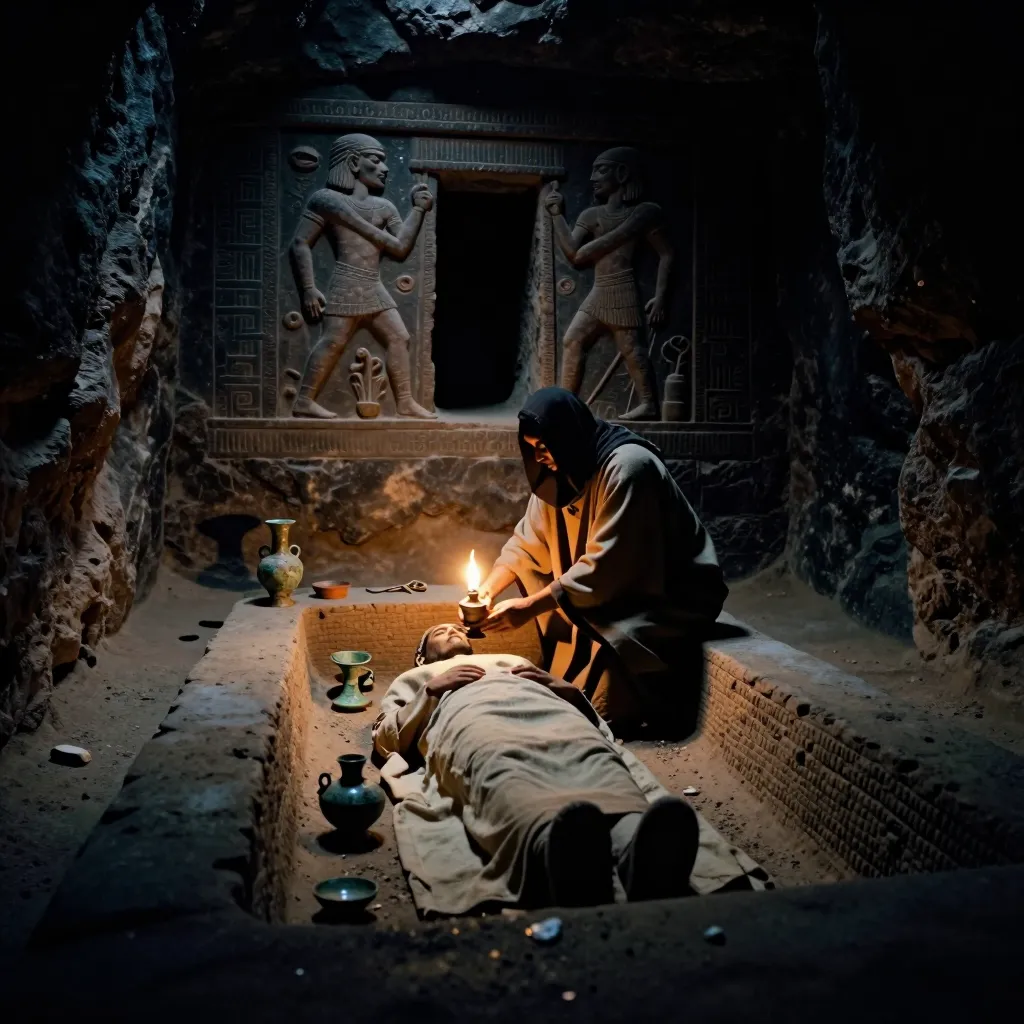
The Gatekeepers of Irkalla: Ancient Mesopotamian Burial and the Restless Dead
In ancient Mesopotamia, burial was a spiritual necessity to keep the restless dead in the underworld. Explore the rituals, from floorboard graves to offerings for Ereshkigal, that ensured spirits didn't return to terrorize the living. Perfect for mythology and history enthusiasts.
The Gatekeepers of Irkalla: Mesopotamian Burial and the Fear of the Restless Dead
[cite_start]In the ancient cradle of civilization, the boundary between the living and the dead was thin, porous, and fraught with spiritual peril[cite: 4, 113]. [cite_start]To the inhabitants of ancient Mesopotamia, the primary purpose of burial was not sanitation or grief, but the critical task of ensuring a soul reached the underworld—and stayed there[cite: 1, 2, 26]. [cite_start]Improper rites didn't just disrespect the deceased; they created a bridge for the restless spirit to return and haunt the living[cite: 1, 13, 115].
The Architecture of the Spirit
[cite_start]According to Babylonian mythology, such as the Atrahasis epic, humans were forged from a divine blueprint: a mixture of earthly clay and the immortal spirit of the sacrificed god We-Ilu[cite: 16, 17, 18]. [cite_start]While the physical body would eventually decay back into the earth, the spirit—known as the gidim in Sumerian or etemmu in Akkadian—remained eternal[cite: 18, 23].
[cite_start]Upon death, this intelligence separated from the body and instinctively sought to return to its origin[cite: 24]. [cite_start]Since the gods resided in the heavens, the spirit's natural inclination was to move upward[cite: 24]. [cite_start]However, the celestial realm was strictly off-limits to mortal souls[cite: 25]. [cite_start]To prevent unwanted spiritual intruders, the gods established Irkalla, a subterranean realm of no return[cite: 25]. [cite_start]Burial served as the essential directional guide, anchoring the soul and pointing it toward its proper place in the depths[cite: 26].
Rites for the Departed
The process of ushering a soul into the afterlife was a meticulous family responsibility.
- [cite_start]The Deathbed Vigil: As death approached, loved ones and often a priest gathered[cite: 30]. [cite_start]An empty chair was placed to the left of the bed, reserved for the spirit as it rose from the corpse[cite: 31].
- [cite_start]Spiritual Sustenance: Offerings of beer and flat bread were placed near the chair to provide the soul with the strength needed for its arduous journey[cite: 31].
- [cite_start]Preparation of the Body: The deceased was washed, anointed with perfumed oils, and dressed in fine clothing and jewelry[cite: 32].
- [cite_start]The Descent: Water and food were sometimes poured directly onto the ground or offered to the corpse, providing the spirit with drink as it "lost its wind" and descended toward the "Mountain"—the entrance to the underworld[cite: 28, 35, 38].
[cite_start]Cremation was largely avoided across Sumerian city-states[cite: 27]. [cite_start]It was believed that destroying the body robbed the spirit of its form in the afterlife, and the rising smoke might mistakenly carry the soul upward toward the gods rather than down to Irkalla[cite: 27].
Graves Beneath the Floorboards
The geography of burial was intimate. [cite_start]In many Mesopotamian households, the dead were interred directly beneath the floors of the family home[cite: 81]. [cite_start]This practice allowed the living to easily tend to the deceased with regular offerings of food and drink, ensuring the spirit remained satisfied and anchored[cite: 81].
| Burial Type | Characteristics |
|---|---|
| Pit Burial | [cite_start]The body was wrapped in a reed mat and placed in a simple hole under the floor[cite: 82, 93]. |
| Jar Burial | [cite_start]One or two large ceramic jars were used to house the corpse, often lidded and sealed[cite: 82]. |
| Sarcophagus | [cite_start]Typically made of ceramic, these often took a "bathtub" shape[cite: 83, 84]. |
| Wall Burial | [cite_start]A practice specifically reserved for infants and children[cite: 82]. |
The Gray Realm of Ereshkigal
[cite_start]The Mesopotamian afterlife was not a paradise for the virtuous or a hell for the wicked[cite: 96]. [cite_start]Instead, it was a dim, egalitarian prison presided over by the goddess Ereshkigal and her consort Nergal[cite: 14, 96]. [cite_start]In this gray world, kings and farmers alike sat listlessly for eternity, said to "eat dust" and drink from puddles[cite: 14, 96, 103].
[cite_start]Even legendary figures like Ur-Nammu or Gilgamesh found the afterlife to be a place of despair[cite: 103, 104]. [cite_start]The only factor that improved a spirit's status was the number of sons they left behind to honor them[cite: 98, 100]. [cite_start]A man with seven sons might sit upon a throne as a companion to the gods, while one with only one son would weep in his loneliness[cite: 101].
The Return of the Dissatisfied
When burial traditions failed, the consequences were terrifying. [cite_start]A "restless spirit" deprived of proper rites or food offerings would seek to escape the twilight of Irkalla[cite: 13, 14]. [cite_start]Ereshkigal herself might grant a soul a "leave of absence" to haunt and terrorize its relatives until they fulfilled their duties[cite: 15, 113].
[cite_start]Common hauntings included the "Let Me Enter" ghosts, who begged the living to eat, drink, or dress with them[cite: 110, 112]. [cite_start]To combat these troublesome entities, an asipu (exorcist) would recite specific spells to banish the spirit back to the underworld[cite: 111, 112]. [cite_start]Ultimately, for the ancient Mesopotamian, the quality of eternity depended not on how one lived, but on how carefully the living tended to the grave[cite: 119].