Majestic-12 Documents: Could the Infamous UFO Papers Have Been Real?
For decades, the Majestic-12 papers were dismissed as an elaborate hoax. But fresh 2026 forensic analysis comparing administrative markings to authentic CIA case files from the 1940s-50s suggests these infamous UFO documents may have originated from within the intelligence community itself.
The Majestic-12 Documents: A Cold Case Reopened
For decades, the name Majestic-12 has hovered at the edge of UFO lore like a half-remembered nightmare—familiar enough to send a chill down the spine of any serious researcher, yet elusive enough to remain firmly in the realm of speculation. The concept of a clandestine government cabal assembled specifically to investigate extraterrestrial contact sounds like the plot of a pulp science fiction novel. Yet the documents that first surfaced in the 1980s continue to generate debate, and recent developments suggest this particular cold case may not be as closed as the FBI once claimed.
The Genesis of a Conspiracy
The Majestic-12 narrative centers on a supposed secret committee established by President Harry S. Truman in 1947—the same year as the infamous Roswell incident. According to the documents that emerged nearly four decades later, this elite group comprised high-ranking military officials, intelligence operatives, and civilian scientists tasked with managing the government's most sensitive extraterrestrial research.
When these papers first circulated among UFO researchers in the 1980s, they appeared to offer the smoking gun that the disclosure movement had been seeking: official government documentation acknowledging the reality of alien visitation. The materials included briefing documents, memoranda, and administrative records that seemed to substantiate the existence of a deeply classified program operating beyond congressional oversight.
The Federal Bureau of Investigation ultimately dismissed the documents as fraudulent, and mainstream academic and journalistic institutions largely followed suit. The Majestic-12 papers were consigned to the dustbin of debunked conspiracy theories—or so it seemed.
The Resurrection of Evidence
In early 2026, fresh claims emerged that threaten to destabilize the established narrative of hoax and debunking. An independent investigator—who has chosen to remain anonymous, adding another layer of mystery to an already murky subject—has reportedly identified correlations between administrative markings on the original Majestic-12 documents and authentic CIA case files from the 1940s and 1950s.
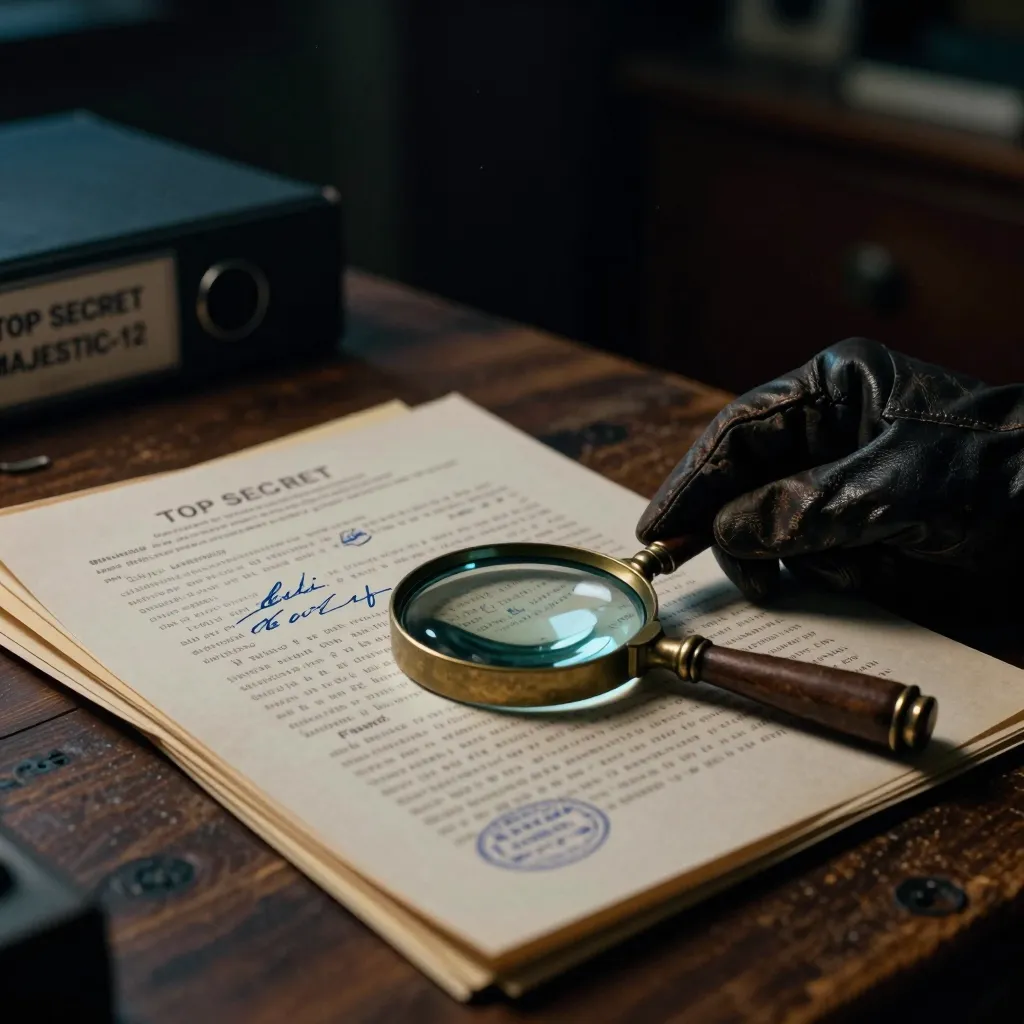
The specific points of convergence are file numbers and bureaucratic stamps—mundane details that carry disproportionate weight in document authentication. These are not the dramatic revelations of alien bodies or crashed spacecraft that typically fuel UFO mythology. Rather, they are the bread crumbs of institutional process: serial numbers, classification markings, and procedural notations that would be extraordinarily difficult to fabricate with period-accurate precision.
The investigator's methodology reportedly involved cross-referencing the Majestic-12 materials against CIA documents that have been declassified and released through official channels in the intervening decades. The resulting matches, if verified, would suggest that whoever created the Majestic-12 papers had access to genuine internal CIA administrative protocols—or that the documents themselves originated from within the intelligence community's actual workflow.
The Authentication Problem
The anonymous nature of this new research introduces a significant complication. In the world of document forensics, chain of custody and researcher credibility are nearly as important as the evidence itself. Without a named investigator willing to stand behind their methodology and submit to peer review, the findings remain tantalizing but unverifiable.
Ryan Wood, a researcher known for his extensive work on the Majestic-12 file corpus, has lent his support to the investigation's credibility. Wood, who provided the original 1980s documents for analysis, has described the research as methodologically sound and historically grounded. Yet even sympathetic observers acknowledge that matching file numbers and stamps, while suggestive, do not constitute definitive proof of the documents' substantive claims.
Administrative markings can be copied, templates can be reconstructed, and sophisticated forgers have historically demonstrated remarkable skill in mimicking official documentation. The presence of authentic-looking bureaucratic artifacts proves only that the documents look official—not that they are official, nor that their extraordinary claims about extraterrestrial contact are true.
The Persistence of the Mystery
What makes the Majestic-12 case particularly fascinating within the broader landscape of unsolved mysteries is its resistance to clean resolution. Most debunked conspiracy theories collapse under scrutiny; most genuine historical revelations eventually find corroboration. Majestic-12 occupies the uncomfortable middle ground where the evidence is too ambiguous to confirm and too specific to fully dismiss.
The documents' continued relevance speaks to a deeper cultural anxiety about government transparency and the unknown. The Cold War era that produced the original materials was defined by classified programs, hidden budgets, and institutional secrecy on an unprecedented scale. In that context, the idea of a Majestic-12 committee feels less like science fiction and more like a logical extension of the national security state's existing architecture.
Whether the 2026 revelations represent a genuine breakthrough or another false dawn in a decades-long investigation remains to be seen. The correlation between administrative markings across different document sets is undeniably intriguing, but it is not conclusive. What it does provide is a reason to keep looking—to continue the forensic examination of materials that have been dismissed too quickly by some and accepted too readily by others.
In the taxonomy of unsolved mysteries, Majestic-12 remains a case where the evidence is fragmentary, the witnesses are either anonymous or deceased, and the truth—if there is a single truth to be found—lies buried beneath layers of classification, speculation, and the passage of nearly eighty years. For researchers and the curious alike, that ambiguity may be the most compelling aspect of all.