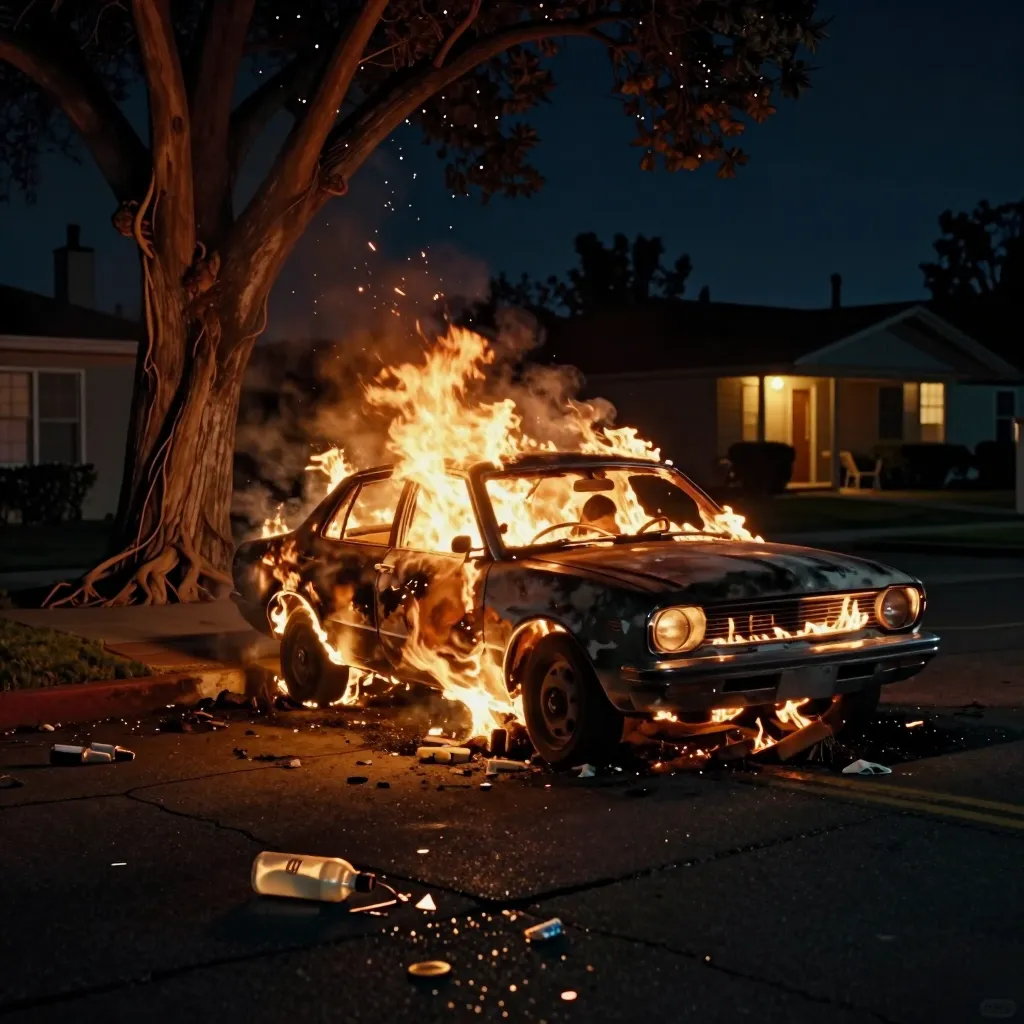
The Banyan Street Tragedy: Lucille Miller’s Infamous California Murder Trial
When Cork Miller was found charred in a Volkswagen Beetle, his wife Lucille claimed it was a tragic accident. However, a gas can in the back seat and a suspicious route through California's orange groves led investigators to suspect a cold and calculated murder.
The Banyan Street Tragedy: A Midnight Drive into Infamy
On the night of October 7, 1964, a Volkswagen Beetle swerved off a quiet road in California’s San Bernardino County and ignited into a localized inferno. What appeared at first glance to be a tragic roadside accident soon spiraled into one of the state's most scrutinized murder trials. The death of Cork Miller, a husband and father found charred in the passenger seat, would haunt his family and the public for decades, leaving behind a trail of unanswered questions and forensic anomalies.
The Midnight Run for Milk
The events began with a seemingly mundane domestic request. According to Lucille Miller, Cork’s wife, her husband had asked for a cup of hot chocolate late that night. Realizing the household was low on milk, and despite a self-professed fear of the dark and poor night vision, Lucille agreed to drive to a nearby store. Cork, who had been feeling unwell and was wrapped in a blanket, accompanied her, curling up on the passenger side and falling asleep.
Lucille’s account of the drive was marked by several peculiar decisions that would later be dissected in a courtroom:
- The Route: Instead of her usual path, Lucille turned onto Banyan Street—a road that, unlike the surrounding neighborhood, was unlit and pitch-black.
- The Sight: Lucille frequently wore sunglasses at night instead of prescription glasses, a habit she attributed to vanity, which further complicated her ability to navigate the darkened groves.
- The Security: Lucille claimed she locked the passenger door from the outside before starting the car, ostensibly to keep the sleeping Cork from falling out against the steep driveway.
A Sudden Blaze in the Orange Groves
As the car traveled along Banyan Street, Lucille claimed the vehicle suddenly lurched toward a berm separating the road from the parallel orange groves. Simultaneously, the back seat reportedly erupted in flames. Lucille leaped from the moving car, her hair singeing as she escaped.
When she turned back, the car was fully engulfed. She rushed to the passenger side, but the door handle was too hot to touch, and the lock she had engaged earlier now served as a barrier. In a state of panic, Lucille allegedly searched the groves for a branch or a rock to break the glass, but her efforts were futile. She eventually ran toward a nearby farmhouse, screaming for help and claiming her husband was burning alive.
The Investigation Begins
The response to the fire raised immediate red flags for law enforcement. When Lucille reached the home of a local resident, Mrs. Swenson, she didn't ask to call the police first. Instead, she requested a call to Harold Lance, a friend from their church who also happened to be a lawyer. This distinction—whether she called a friend or legal counsel—became a focal point of the prosecution's narrative.
When authorities arrived at the scene on Banyan Street, they found the Volkswagen still smoldering. Cork Miller’s remains were found slumped against the passenger window, burnt beyond recognition. However, the physical evidence at the scene did not align with a standard automotive accident:
- The Fuel Source: Investigators found an empty, blackened gas can lying on its side in the back seat of the car.
- Mechanical Integrity: The gasoline tank had not ruptured, leaving the source of the rapid, intense fire a mystery.
- Positioning: The car’s parking lights were on, and its position relative to the embankment seemed inconsistent with a high-speed swerve or a mechanical failure.
Legal Maneuvers and Dark Suspicions
By 2:00 a.m. the following morning, homicide detectives were already on-site. Harold Lance and his brother, Bud (a criminal attorney), arrived to represent Lucille, sensing that the police were already forming a theory of foul play. The investigators grew frustrated with the presence of the lawyers, who prevented the police from questioning a distraught Lucille in the immediate aftermath of the fire.
To the detectives, the scenario felt staged. They questioned why a woman would not crawl through flames to save her husband and why a routine trip for milk ended in a remote orange grove with a gas can in the back seat. While Lucille maintained her innocence, claiming a tragic series of events led to the fire, the San Bernardino County Sheriff’s Department was already preparing a case that would paint her not as a grieving widow, but as a calculated architect of murder.