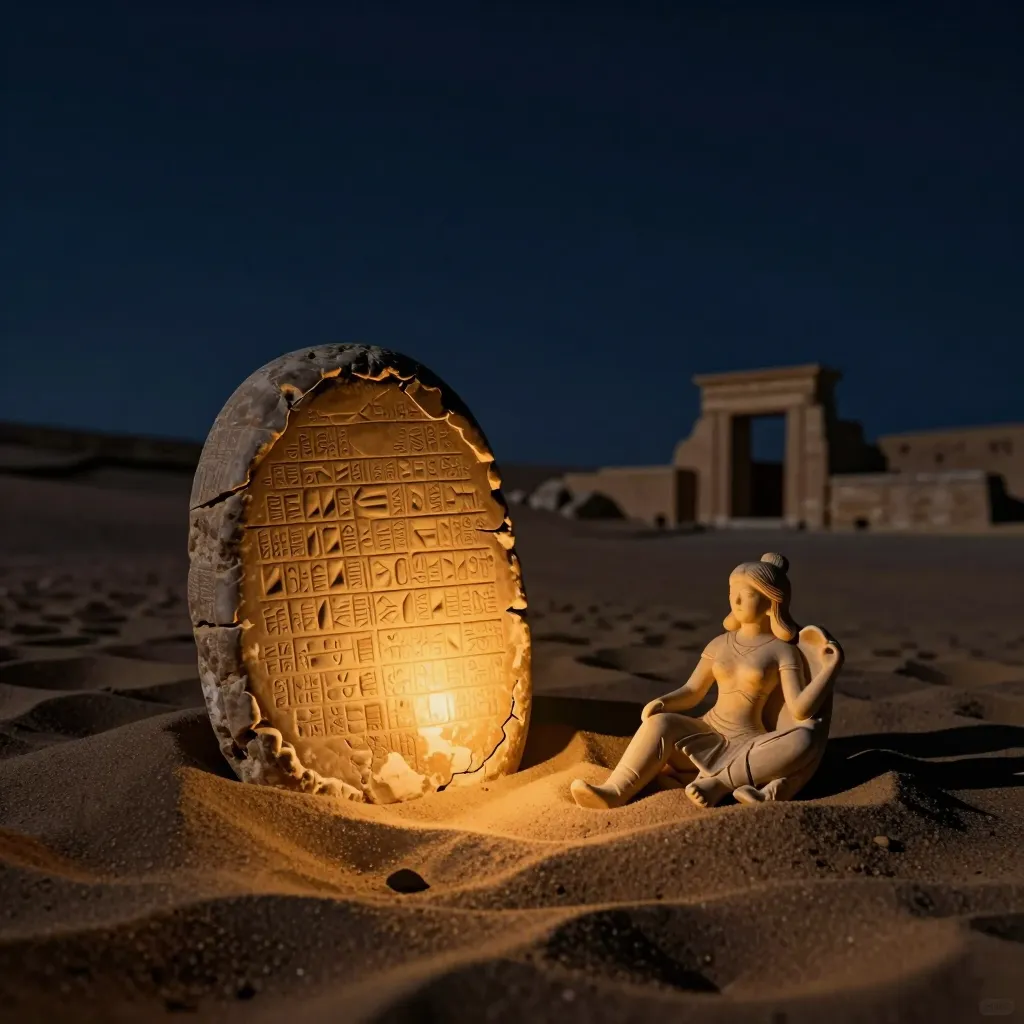
Love, Law, and the Looming Shadow: Marriage in Ancient Mesopotamia
Explore the brutal pragmatism of ancient Mesopotamian marriage systems where love was treated as a terminal sickness, unions functioned as property transactions, and Code of Hammurabi prescribed death for adultery, and women navigated complex hierarchies as wives, concubines, or runaways. Discover how cuneiform tablets reveal both the cold machinery of social reproduction and the persistent human hunger for genuine connection.
Love, Law, and the Looming Shadow of the River: Marriage in Ancient Mesopotamia
In the cradle of civilization, where the Tigris and Euphrates carved pathways through the dust of history, human hearts beat with the same desperate longing that pulses through us today. The people of ancient Mesopotamia—Sumerians, Babylonians, Assyrians—left behind clay tablets that whisper of romantic obsession, contractual obligation, and the eternal tension between passion and social order. Their world was one where love could be diagnosed as a terminal illness, where marriage operated as a legal covenant between families, and where the punishment for infidelity might end with bodies sinking into the dark waters of the Euphrates.
The Sickness That Had No Cure
Among the thousands of cuneiform tablets discovered in the ruins of Nineveh, particularly within the famed Library of Ashurbanipal, medical texts prescribed remedies for fevers, wounds, and demonic possession. Yet one affliction remained beyond the reach of priest or physician: lovesickness.
A diagnostic passage describes the symptoms with unsettling precision—the patient who clears his throat constantly, who loses his words mid-sentence, who mutters to himself in empty fields and laughs without cause in the corners of farmland. The lovesick sufferer finds no pleasure in bread or beer, clutches at a tightening throat, and exhales great sighs while repeating the same lament: "Ah, my poor heart!" The text notes, with clinical detachment, that this malady strikes men and women alike, offering no remedy, no incantation, no herbal poultice to ease the wound.
This was not mere poetic flourish. In a civilization that systematized virtually every aspect of human experience—from tax collection to divination—the acknowledgment that romantic passion could overwhelm rational behavior suggests how deeply the Mesopotamians understood the disruptive power of desire. Love, in their cosmology, was something that could unmake the social order as surely as any invading army.
The Business of Bloodlines
Against this chaotic force, Mesopotamian society erected elaborate institutional frameworks. Marriage was never simply a private matter between two individuals. It functioned as a legal contract, a property transaction, and a mechanism for ensuring communal continuity. The Sumerian language itself encoded this pragmatism: their word for "love" literally translated to "measuring the earth"—the act of marking boundaries, claiming territory, establishing order upon the wild.
The process of marriage followed a rigid sequence of five stages, each essential for legal validity:
- The contractual negotiation between family representatives, not the prospective spouses
- Exchange of value—the bride price flowing to the bride's family, the dowry accompanying the woman to her new household
- The ceremonial feast, without which no union was recognized
- The bride's relocation to her father-in-law's domain
- Consummation and conception, with virginity expected and pregnancy soon to follow
Failure at any stage rendered the marriage void. A non-virgin bride could be returned to her family. An infertile wife faced replacement by concubines. The system was designed not for personal fulfillment but for what the ancients called destiny—the continuation of the family line, the preservation of property, the stability of the city-state.
The Shadow Market of Brides
Herodotus, the Greek historian who traveled through the Persian Empire in the fifth century BCE, recorded a Babylonian custom that modern readers find particularly alien: the annual bride auction. Each year, eligible young women were assembled in village squares while men formed bidding circles around them. The herald began with the most beautiful, selling her to the highest bidder among the wealthy. As the auction progressed through ranks of diminishing beauty, the prices dropped—but the "compensation" increased. Commoners who accepted less attractive wives received monetary payments from the auction proceeds, creating a redistribution system that ensured even the poor could marry.
Whether this practice was universal or localized, whether it persisted for centuries or faded quickly, remains debated among scholars. What is certain is that the Babylonians recognized marriage as an economic transaction involving the transfer of a woman's reproductive capacity and labor power from one kin group to another. Romance, when it existed, was a secondary consideration—a fortunate accident rather than a prerequisite.
The Code That Bound Them
Hammurabi's famous law code, inscribed in black diorite around 1754 BCE, codified the penalties for marital disruption with characteristic severity. A suitor who broke his engagement forfeited his entire deposit and bride price. A father-in-law who withdrew his daughter from a promised match paid double. If a rival suitor induced such a betrayal, he faced exclusion from marriage entirely—the daughter he sought would be forbidden to him.
These penalties existed because young Mesopotamians, like young people everywhere, resisted parental arrangements. The mythological literature preserves fragments of this rebellion. Inanna, the goddess of love and war, was encouraged to marry Enkimdu, the prosperous farmer-god. Instead, she chose Dumuzi, the shepherd—less wealthy, perhaps, but the object of her desire. One poem captures her sneaking from her mother's house to meet him beneath stars "which sparkled as she did," then panicking as dawn approached, demanding that Dumuzi invent a lie to explain her absence. The suggested alibi—that she had been persuaded by girlfriends to attend music and dance—reveals the ancient origins of excuses that still echo through teenage bedrooms today.
The Architecture of Desire
Mesopotamian sexual culture operated with a frankness that would shock modern sensibilities. Without the Christian inheritance of shame or the Victorian legacy of repression, the ancients approached physical intimacy as they approached cuisine: a natural activity capable of refinement and cultural elevation. Texts reference encounters on rooftop terraces, in orchard fields, on deserted roads, even in city streets—sometimes with prostitutes, sometimes with women "pounced upon" in spontaneous passion.
Homosexual relationships appear in the record without apparent stigma. Men who "preferred to take the female role" are mentioned matter-of-factly. Various positions are catalogued with the precision of technical manuals. Anal intercourse served as a common contraceptive method in a society where pregnancy was generally desired within marriage but potentially problematic outside it.
Yet this openness existed within strict boundaries. Adultery—defined primarily as a married woman's extramarital activity—threatened the paternity certainty essential for inheritance systems. The Code of Hammurabi prescribed drowning for both the adulterous wife and her lover, impalement as an alternative, though the wronged husband could petition the king for mercy if he wished to preserve his wife's life. Male infidelity, by contrast, was punished only when it infringed upon another man's property rights—sleeping with a married woman, not sleeping with an unmarried one.
The Second Wives and the Silent Womb
Childlessness was the great terror of Mesopotamian marriage. A barren wife faced not only personal grief but social delegitimization. The legal and religious systems assumed infertility was always female in origin; the possibility of male sterility never seems to have been entertained. A husband could not divorce a sick wife, but he could add concubines to his household—women selected, sometimes with the first wife's consultation, specifically for their reproductive capacity.
The children of concubines became, legally, the children of the first wife. This system of surrogate motherhood ensured that family lines continued even when biology failed the primary spouse. A man could accumulate multiple concubines according to his resources and desires, though polygamy created complex household hierarchies that must have generated their own tensions and tragedies.
The Escape Into the Unknown
Divorce was possible but perilous, particularly for women. A husband could dissolve the union for infertility, adultery, or neglect of domestic duties, though he would forfeit the dowry and absorb social stigma. A wife seeking divorce faced nearly impossible barriers—she had to prove abuse or neglect conclusively, and even then risked expulsion from the household "penniless and naked."
Yet women did escape. Cuneiform records mention wives who fled their homes repeatedly—two, three, eight times—some returning chastened, others disappearing permanently. These runaways traveled alone to distant cities, establishing new identities, building new lives. The phenomenon was uncommon enough to be noteworthy, common enough to be recorded. It suggests that beneath the rigid legal structures, individual women found paths to autonomy, however dangerous and uncertain.
The Letters From Mari
Not all Mesopotamian marriages were prisons of obligation. The correspondence between Zimri-Lim, king of Mari, and his wife Shiptu reveals a partnership built on mutual trust, political collaboration, and evident affection. They discussed statecraft, shared intelligence, relied upon each other's judgment. Their letters suggest that even within arranged marriages, genuine emotional bonds could develop—companionship carved from the raw material of contractual necessity.
Archaeology offers further testimony. A gypsum statue from 2700 BCE depicts an elderly Sumerian couple seated side by side, their forms fused into a single stone block. His arm encircles her shoulder; their hands clasp; their wide eyes stare forward toward a shared future while their aged faces seem to remember a shared past. The sculptor captured something eternal: the possibility that two people, thrust together by social obligation, might forge something authentic and enduring.
The Descent and Return
The mythological corpus of Mesopotamia, particularly the stories of Inanna, complicates any simple narrative of female subjugation. In The Descent of Inanna, the goddess travels to the underworld and returns transformed, outwitting her sister Ereshkigal and the death god Nergal. In other tales, she manipulates gods and kings with equal facility, exercising sexual autonomy and political power that no mortal woman could claim.
These myths may have functioned as cautionary tales for parents—see what happens when daughters follow their desires?—or as aspirational fantasies for women trapped in arranged marriages. They certainly demonstrate that Mesopotamian culture could imagine female agency in its most extreme forms, even while constraining the actual women who lived within its cities.
The Weight of Continuity
Marriage in ancient Mesopotamia was a technology designed to solve specific problems: the transfer of property between generations, the care of the elderly, the socialization of children, the prevention of chaotic sexuality. It operated with a cold logic that modern readers find unsettling. Yet within this system, individuals found space for poetry and passion, for rebellion and reconciliation, for the same desperate attempts to bridge the gap between human isolation and human connection that occupy us today.
The clay tablets preserve a Sumerian proverb in which a husband boasts that his wife has borne him eight sons and remains eager for his embrace. This is not the voice of contractual obligation. It is the voice of someone who has discovered, against the odds, that the machinery of social reproduction can sometimes generate genuine human warmth.
The Mesopotamians knew that love could destroy. Their medical texts diagnosed it as a fatal disease. Their legal codes structured marriage as a defense against its chaos. But their poems, their letters, and their art suggest they also knew what we know: that the same force which unmakes the social order can also, occasionally, sustain it.