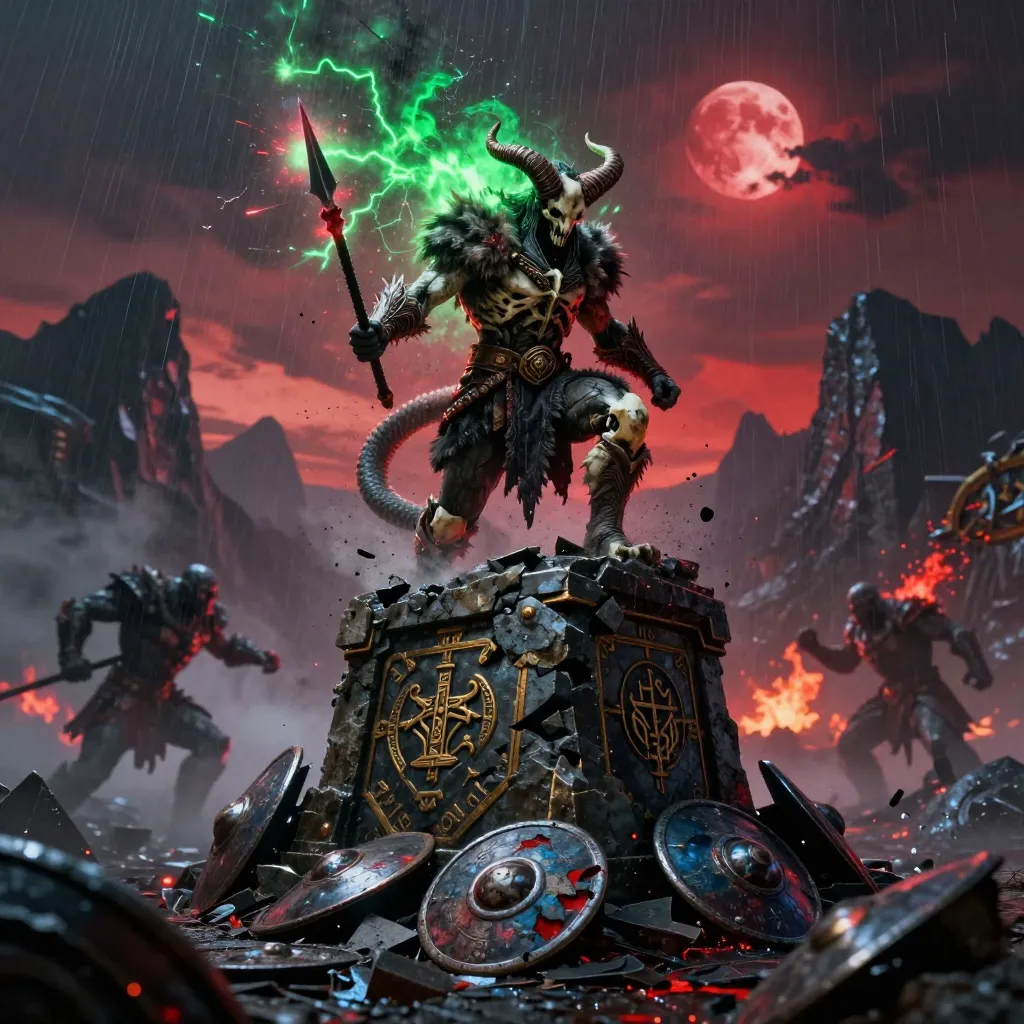
Loki: The Shape-Shifting Trickster Who Doomed the Norse Gods
Loki, a bridge between gods and giants, uses his shapeshifting to both rescue and ruin the Æsir. His acts, from Baldr's death to the binding punishment, directly cause Ragnarök. Despite his absence from worship, his myths embody Norse themes of fate and duality, captivating those who explore ancient folklore.
Loki: The Trickster Who Unraveled the Norse Cosmos
Loki stands as one of the most enigmatic figures in Norse mythology—a shape‑shifter, a catalyst for chaos, and a being whose loyalties shift as easily as his form. Though often counted among the Æsir, his origins lie with the jötnar, and his actions repeatedly tip the delicate balance between order and ruin.
Origins and Family
Loki’s father is the giant Fárbauti (“Cruel Striker”), while his mother is either Laufey or Nál, figures whose exact nature remains obscure in the surviving sources. This ambiguous parentage already marks him as a bridge between gods and giants.
Through his union with the giantess Angrboda, Loki fathers three beings who each embody a different facet of existential threat:
- Hel, ruler of the underworld, who governs those who do not die in battle.
- Jörmungandr, the Midgard Serpent whose coils encircle the world and whose clash with Thor signals the onset of Ragnarök.
- Fenrir, the monstrous wolf destined to slay Odin during the final battle.
With his wife Sigyn, Loki also fathers Nari (or Narfi), a son whose name hints at “corpse,” further underscoring the shadow that trails his lineage.
Shapeshifting and Unusual Parentage
Loki’s mastery of transformation is perhaps most strikingly displayed in the tale of Sleipnir’s birth. To thwart a giant’s claim on the fortification of Asgard, Loki assumes the form of a mare, lures the stallion Svaðilfari, and gives birth to the eight‑legged steed that becomes Odin’s mount. This episode not only highlights his cunning but also reinforces the theme of Loki as both mother and father—an embodiment of fluid identity that defies conventional Norse gender roles.
Agent of Chaos and Unwitting Savior
Many myths portray Loki as the architect of disaster who later feels compelled to amend the havoc he wrought. In the kidnapping of Iðunn, his thoughtless bargain with the giant Þiazi places the goddess of youth in jeopardy; only after the gods threaten his life does he retrieve her, ultimately causing Þiazi’s death.
A similar pattern emerges in the story of Skaði, Þiazi’s daughter, who demands recompense for her father’s slaying. Loki’s bizarre stunt—tying a rope to a goat’s beard and his own testicles—provokes laughter and appeases the goddess, yet the act is undeniably grotesque, underscoring his propensity to resolve crises through absurdity rather than honor.
The Death of Baldr
Loki’s most infamous deed is the orchestration of Baldr’s demise. Upon learning that every entity had sworn not to harm the beloved god—except the seemingly innocuous mistletoe—Loki fashions a spear from the plant, places it in the blind god Höðr’s hand, and guides the fatal throw. Baldr’s death plunges the cosmos into grief and sets in motion the events that culminate in Ragnarök.
When Hermóðr rides Sleipnir to Hel’s realm to plead for Baldr’s return, the goddess stipulates that all beings must weep for the dead god. Every creature complies—except a lone giantess, Þökk, widely interpreted as Loki in disguise. Thus Baldr remains bound to Hel, a direct consequence of Loki’s deceit.
Binding and Punishment
The gods’ retribution is stark: they bind Loki with the entrails of his son Nari, suspending him beneath a serpent that drips venom onto his face. Sigyn catches the poison in a bowl, but whenever she must empty it, the venom lands on Loki, causing him to writhe in agony. These spasms are said to create earthquakes, a vivid illustration of how his torment reverberates through the world.
He remains imprisoned until the onset of Ragnarök, when he breaks free to join the jötnar in their assault on the gods. In the final clash, Loki and Heimdall strike each other down, mutually sealing their fates.
Alternative Traditions
The Danish chronicler Saxo Grammaticus recounts a parallel tale in which Thor encounters a figure named Útgarða‑Loki (“Loki of the Out‑gard”) bound in the same manner as the Icelandic Loki. This duplication suggests that even among pagan Scandinavians, opinions diverged on whether Loki was a god, a giant, or a liminal entity occupying both realms.
The Meaning of “Loki”
Scholars have long debated the etymology of Loki’s name. Recent philological work proposes that the Old Norse term loki denoted a “knot” or “tangle,” akin to the knots in a fishing net. This interpretation aligns with two aspects of his mythos:
- Net‑maker—Loki’s crafting of literal nets and metaphorical schemes that ensnare the gods.
- Cosmic knot—the disruptive twist in an otherwise straight cosmic thread, whose tightening ultimately unravels the divine order.
Absence of Cult
Despite his prominence in myth, no archaeological or textual evidence attests to any historical worship of Loki. His reputation as a betrayer of divine values—honor, loyalty, and bravery—likely rendered him anathema to the communal rites that celebrated the Æsir’s virtues. His legacy, therefore, endures not in temples but in the stories that caution against the allure of unchecked cunning.
Loki remains a mirror for the Norse worldview: a reminder that even the most brilliant trickster can become the agent of his own undoing, and that the line between savior and destroyer is often as thin as a shifted shape.