The Living Dead and the Fear of Fenrir: Deviant Viking Age Burials
Explore the chilling connection between Viking Age deviant burials and the myth of Fenrir. Learn how ritualistic practices were used to contain the 'living dead' and protect the community from supernatural threats during a time of profound mythological fear.
The Corpse That Would Not Stay Buried: Viking Fear of the Walking Dead
In the twilight of the Scandinavian Iron Age, death was not the end—it was merely a locked door that some refused to keep shut. The Norse peoples who carved their legends into runestones and sailed their longships across frozen seas harbored a peculiar terror: that the dead might rise, not as spirits, but as flesh. Heavy stones, severed heads, and bodies bound face-down in the earth were not the products of cruelty, but of cosmic dread.
The Draugr: A Monster Made of Meat and Malice
The Norse undead were not wispy phantoms. The draugr—the "again-walker"—was a reanimated corpse, bloated with unnatural strength and reeking of rot. Unlike the ghostly revenants of later European folklore, the draugr retained its physical form, its grave goods, and its capacity for violence.
Saga literature paints a grim picture. The Grettis Saga tells of Glamr, a shepherd who returns from the dead to crush the walls of farmhouses and slaughter livestock with bare hands. The Eyrbyggja Saga describes Thorolf Halt-foot, whose revenant prowls the district in a death-stench so foul it kills birds in flight. These were not cautionary tales for children. They were warnings embedded in a worldview where the boundary between living and dead remained dangerously permeable.
Archaeology confirms the fear was institutional. Across Scandinavia and Norse settlements from the Scottish Isles to Iceland, excavators have uncovered graves that violate every norm of Viking funerary practice. These "deviant burials" reveal a society that treated certain corpses as active threats.
The Archaeology of Desperation
Standard Viking burial was dignified. The wealthy were interred in ships with weapons, tools, and sacrificed animals; the common dead were cremated or inhumed with modest grave goods. But deviant burials tell a different story.
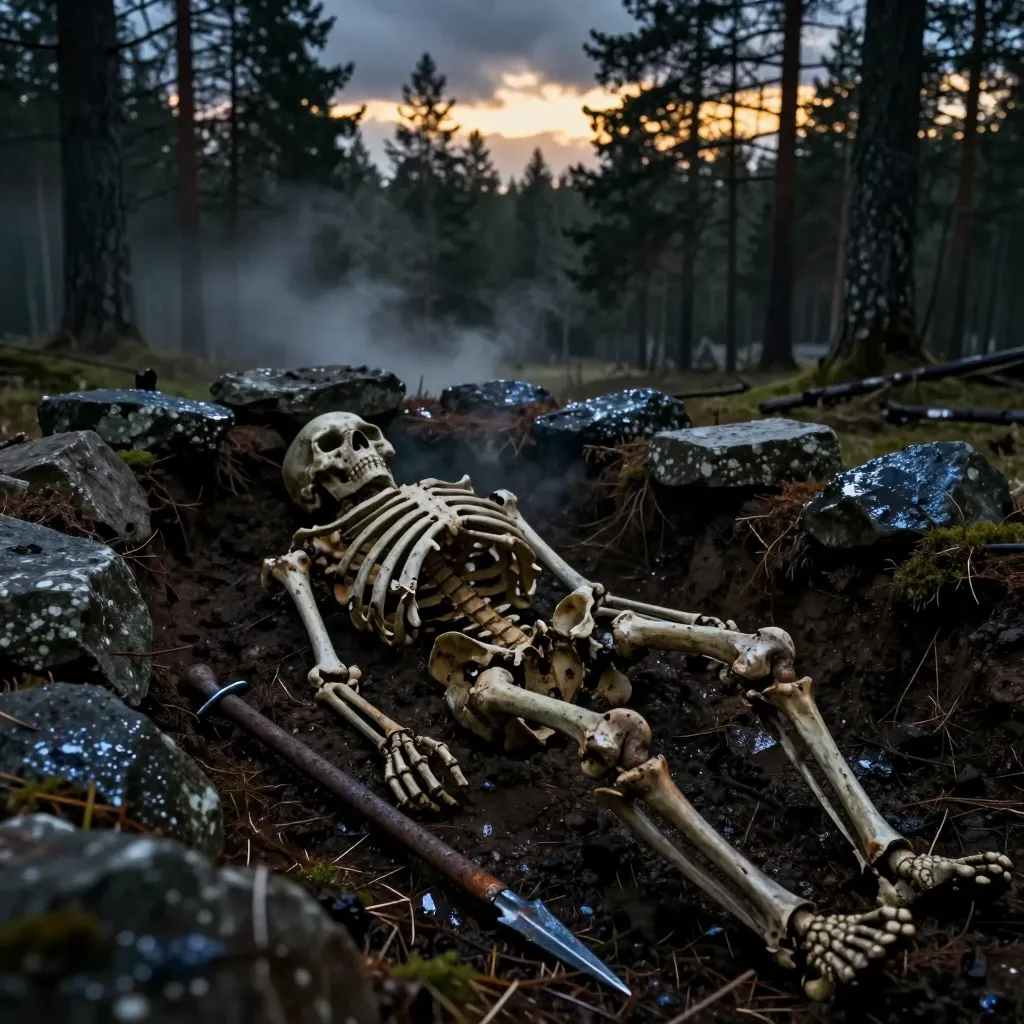
At sites across Norway, Sweden, and Denmark, archaeologists have found skeletons pinned beneath massive boulders—stones weighing hundreds of kilograms placed deliberately across the chest, abdomen, or limbs. This was not structural. It was restraint. The living were attempting to physically anchor the dead to the earth.
Decapitation appears with disturbing frequency. In these graves, the head has been severed post-mortem and repositioned between the legs or behind the back. The logic was surgical: a revenant without a head cannot see its prey, cannot navigate, cannot hunt. Some bodies were buried prone—face-down in the dirt—on the theory that if they dug upward, they would only tunnel deeper into oblivion.
Binding, too, was common. Ropes, chains, and even the deliberate breaking of limbs appear in the osteological record. At one site in Gotland, a skeleton was found with its femurs fractured and its ankles bound with iron wire. The community had not merely killed this person. They had processed them.
The Apocalyptic Framework
To understand why the Norse went to such extremes, one must understand their cosmology. The Viking universe was not static. It was hurtling toward an inevitable end: Ragnarök, the Twilight of the Gods, when the forces of chaos would break their bonds and consume the world.
Central to this apocalypse was Fenrir, the monstrous wolf born of Loki and the giantess Angrboda. The gods, terrified by prophecy, bound Fenrir with a magical fetter forged by dwarves. But the binding was temporary. At Ragnarök, the wolf would break free. His upper jaw would touch the heavens; his lower, the earth. He would devour Odin himself.
Fenrir would not fight alone. The ship Naglfar—constructed, according to the Prose Edda, from the untrimmed fingernails and toenails of the dead—would carry an army of giants and the monstrous dead from Hel's realm. The boundaries between worlds would collapse. The deceased would march.
In this context, deviant burial takes on cosmic significance. Every corpse successfully kept in its grave was one less soldier for the army of chaos. Every stone, every severed head, every bound limb was an act of resistance against the end of all things. The gods bound Fenrir; mortals bound their dead. The parallel was intentional and theologically loaded.
From Cremation to Inhumation: A Theological Shift
The fear of the walking dead intensified with the arrival of Christianity. In the pagan era, cremation was common. Fire destroyed the physical vessel; it released the spirit and, critically, eliminated the material substrate a Draugr required. The dead were literally reduced to ash.
Christianity changed the equation. Inhumation—burying the body intact in consecrated ground—became the norm. For a population still steeped in beliefs about corporeal revenants, this was terrifying. The corpse remained whole, buried in the earth, waiting. The theological shift from purification-by-fire to preservation-for-resurrection collided with older anxieties about the dead who refused to rest.
The result was the persistence, and perhaps intensification, of apotropaic burial practices well into the Christian period. Stones and decapitations appear in Christian-era graves with disturbing regularity. Old fears adapted to new frameworks. The Draugr did not vanish with the cross; it was simply reinterpreted, demonized, and feared with renewed urgency.
The Weight of Cosmic Order
The deviant burials of the Viking Age are more than archaeological curiosities. They are physical manifestations of a psychological landscape defined by apocalyptic anxiety. The Norse lived in a universe where the dead could rise, where the wolf would eventually break free, and where the final battle was not a matter of if, but when.
The stones placed upon chests were not mere grave markers. They were anchors, holding down not just a corpse, but a fragment of cosmic order. The decapitations were not desecrations. They were surgical interventions against entropy. Every deviant burial was a small, desperate act of participation in the war between order and chaos—a war the Norse knew they would ultimately lose, but refused to surrender prematurely.
In the end, the Vikings did not fear death. They feared what came after: the dead who would not stay dead, the wolf who would not stay bound, and the twilight that crept closer with every passing winter. The stones were heavy. But the dread they held down was heavier still.