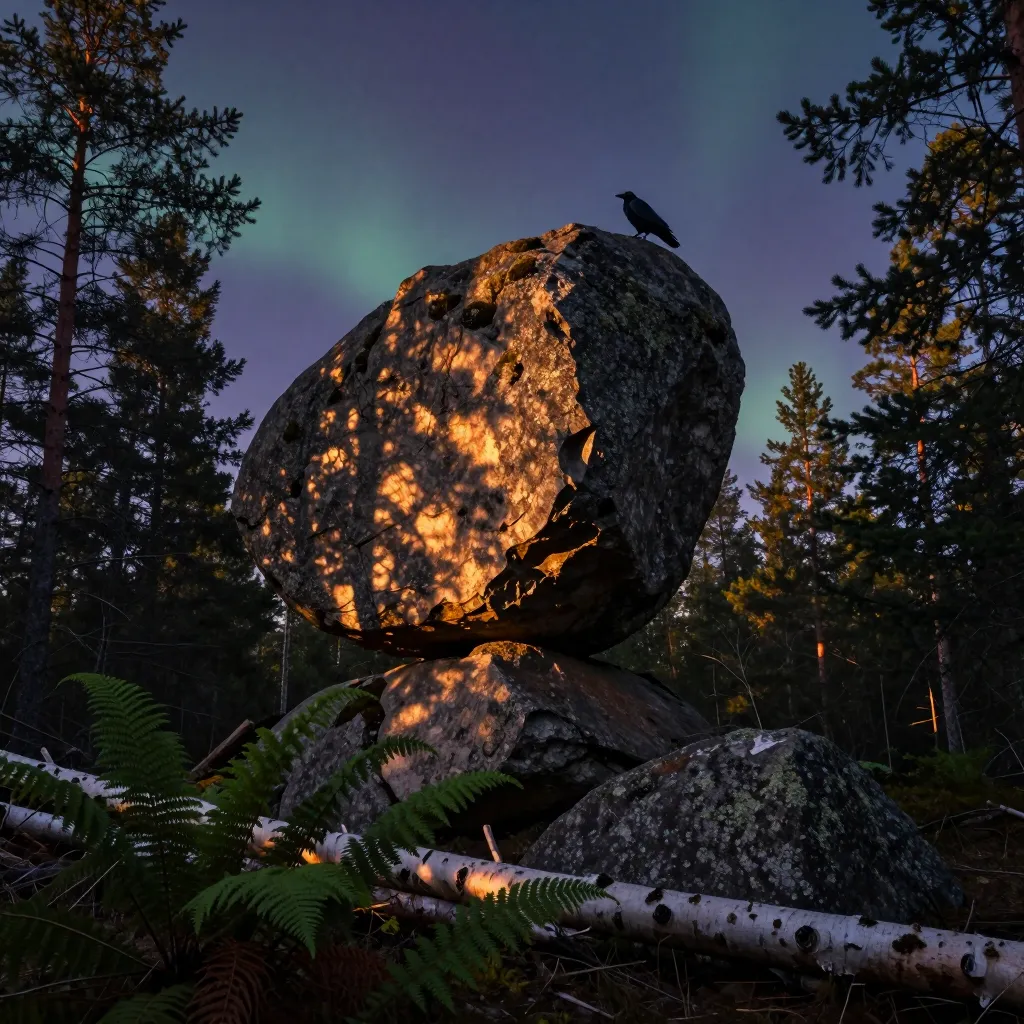
The Kummakivi Balancing Rock: Finland's Gravity-Defying Mystery
Deep in the Finnish wilderness lies Kummakivi, a massive balancing rock that seems to defy the laws of physics. For generations, locals have whispered about how it came to rest on its precarious perch. This geological marvel draws curious travelers and folklore enthusiasts alike, offering a glimpse into ancient explanations for nature's strangest formations. Discover what Finnish legends say about this gravity-defying stone.
The Kummakivi Balancing Rock: Finland's Gravity-Defying Enigma
Deep in the southeastern forests of Finland, where ancient pines whisper secrets to the wind and moss carpets the forest floor in emerald silence, a geological impossibility has stood for millennia. The Kummakivi Balancing Rock—its very name translating to "strange rock"—challenges everything we assume about gravity, weight, and the permanence of stone. Here, in the municipality of Ruokolahti within the South Karelia region, a massive boulder perches upon another as delicately as a coin balanced on a fingertip, yet with the immovable permanence of a mountain rooted to the earth.
A Formation That Defies Intuition
The spectacle consists of two distinct granite masses. The lower boulder emerges from the earth like a half-buried dome, its upper surface polished smooth and curving gently upward. Resting upon this convex pedestal is an upper rock of staggering proportions—approximately seven meters in length and weighing many tons. The contact point between these two geological titans is shockingly minimal, creating the visual illusion that the upper stone hovers rather than rests, that at any moment it must surely tumble to the forest floor below.
Yet it does not.
Visitors who encounter Kummakivi for the first time invariably experience a profound cognitive dissonance. The eye insists the structure is temporary, precarious, moments from collapse. The mind calculates angles, estimates center of gravity, predicts motion. But the rock remains utterly still. Those who have attempted to test its stability—pushing, heaving, applying collective human force—report the same baffling result: the stone does not shift. Not a millimeter. Not a tremor. It is as though the forest itself holds its breath, keeping the impossible suspended in perpetual equilibrium.
Whispers of Giants and Ancient Forces
For the people who once inhabited these woodlands thousands of years ago, Kummakivi presented a mystery that demanded explanation. These were not a people who possessed geological surveys or understood glacial mechanics; they knew only that no human strength could move such a stone, that no natural law they understood could account for its position. When brute force failed to explain the phenomenon, the mind turns to forces beyond the physical—to the supernatural inhabitants of Finnish folklore.
The mythology of Finland is rich with beings of immense power who dwell in the rocky places of the world. Among them are the hiidet (singular: hiisi), giant-like creatures associated with wilderness, stones, and ancient magic. These beings, according to tradition, possessed strength far beyond mortal comprehension. They were known to hurl boulders across landscapes, to construct cairns from massive stones, to carve strange hollows in bedrock that they used for churning milk. In the worldview of ancient Finns, the explanation was clear: a hiisi had placed Kummakivi here, either as a demonstration of strength, a marker of territory, or simply as one of the mysterious acts of giant-kind that require no further justification.
This explanation, while supernatural, carries its own internal logic. It acknowledges the fundamental truth that the rock's position seems to require intentionality, that its balance feels too perfect, too deliberate to be accidental. The giant hypothesis transforms Kummakivi from a mere stone into a monument—a physical memory of the time when the world was younger and the boundaries between the natural and the supernatural were more permeable.
The Glacial Hypothesis: Science Enters the Forest
Modern geology offers an alternative narrative, one no less dramatic for being natural. During the last Ice Age, vast glaciers covered much of northern Europe, sheets of ice kilometers thick that flowed like frozen rivers across the landscape. These glaciers were not merely passive ice; they were geological engines, grinding bedrock, transporting debris, and reshaping continents.
The scientific explanation for Kummakivi suggests that during this glacial period, the massive upper boulder was entrained within the ice sheet and transported to its current location. As the climate warmed and the glaciers began their slow retreat northward approximately 12,000 years ago, the ice deposited its cargo of rocks across the newly exposed terrain. Kummakivi, according to this theory, is a glacial erratic—a boulder transported far from its original bedrock source and left behind when the ice melted away.
The specific balancing act, geologists suggest, results from the precise way the glacier deposited the stone onto the convex bedrock below. Over millennia, erosion may have subtly adjusted the contact points, but the fundamental balance was established in that moment of glacial release. The rock's apparent instability is, paradoxically, a state of profound stability—the center of gravity falls precisely within the base of support, and the friction between the two stone surfaces prevents any sliding motion.
Kummakivi in Global Context
Finland's balancing wonder is not unique in the world. Similar formations exist across continents, each carrying its own cultural significance and scientific interest. In Mamallapuram, India, the "Krishna's Butterball" presents a similar defiance of gravity—a 250-ton boulder resting on a slope at an angle that seems to mock physics, named for an avatar of the Hindu deity Vishnu known for his love of butter.
In the American Southwest, researchers have studied balancing rocks with a different purpose in mind. These natural formations serve as what scientists call "seismoscopes"—not instruments that measure earthquakes, but evidence of their absence. A balancing rock that has remained upright for thousands of years indicates that the region has not experienced ground shaking strong enough to topple it. By calculating the precise force required to disturb such rocks, seismologists can reconstruct the history of earthquake intensity in an area, providing crucial data for hazard assessment.
This scientific application transforms these geological curiosities into life-saving tools. They are, in essence, natural history books written in stone, recording the seismic stability of their locations across millennia. Kummakivi, given its protected status since 1962, may yet contribute to similar research in Finland, helping scientists understand the earthquake history of the Baltic Shield.
The Persistence of Mystery
Despite scientific explanation, Kummakivi retains its power to unsettle and amaze. There is something in the human psyche that resists the purely mechanical explanation, that wants to see intention behind such perfect balance. The rock stands as a boundary marker between the rational and the wondrous, a place where geology and folklore meet without fully resolving their differences.
The forest around Kummakivi remains largely as it has been for centuries—quiet, shadowed, unchanged by the passage of human civilization. The rock itself, weathered by countless seasons, continues its patient vigil. Whether placed by ancient giants or deposited by retreating ice, it serves as a reminder that the natural world still contains phenomena that challenge our understanding, that resist our attempts at categorization and control.
In the end, Kummakivi asks nothing of us but attention. It does not explain itself, does not yield to our pushing, does not confirm or deny the stories told about it. It simply is—strange, balanced, immovable, and utterly mysterious. In a world increasingly mapped and measured, there is profound value in such persistent enigmas. They remind us that wonder is not merely the province of the supernatural, but a natural response to a universe that remains, in countless ways, beyond our complete comprehension.