Betrayal in the Warlocks: The Murder of Keith Palumbo and the Cemetery Crypt
When Keith Palumbo vanished in 2020, his mother's intuition led police to a Warlocks MC clubhouse and a 19th-century cemetery crypt. Inside, investigators found Palumbo and a second, long-forgotten victim, exposing a brutal culture of paranoia and lethal betrayal among lifelong friends.
The Keith Palumbo Case: A Tattoo Artist's Murder and the Dark Secrets of a Philadelphia Biker Gang
In the shadowed corners of Philadelphia's criminal underworld, some stories unravel with the slow, inevitable dread of a Greek tragedy. The murder of Keith Palumbo is one such tale—a narrative of misplaced trust, outlaw brotherhoods, and a friendship that curdled into something lethal. What began as a routine missing persons report in 2020 would ultimately expose the brutal machinery of the Warlocks Motorcycle Club and reveal how quickly loyalty can dissolve into betrayal.
A Mother's Worst Premonition
Keith Palumbo was not a man who seemed destined for such an ending. At 36, he was a tattoo artist with artistic ambitions, a musician with a growing reputation, and a son who still borrowed his mother's car. When Dottie Palumbo reported her son missing in the summer of 2020, she carried with her more than the standard anxiety of a parent. During their final conversation, Keith had been visibly agitated, his demeanor off-kilter. She noted the gold guitar pick necklace she had given him—an object that would later become a crucial piece of forensic evidence.
Upper Darby Township Police Superintendent Timothy Bernhardt would later describe Dottie's intuition as something almost preternatural, that maternal alarm that transcends logic. Four days after borrowing her vehicle, Keith had simply vanished, leaving behind a network of concerned friends and a growing suspicion that something had gone terribly wrong.
The First Threads of Investigation
The discovery of Dottie's abandoned car in a neighborhood notorious for drug trafficking introduced an immediate, troubling possibility. Keith had wrestled with addiction in the past, and those closest to him feared the worst—that he had succumbed to old demons and disappeared into the anonymous machinery of the streets.
But Keith's friends pointed investigators toward a more sinister direction. They urged police to locate Michael DeLuca, Keith's childhood companion and a member of the Warlocks, one of Philadelphia's most notorious outlaw motorcycle gangs. To law enforcement, DeLuca was a familiar figure—a man with a prison record for aggravated assault who projected an aura of calculated menace. "Somewhat of an intimidating person," retired Philadelphia Police Detective Joe Bamberski would later note, with the understatement typical of seasoned investigators.
The complication was immediate and disturbing: Mike DeLuca had also vanished.
A Prior Wounding and the Code of Silence
As detectives expanded their inquiry, a critical piece of context emerged. Ten days before his disappearance, Keith Palumbo had been shot in the leg under circumstances that remained deliberately obscured. When questioned, he refused to identify his attacker, adhering to that unwritten code of silence that governs certain subcultures—an omertà of the streets that would ultimately cost him his life.
This refusal to cooperate, while perhaps understandable within Keith's social framework, created a fatal blind spot for investigators. Someone had already demonstrated a willingness to harm him, yet the identity of that person remained locked behind a wall of silence.
The Warlocks and a Grudge That Festered
The investigation's trajectory shifted dramatically when detectives turned their attention to Buck Evans, another Warlocks member with both a criminal pedigree and a specific grievance against Keith. Evans harbored a deep resentment, convinced that Palumbo had been responsible for his son's arrest on drug charges. In the calculus of outlaw culture, such an accusation constituted a capital offense.
During interrogation, Evans made a partial confession that only deepened the mystery. He admitted to shooting Keith in the leg—the wound that had gone unreported—but denied any involvement in his subsequent disappearance. Yet his testimony carried an ominous undertone. Evans suggested that whatever had ultimately befallen Keith may have occurred at the Warlocks' clubhouse, a location that would soon yield its own horrors.
Blood on the Walls
What investigators found at the clubhouse defied their most disturbing expectations. The interior bore the unmistakable signatures of extreme violence: high-velocity blood spatter coating the walls in a fine mist of crimson droplets, and a substantial pool of blood that had seeped along the baseboards. The scene spoke of a confrontation that had escalated far beyond a simple assault.
But whose blood decorated these walls? The question haunted the investigation. With both Keith Palumbo and Mike DeLuca missing, the evidence pointed toward a catastrophic event, yet the identities of the victims remained unconfirmed.
The Cemetery Crypt
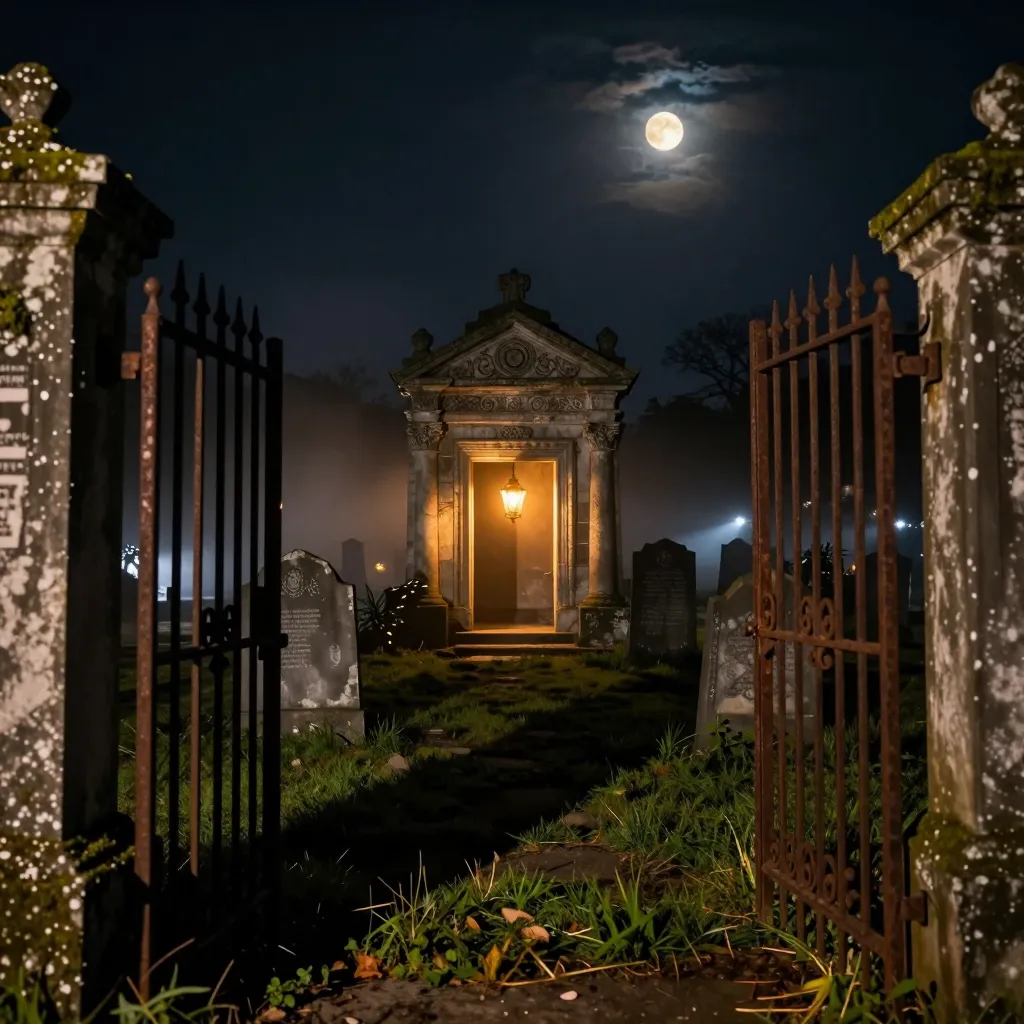
Keith's cell phone records provided the next crucial lead, tracking his device's final signal to the vicinity of Mount Moriah Cemetery & Arboretum—a sprawling 200-acre burial ground that dates back to the mid-19th century. Among the weathered headstones and Victorian monuments, investigators noticed something anomalous: a pre-Civil War crypt with a displaced capstone and fresh scratches marring the surrounding marble.
Prying open the sealed entrance, they lowered an inspection camera into the darkness. The footage revealed a fragment of blue material. When Detective John Taggart peered inside, he confronted a scene of almost cinematic horror. A body lay atop a tarp, positioned face-up in the confined stone chamber. "Almost like he's staring back at you," Taggart would recall.
The remains wore a guitar pick necklace—Dottie's gift, the talisman that confirmed the worst. Keith Palumbo had been found, but the discovery carried an additional shock. Beside him lay a second corpse, significantly more decomposed, suggesting it had rested there for years rather than weeks.
Two Bodies, One Grave
Forensic identification confirmed the victims: Keith Palumbo, missing for a matter of days, and David Rossillo, a prospective Warlocks member who had disappeared without trace in 2017. The crypt had served as a clandestine charnel house for the motorcycle club, a repository for those who had crossed its invisible boundaries.
Laboratory analysis of the blood recovered from the clubhouse confirmed it belonged to Keith, establishing the location as the primary crime scene. The narrative was becoming clear: Keith had been murdered at the clubhouse, then transported to the cemetery for concealment. But the mechanics of the crime, and the identities of all participants, remained partially obscured.
The Architecture of Betrayal
The arrest of multiple Warlocks members triggered a cascade of confessions that exposed the gang's internal culture as a hollow performance of loyalty. Donna Morelli, the clubhouse owner, admitted to assisting in the cover-up at the gravesite. Surveillance footage captured her truck—driven by Mike DeLuca with fellow Warlocks member Billy Gibson as passenger—transporting what appeared to be a body to her residence, which backed directly onto the cemetery.
The full picture emerged in fragments, colored by self-interest and mutual recrimination. Buck Evans and Billy Gibson both implicated Mike DeLuca as the primary perpetrator, claiming he had executed Keith with a gunshot to the head inside the clubhouse. The motive they attributed to him was both paranoid and tragically mundane: DeLuca had convinced himself that his childhood friend was a police informant.
Detective Taggart observed the irony with bitter clarity. The Warlocks' vaunted code of silence, their theatrical commitment to brotherhood and non-cooperation with law enforcement, dissolved instantly under pressure. "All that loyalty of the Warlocks about not snitching," Taggart noted, "they all turned out to be snitches."
The Arrest and a Friendship's End
Mike DeLuca's flight from justice ended in 2021, not in Philadelphia but in Wyoming, where a routine traffic stop led to his apprehension and extradition. The geographic distance between his capture and the crime scene suggested months of calculated evasion, a life spent looking over his shoulder.
In 2023, DeLuca pleaded guilty to murder and received a sentence of 25 to 35 years in prison—a substantial term that nonetheless failed to fully capture the dimensions of his betrayal. Buck Evans, Billy Gibson, and Donna Morelli each pleaded guilty to their roles in concealing the murder, receiving sentences of 18 to 24 months.
For those who had known both men since childhood, the revelation carried a particular devastation. Matthew Sondermann, a mutual friend, struggled to reconcile the Mike DeLuca he had known with the man who had executed his closest companion. "Growing up, we were inseparable, best friends, did everything together," Sonnermann reflected. And Dottie Palumbo, who had loved DeLuca as a second son, faced the impossible task of processing that affection in light of his actions.
The Crypt's Older Secret
The discovery of David Rossillo's remains alongside Keith's introduced an unsettling dimension to the case. Rossillo, a prospective Warlocks member missing since 2017, suggested that the cemetery crypt had served as the club's preferred method of body disposal for years. His presence raised questions about how many other secrets might lie buried in Philadelphia's forgotten spaces, how many other disappearances might be traced back to the same network of violence.
The Rossillo case remains a separate tragedy, his death predating Keith's by three years yet sharing the same clandestine grave. Whether his murder followed a similar pattern of paranoia and internal gang justice, or whether the circumstances were entirely different, remains part of the unspoken history of the Warlocks Motorcycle Club.
The Nature of Outlaw Loyalty
The Palumbo case illuminates the paradox at the heart of outlaw motorcycle culture: the passionate rhetoric of brotherhood and unconditional loyalty that masks a reality of suspicion, preemptive violence, and swift betrayal. Mike DeLuca's willingness to believe his childhood friend was an informant, and to act on that belief with lethal finality, reveals how the gang's internal logic can override decades of genuine human connection.
The speed with which arrested members cooperated with prosecutors further undermines the mythology of the outlaw code. In practice, the Warlocks' loyalty proved conditional, transactional, and ultimately self-serving—a performance maintained only until the cost of silence exceeded the cost of confession.
A Mother's Necklace
The gold guitar pick necklace that Dottie Palumbo had given her son became, in death, the instrument of his identification and the silent witness to his final moments. It is a detail that carries the weight of Greek tragedy—a mother's love transformed into forensic evidence, a gift that outlived the giver's worst fears.
In the end, the case of Keith Palumbo is not merely a true crime narrative but a meditation on the fragility of trust, the corrosive effects of paranoia, and the ways in which human relationships can be weaponized by the institutions that claim to value them most. The crypt at Mount Moriah Cemetery held two bodies, but the true casualty was something less tangible: the belief that childhood friendship could survive the brutal logic of outlaw brotherhood.
For the investigators who cracked the case, for the friends who must reconcile memory with reality, and most of all for Dottie Palumbo, the resolution brings only partial comfort. Justice, in its bureaucratic form, has been administered. But the deeper mysteries—why a man would kill his oldest friend, why loyalty curdles so quickly into violence, why some graves hold more than their expected share of secrets—remain as dark and unyielding as the stone chamber where Keith Palumbo was finally found.