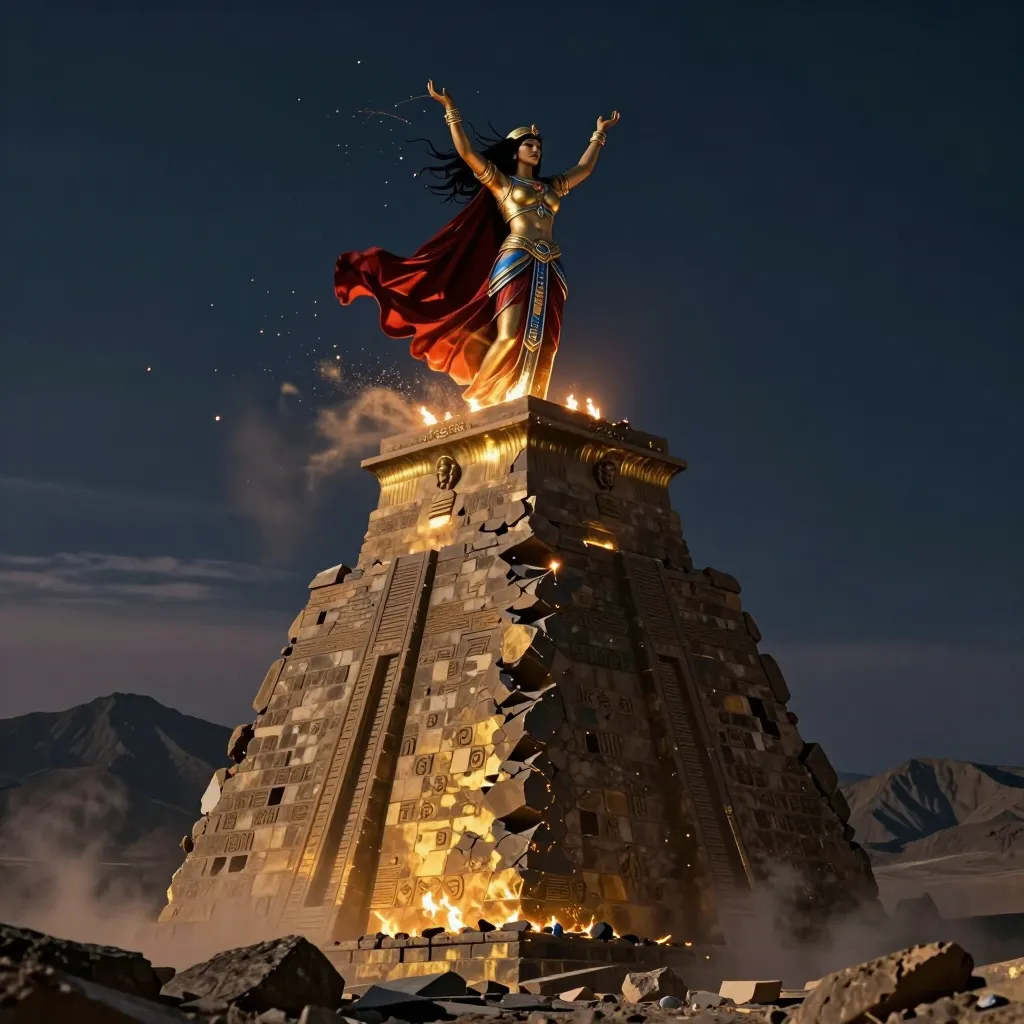
Inanna and Ebih: How a Goddess Destroyed a Mountain for Disrespecting Her
Long before Greek epics, Enheduanna—the world's first known author—composed a fierce mythological narrative about divine feminine rage. Inanna and Ebih tells how the goddess Inanna transforms a mountain's arrogance into ashes when it refuses submission. This ancient Mesopotamian poem explores autonomy, justified wrath, and cosmic power through stunning martial imagery and ritual transformation.
Inanna and Ebih: The Mountain's Defiance
The First Named Poet and Her Warrior Goddess
Long before Homer composed his epics, before the Greek tragedians shaped their myths, a woman named Enheduanna inscribed her name into history. Living around 2300 BCE in the Akkadian Empire, she holds the distinction of being the first author known by name in world literature. Among her surviving works, the poem Inanna and Ebih stands as a testament to divine feminine power—a narrative where a goddess refuses to accept disrespect and transforms herself into an instrument of retribution.
The original title, Inninmehusa, translates to "Goddess of the Fearsome Powers." The poem belongs to a collection of at least forty compositions attributed to Enheduanna, though modern scholars continue debating the extent of her authorship. What remains uncontested is the poem's endurance: archaeologists have recovered approximately eighty copies from the ruins of Nippur and other ancient cities across modern Iraq. Its importance in Mesopotamian education cannot be overstated—it formed part of the Decad, a set of complex texts that scribal students mastered before graduation from the edubba, the "House of Tablets."
The Narrative Arc: From Insult to Annihilation
The poem opens with twenty-four lines of pure exaltation. Inanna appears in her full terrifying glory—clad in divine powers, drenched in blood, devastating lands with arrow and strength. She roars like a lion across heaven and earth, trampling hostile territories beneath her feet. This is no gentle deity but a force of nature, a storm given feminine form.
The narrative pivots when Inanna walks through the mountain ranges of Elam, Subir, and Lulubi. She approaches the mountain Ebih, personified as a living entity capable of choice and disrespect. The mountain fails to bow. It does not press its nose to the ground or rub its lips in dust—the gestures of proper submission. This refusal triggers something ancient and terrible within the goddess.
Inanna's response unfolds across several speeches filled with military imagery. She will bring battering rams against the mountain's magnificent sides, smaller rams against its lesser slopes. She will fill her quiver with arrows, polish her lance, and prepare shield and throwstick. Fire will consume Ebih's thick forests. Gibil, the purifier god, will bare his teeth at its watercourses. She frames this destruction as a "game," a holy sport befitting her station.
The Divine Council and Inanna's Defiance
Before acting, Inanna performs the proper ritual observances. She dons royal garments, bedecks herself with cornelian and lapis lazuli, and approaches the sky god An at the Gate of Wonder. Her petition to An recapitulates her grievance: the mountain showed no fear, offered no proper submission. She requests divine sanction for her campaign of destruction.
An's response reveals the poem's central tension. The sky god refuses. He describes Ebih's magnificence in terms that mirror Inanna's own exalted nature—the mountain pours terror upon divine abodes, spreads fear among holy dwellings, extends its arrogance grandly to heaven's center. Its gardens flourish with hanging fruit, its trees reach toward heaven's roots. Lions roam beneath its canopy. Wild rams and stags move freely through its grasses. An delivers a stark warning: "You cannot pass through its terror and fear. The mountain range's radiance is fearsome. Maiden Inanna, you cannot oppose it."
This moment defines the poem's power. Inanna does not accept divine counsel. She does not moderate her response. Instead, she opens the arsenal, summons storms, and advances alone. The text describes her grabbing Ebih's neck "as if ripping up esparto grass," pressing her dagger's teeth into its interior, roaring like thunder. She damns the forests, curses the trees, kills oaks with drought, and pours fire across the mountain's flanks until smoke grows dense and impenetrable.
Victory and Its Aftermath
The poem's climax arrives when Inanna addresses the defeated mountain directly. Her speech carries the weight of justification: Ebih fell not despite its elevation and beauty, but because of them. Its height became hubris. Its holy garment became presumption. Its reach toward heaven became overreach. She seized its tusks like an elephant's, brought it down by its horns like a wild bull, forced its strength to the ground.
The final sections transform this personal victory into cosmic order. Inanna builds a palace, establishes a throne, and reorganizes cultic practices. She gives daggers to the kurjara performers, drums to the gala, and changes the headgear of the pilipili. These details suggest the poem functioned partly as etiological myth—explaining how certain religious practices originated from Inanna's triumph. The work concludes, as Mesopotamian literary tradition demanded, with praise for Nisaba, goddess of writing, acknowledging the divine inspiration behind the composition.
Interpretive Possibilities
The scholarly literature surrounding Inanna and Ebih exceeds that of Enheduanna's other major works—Inninsagurra (The Great-Hearted Mistress) and Ninmesarra (The Exaltation of Inanna). This abundance of interpretation reflects the poem's symbolic density. Some readings approach it as allegory for ecological disaster, others as proto-feminist revision of the Fall narrative, still others as political propaganda celebrating Akkadian military campaigns against northern mountain peoples.
One particularly compelling interpretation connects the poem to historical events at Ur. A figure named Lugal-Ane apparently led a successful coup that temporarily drove Enheduanna from her position as high priestess of Nanna. Under this reading, Inanna's victory over Ebih mirrors Enheduanna's eventual restoration to power—a restoration she credited to divine intervention. The parallel between the goddess who refuses to accept disrespect and the priestess who refused to accept exile proves suggestive, though impossible to confirm definitively.
Yet the text supports simpler readings equally well. Inanna appears throughout Mesopotamian mythology as a figure of autonomous feminine power—proud, determined, acting without regard for consequence. Whether Enheduanna wrote this poem or another scribe composed it, the work celebrates a goddess who demands recognition and destroys those who withhold it. This theme resonates across centuries of Mesopotamian literature, finding later expression in works like Inanna and Su-kale-tuda, where the goddess hunts down and kills a man who assaulted her rather than accepting victimhood.
The Poem's Enduring Resonance
What survives of Inanna and Ebih offers modern readers entry into a worldview where mountains breathe, gods walk among geographical features, and divine feminine power demands acknowledgment rather than requesting it. The poem's structure—praise, narrative, petition, rejection, action, victory, transformation—establishes patterns that echo through subsequent religious literature.
The archaeological evidence suggests this was not esoteric text. Its presence in scribal curricula across multiple cities indicates widespread cultural importance. Students learned to write by copying lines where a goddess roared like thunder and made mountains tremble. The normalization of such imagery in educational contexts implies a society that could accommodate, even celebrate, feminine power in its most destructive and autonomous forms.
Whether approached as historical allegory, religious document, literary achievement, or psychological exploration of justified rage, Inanna and Ebih rewards attention. It stands among humanity's earliest surviving narratives of a woman—divine, yet recognizably human in her response to disrespect—who refuses to accept the boundaries others place upon her.