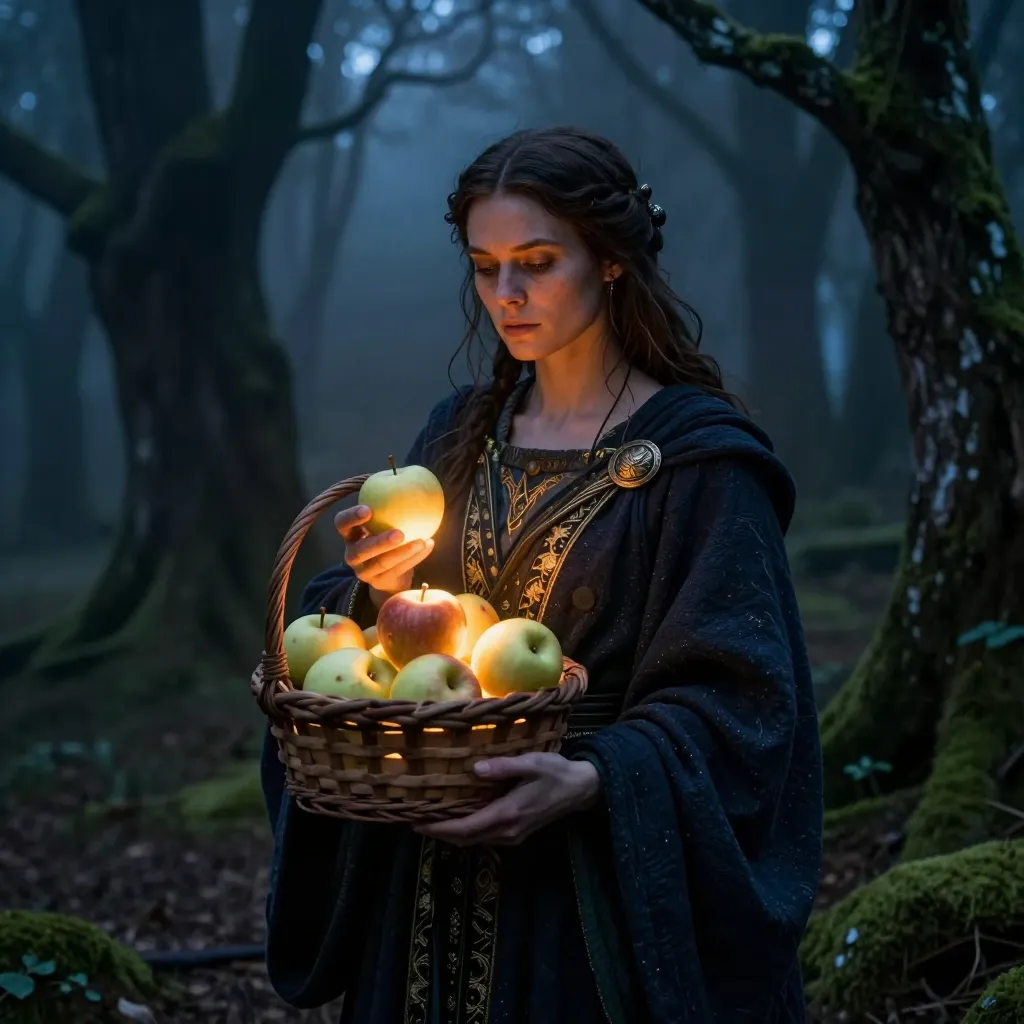
Idun: The Norse Goddess Who Guards the Gods' Immortality
Meet Idun, the Norse goddess of eternal youth whose mysterious fruit keeps the Aesir gods immortal. Unlike warriors or tricksters, her power lies in preservation—without her, even Odin and Thor would crumble to dust. Explore the myths, the medieval misunderstandings about her 'golden apples,' and the dark secrets hinted at in ancient poetry.
Idun: The Norse Guardian of Eternal Youth
In the shadowed halls of Asgard, where gods and giants wage their endless wars of wit and will, there exists a deity whose power lies not in thunder or trickery, but in the quiet magic of preservation. Her name is Idun (Old Norse: Iðunn), and she holds within her keeping the secret to immortality itself.
The Keeper of the Gods' Youth
Idun stands among the Aesir, that formidable tribe of Norse deities who preside over order and civilization. Yet unlike her more celebrated kin—Odin with his ravens and sacrifices, Thor with his world-shattering hammer—Idun's significance rests upon something far more fragile: fruit that halts the relentless march of time.
The most complete tale of her role survives in The Kidnapping of Idun, preserved in the skaldic poem Haustlöng and Snorri Sturluson's Prose Edda. Here we find the gods growing old, their immortal faces creasing with wrinkles, their divine strength waning—until Idun appears with her basket of rejuvenating produce. With each bite, youth floods back through divine veins. Without her, the Aesir face the same decay that claims mortal men.
The Mystery of the Fruit
Modern retellings almost universally depict Idun's bounty as golden apples, a image so pervasive it has become inseparable from her identity. Yet this interpretation carries the weight of medieval misunderstanding rather than ancient belief.
The Old Norse term epli served as a catch-all word for fruits and nuts of many kinds. True apples in the modern sense arrived in Scandinavia only in the late Middle Ages, centuries after the Viking Age had ended. Whether Idun carried apples, nuts, berries, or some mythical fruit unknown to earthly orchards remains lost to time. What matters is the function: these were not mere snacks but the sustenance of eternal life, as essential to the gods as mead or sunlight.
The Marriage of Poetry and Preservation
Idun's consort is Bragi, the skaldic god of poetry and eloquence. He serves as Asgard's court poet, his tongue weaving words into charms and histories, while his wife ensures those who listen will live forever to hear them. Together they represent two forms of immortality: the endurance of art and the defiance of aging.
A darker thread appears in Lokasenna, the "Flyting of Loki," where the trickster god hurls accusations at every deity present. To Idun, Loki delivers a venomous charge: that she has lain with her own brother's killer. The identities of brother and murderer alike have vanished from surviving sources. No saga explains this cryptic reference, no poem illuminates the shadow. It hangs in the record like a half-heard whisper—a reminder that even the guardians of youth carry secrets, and that Norse mythology contains depths we may never fully sound.
The Silence of the Sources
For a goddess of such vital importance, Idun appears remarkably rarely in the surviving corpus. The Norse myths that escaped the fires of Christianization and the erosion of centuries offer only glimpses: her role in the kidnapping tale, her marriage to Bragi, Loki's accusation, and scattered references in kennings and poetic metaphors.
This sparseness is not unique to Idun. The Norse pantheon contains many figures—goddesses particularly—whose stories existed in oral traditions now forever lost. What we possess are fragments, sometimes contradictory, often tantalizing in their incompleteness. Idun remains one of the most vivid of these partial portraits: defined entirely by her function, yet through that function achieving an importance that rivals any warrior god.
The Eternal Return
In the end, Idun embodies one of mythology's most ancient anxieties: the fear of aging, the desperation to hold back time's river. The gods themselves, for all their power, depend upon her. Without the Rejuvenating One, Asgard would become a realm of elderly deities, their thunder muted, their wisdom grown senile, their reign crumbling into dust.
She stands as testament to the belief that even immortality requires maintenance, that eternal life demands eternal vigilance. In a mythology where Ragnarök—the final destruction—looms inevitable, Idun offers a smaller, more personal form of apocalypse averted: the death that comes not in battle or flame, but in the quiet surrender to years.
Her basket, whatever fruit it truly held, represents the dream of all mortal cultures: not to escape death entirely, but to choose its hour.