Herlaugshaugen: Scientific Study Rewrites the Legend of a Lost Viking King
Archaeologists at Herlaugshaugen have debunked a centuries-old Norse legend. By carbon-dating a 1,300-year-old ship burial, scientists reveal a sophisticated maritime culture that predates the Viking Age, challenging everything we thought we knew about early European expansion and naval power.
The Ship Beneath the Mound: How a Viking Legend Hid an Older, Stranger Truth
For centuries, a massive grass-covered hill on the Norwegian island of Leka guarded a secret that would rewrite maritime history. Local legend claimed it held a king who chose death over submission. Modern science revealed something far more mysterious: a 1,300-year-old ship burial that predates the Viking Age itself, bridging a forgotten gap between ancient seafaring cultures across the North Sea.
The Legend of the Living King
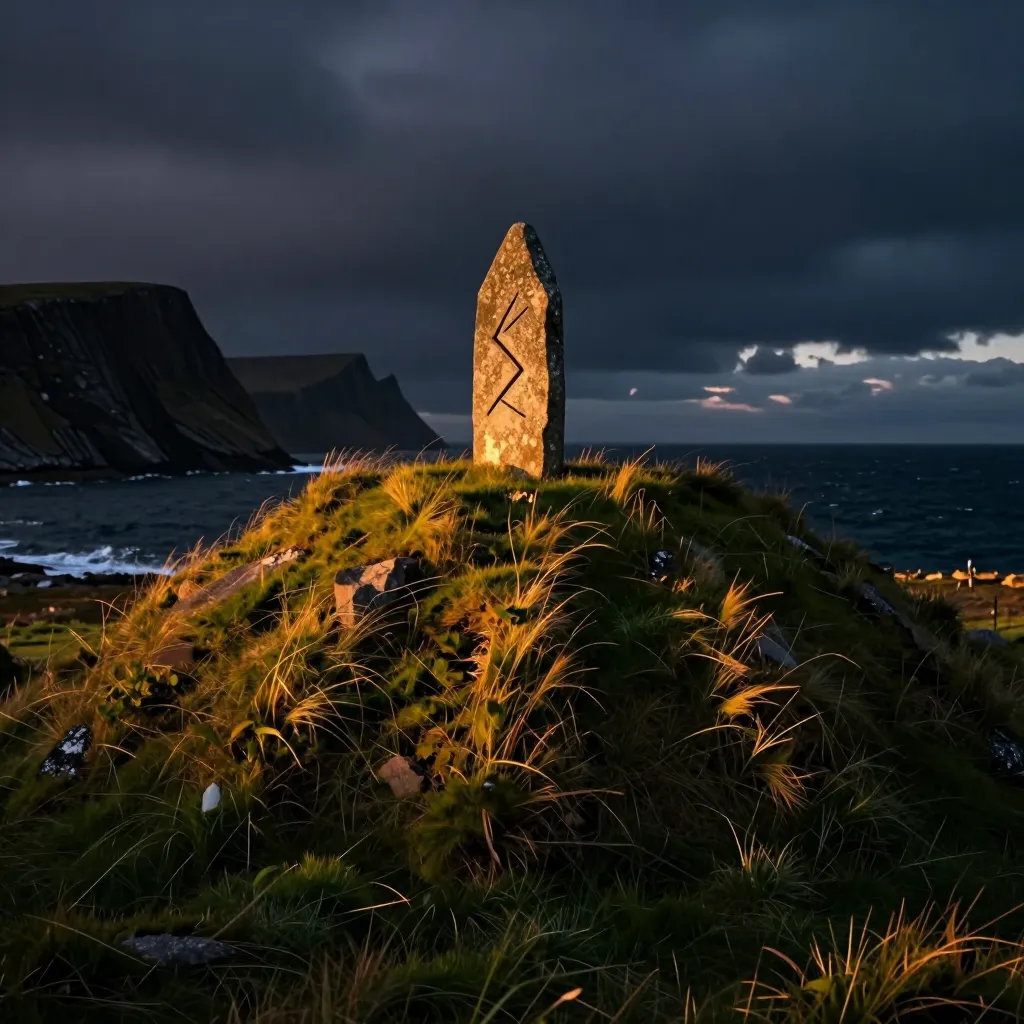
Rising 12.5 meters high and stretching over 60 meters across, Herlaugshaugen dominates the coastal landscape of Leka like a slumbering giant. According to thirteenth-century Norse sagas, the mound entombed King Herlaug—a pre-Viking ruler of the Namdalen region who, rather than bend the knee to Harald Fairhair (Norway's first unified king), reportedly ordered himself sealed inside the earthwork alive, surrounded by his loyal men.
This macabre tale prompted treasure hunters to breach the mound in the 1700s. They emerged with tantalizing fragments: a seated skeleton, a rusted sword, animal bones, and curious iron nails. Then the artifacts vanished. Lost to time, damaged by improper storage, or simply scattered to private collections—no one knows. For more than two centuries, archaeologists could only wonder whether the hill truly contained a vessel or if the nails were merely random debris from some other structure.
The legend persisted, but the evidence did not.
When Science Overrides Myth
In 2023, a research team from NTNU University Museum returned to Herlaugshaugen with modern archaeological methods and a specific mission: find definitive proof of a ship and date it with precision.
Working through three carefully positioned trenches, they uncovered 29 iron rivets—clinker nails, the distinctive fasteners used to join overlapping planks in the construction technique that would later define Viking shipbuilding. Some still clung to fragments of preserved wood, likely elm or oak, that had survived more than a millennium in the acidic soil.
The dimensions told a striking story. Based on the spacing and size of the rivets, the vessel stretched beyond 20 meters—nearly 65 feet—placing it firmly in the category of ocean-going craft rather than coastal fishing boats or river ferries. Someone in this region had possessed the naval engineering expertise to construct a serious seagoing ship far earlier than conventional timelines suggested.
Radiocarbon dating of the preserved wood and charcoal from the mound's construction layers delivered the most startling result: approximately AD 700, with a margin placing it at the transition between the seventh and eighth centuries.
King Herlaug, according to saga tradition, died around AD 780—roughly eighty years too late to claim this burial. The skeleton from the eighteenth-century excavation is gone, unidentifiable, perhaps never the king at all. Whoever truly rests beneath Herlaugshaugen remains nameless, but their status is unmistakable. This was a person of immense wealth and authority, capable of commanding the resources to build and inter a vessel that would have been among the most sophisticated technology of its era.
The Missing Century
Before this discovery, Scandinavian archaeology faced a puzzling void. The great ship burials of Anglo-Saxon England—notably Sutton Hoo, dated between AD 600 and 625—stood as early examples of the tradition. In Sweden, the boat graves at Vendel and Valsgärde spanned the sixth through eighth centuries. Yet the oldest confirmed monumental ship burials in Norway itself, on the island of Karmøy, only appeared in the late eighth century. The famous Oseberg and Gokstad ships belonged to the ninth century.
A gap of nearly two centuries yawned between the English examples and the Norwegian ones. Did the tradition originate elsewhere and migrate north? Did early Scandinavian ship burials exist but remain undiscovered? Or was there some discontinuity in the practice?
Herlaugshaugen, dated to around AD 700, slots precisely into that missing interval. It transforms the question from "why the gap?" to "what connected these cultures across the North Sea?"
The researchers argue this points to a shared cultural tradition rooted not in Viking expansion but in the broader Merovingian period (AD 550–800)—a time of emerging kingdoms, long-distance trade networks, and maritime power struggles across Northern Europe. The ship burial was not a Viking invention. It was an inheritance, a statement of authority expressed through naval symbolism that predated the Viking Age by generations.
A Beacon in the Maritime Network
The location itself carries significance beyond the burial. Leka sits at a natural crossroads where north-south coastal routes intersect with east-west inland valleys. The island's geology—ancient ocean floor thrust upward during the Caledonian orogeny—creates distinctive formations visible from far out at sea. For mariners navigating by landmark, Leka would have served as a recognizable waypoint, a fixed point in the fluid world of coastal travel.
The burial mound's placement exploits this visibility. Positioned to overlook the narrow strait separating Leka from the mainland, it would have dominated the view of anyone passing through this maritime chokepoint. This was not a hidden tomb but a public monument—a permanent assertion of power over a critical junction in the regional network.
The wealth required for such construction could not have come from agriculture alone in this rugged coastal terrain. The resources point to trade, possibly over considerable distances, connecting northern and southern Scandinavia and potentially extending across the North Sea to Britain and the European continent. The ship itself, large and expertly built, testifies to a community with deep maritime expertise and access to materials and labor far beyond subsistence levels.
The Deeper Currents
What makes Herlaugshaugen genuinely strange is not merely its age but what it implies about the shadowy centuries before recorded Viking history. We tend to imagine the Viking Age as an eruption—sudden, violent, unprecedented. Discoveries like this suggest instead a long, submerged preparation: centuries of shipbuilding refinement, network cultivation, and ideological development that would eventually surface in the explosive expansion of the eighth through eleventh centuries.
The person buried beneath Herlaugshaugen lived in a world we barely understand, at a time when the cultural DNA of the Viking Age was still forming. They commanded a ship that could cross seas, in a society that valued naval power enough to bury its elite with their vessels, within a network that connected distant shores. Yet they remain faceless, their name erased, their story overwritten by a later legend of a different king entirely.
In the end, the mound kept its most important secret until modern science peeled back the layers of myth. The legend of King Herlaug—dramatic, memorable, historically specific—proved to be a misdirection. The truth beneath was older, stranger, and more significant: a forgotten node in a maritime network that would eventually reshape Europe, buried with their ship in the dark earth of a windswept Norwegian island, waiting thirteen centuries to tell its story.