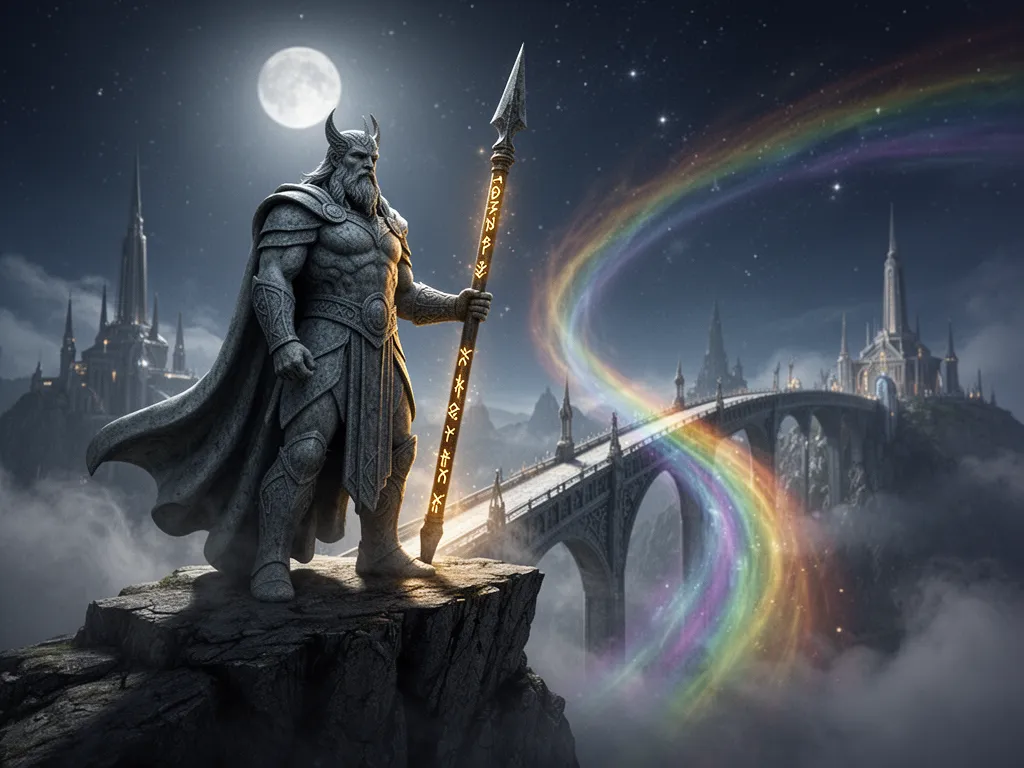
Heimdall: The Divine Guardian of the Bifrost and Sentinel of Asgard
Discover the mysterious origins and vital role of Heimdall, the White God of Norse mythology. Born of nine mothers, he guards the rainbow bridge Bifrost with sight that pierces darkness and a horn that echoes across the nine worlds to signal the end of days.
Heimdall: The Silent Sentinel of Asgard
In the celestial architecture of the Norse cosmos, where the realm of the gods meets the path of the living, stands a figure of unmatched vigilance. Heimdall, the "White God," serves as the eternal sentry of Asgard. Positioned at the edge of the heavens, he is the first line of defense against the chaotic forces of the Jotnar (giants) and the herald of the end of days.
The Guardian of the Rainbow Bridge
Heimdall’s primary residence is Himinbjörg, or "Sky Cliffs." This celestial fortress is situated where the burning rainbow bridge, Bifrost, connects the divine realm of the Aesir to Midgard, the world of humanity. The location is strategically vital; it is the only permanent gateway to the gods' stronghold.
To fulfill his role as the ultimate watchman, Heimdall is endowed with supernatural senses that transcend the physical limits of other gods:
- Divine Sight: He can see for hundreds of miles, piercing through the thickest darkness of night as easily as the clarity of day.
- Preternatural Hearing: His ears are so sensitive that he can hear the grass pushing through the earth in Midgard and the wool growing on the backs of sheep.
- Endurance: He requires less sleep than a bird, remaining awake and alert while the rest of the cosmos rests.
The Mystery of His Origin
The birth of Heimdall is one of the most enigmatic episodes in Norse mythology. He is a son of Odin, the Allfather, but he was not born of a single mother. According to ancient poems like the Völuspá in skamma, Heimdall was carried by nine sisters—nine giantesses who combined their power to bring him into existence.
While some scholars attempt to link these nine mothers to the daughters of the sea god Ægir, the names and characteristics often conflict, leaving the "White God's" lineage shrouded in mystery. This unique birth may account for his extraordinary strength and his deep connection to the elemental forces of the sea and earth.
The Gjallarhorn and the Echo of Fate
At Heimdall’s side rests the Gjallarhorn, the "Resounding Horn." For much of the mythological timeline, the horn remains silent, its golden bell waiting for the moment of ultimate crisis. When Heimdall finally raises the Gjallarhorn to his lips, its blast will be heard throughout all nine worlds.
This sound will not be a call to celebration, but the signal of Ragnarök—the Twilight of the Gods. It marks the moment the giants storm the Bifrost and the world tree, Yggdrasil, begins to tremble.
The Sacred Sacrifice
A cryptic tradition suggests that Heimdall’s connection to the Allfather goes beyond blood. Just as Odin sacrificed an eye to Mímir’s Well to gain cosmic wisdom, a verse in the Völuspá mentions that Heimdall's hljóð (often translated as his "hearing" or perhaps a physical ear) is hidden beneath the roots of Yggdrasil. This suggests that Heimdall may have surrendered a part of himself to the well of the World Tree in exchange for his terrifyingly acute senses, mirroring the high price the gods must pay for their power.
The Eternal Rivalry: Heimdall vs. Loki
Heimdall represents order, duty, and unwavering loyalty. His natural antithesis is Loki, the god of mischief and chaos. Throughout the myths, the two are frequently at odds. This rivalry is destined to reach a bloody conclusion during Ragnarök. As the cosmos collapses, Heimdall and Loki will face each other on the battlefield of Vígríðr. In a final act of cosmic balance, the guardian and the trickster will slay one another, ensuring that the old world dies completely so a new one can emerge from the ashes.
The Father of Social Order
Beyond his role as a soldier, Heimdall is often identified with the figure Rig. In this aspect, he traveled across Midgard, visiting the homes of men and fathering the three classes of Norse society: the thralls (laborers), the karls (farmers and free men), and the jarls (nobles and warriors). This positions Heimdall not just as a protector of the gods, but as the foundational architect of human civilization, binding the fate of humanity to the divine sentinel of the sky.