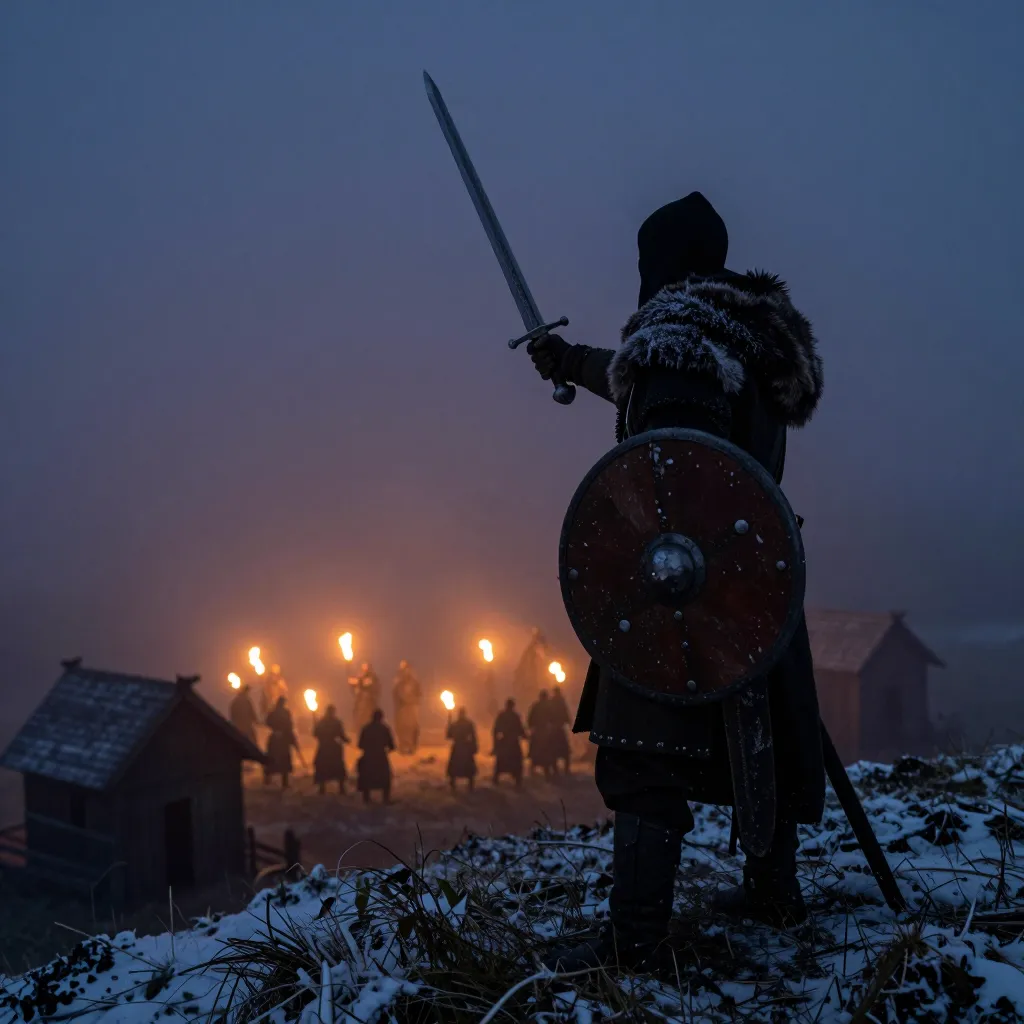
The Blood Bond: Martial Culture and War Bands of Early Germania
Explore the dark history of Germanic tribes where status was seized through combat and loyalty to a chieftain superseded family ties. This deep dive covers the visceral reality of the comitatus war bands, their prestigious pattern-welded blades, and the terrifying fear of battlefield shame.
The Blood Bond: War Bands and the Martial Culture of Early Germania
[cite_start]In the shadow of the Roman Empire, the Germanic tribes of the third and fourth centuries forged a society where the line between life and death was drawn by the edge of a blade[cite: 10, 17]. [cite_start]To these people, peace was not a virtue but a stagnant void; wealth and status were not inherited through commerce, but seized through the visceral reality of combat[cite: 10, 13, 15]. [cite_start]At the heart of this dark, martial world stood the comitatus—a devoted war band bound to a chieftain by blood-oath and the promise of plunder[cite: 10, 11].
The Shadow of the Comitatus
[cite_start]The comitatus served as the vital pulse of Germanic political life[cite: 11]. [cite_start]It was an elite retinue of warriors who lived, ate, and fought alongside their chosen leader[cite: 10]. [cite_start]This relationship was a grim symbiosis: the warriors provided the raw violence necessary to sustain the chief’s power, while the chief was required to provide a constant stream of gold, weapons, and land to ensure their loyalty[cite: 14].
[cite_start]This cycle of reward and service made sustained peace impossible[cite: 15]. [cite_start]A leader who failed to provide the spoils of war would soon find his war band dissolving, as warriors sought out more successful, blood-stained commanders[cite: 14, 16]. [cite_start]This relentless drive for conquest eventually fueled the massive confederations that would challenge and ultimately dismantle the Roman frontier[cite: 17].
Loyalty Beyond Kinship
[cite_start]The bond between a warrior and his leader often superseded even the ties of family or tribe[cite: 19]. [cite_start]In this early medieval era, modern notions of nationalism did not exist; a warrior’s identity was rooted in his personal oath[cite: 19]. [cite_start]This fanatical loyalty was so deep-seated that Germanic mercenaries serving in the Roman army were known to fight against their own kin without hesitation, bound strictly by the contract of service to their commanders[cite: 20].
[cite_start]In the heat of battle, formal discipline was largely absent[cite: 18]. [cite_start]Instead, the ranks were held together by a terrifying fear of dishonor[cite: 18]. [cite_start]To survive a battle in which one’s leader had fallen was considered a mark of eternal shame, driving warriors to fight with a reckless ferocity that stunned their more "civilized" opponents[cite: 18].
The Arsenal of the Barbarian
The equipment of a Germanic warrior was a direct reflection of his standing within this violent hierarchy:
- [cite_start]The Sword: The most prestigious weapon was the long, two-edged sword[cite: 38]. [cite_start]The most prized blades were crafted using complex pattern-welding techniques—often mimicking or stolen from Roman designs[cite: 38].
- [cite_start]Offensive Tools: For the common warrior, the spear and a heavy, single-bladed knife were the standard tools of the trade[cite: 39]. [cite_start]Tribes like the Franks also favored the throwing axe, a weapon designed to shatter enemy shields before the initial collision[cite: 40].
- [cite_start]Protection: While the elite wore chainmail or scale armor and iron helmets, the average warrior entered the fray with little more than a leather cap and a sturdy wooden shield[cite: 41, 42, 43]. [cite_start]A coat of mail was a luxury, often valued as highly as multiple horses or oxen[cite: 41].
Tactics of the Shield Wall
[cite_start]Most Germanic warfare was a brutal, ground-level affair conducted on foot[cite: 45]. [cite_start]While the Goths eventually developed a formidable cavalry—influenced by the nomads of the steppes—most tribes viewed horses as tools for scouting or raiding rather than primary instruments of battle[cite: 45].
[cite_start]In defensive engagements, Germanic warriors utilized the shield wall, a formation where shields overlapped to create a nearly impenetrable barrier of timber and hide[cite: 50]. [cite_start]Inspired by Roman legionary tactics, this formation was formidable but fragile; once the wall was breached, the lack of formal drill meant the formation would often collapse into a chaotic, bloody rout[cite: 50, 51].
Their approach to siege craft was equally primal. [cite_start]Lacking the technical machinery of the Mediterranean world, many leaders avoided fortified cities entirely[cite: 48, 49]. [cite_start]As the Visigoth leader Fritigern famously remarked, he had "no quarrel with stone walls," preferring instead to settle disputes in the open field where the strength of a man’s arm—and the depth of his loyalty—decided the fate of kingdoms[cite: 49].