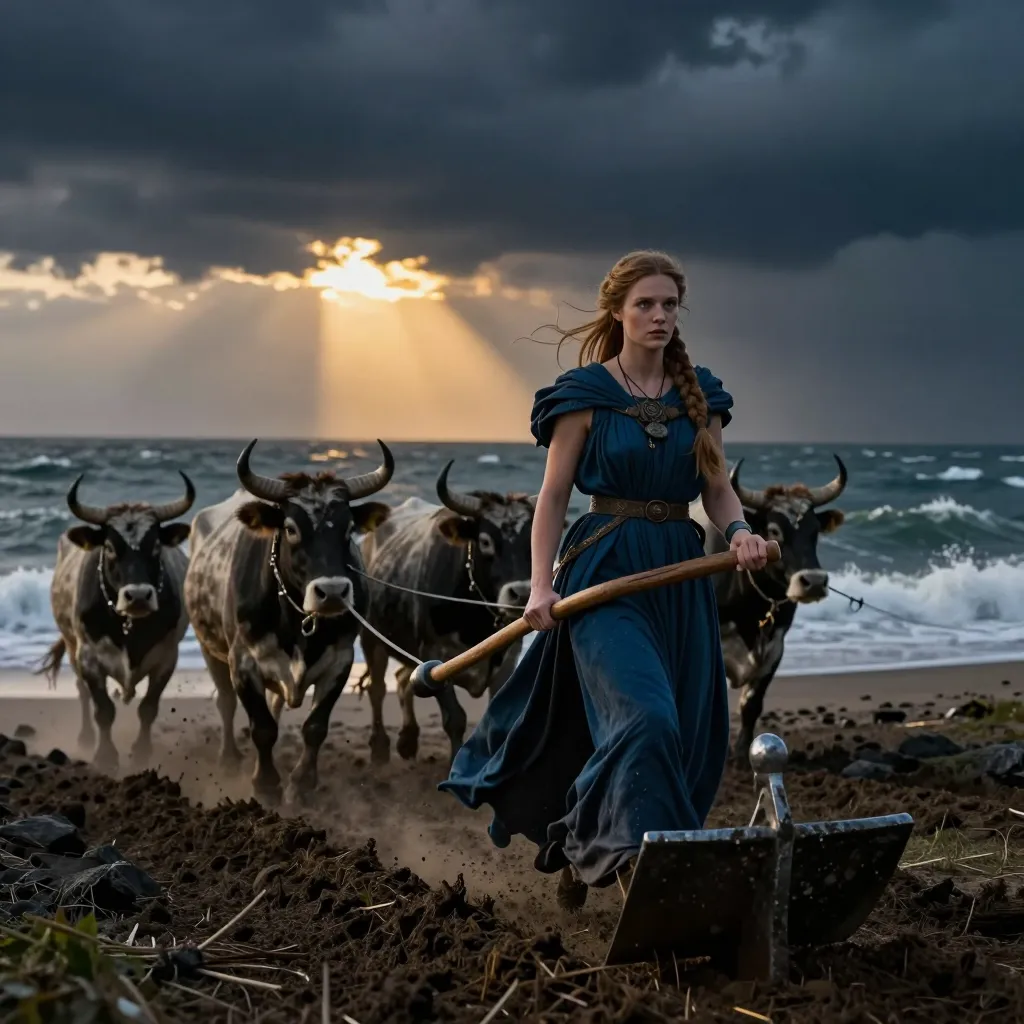
Gefjun: The Norse Goddess Who Ploughed Zealand from Sweden
Gefjun, the Norse goddess of fertility, is famed for ploughing the island of Zealand from Sweden in a single night, fulfilling a royal challenge. This myth underscores ancient Scandinavian reverence for land, prosperity, and nature's transformative power, inspiring tales of divine ingenuity.
Gefjun: The Norse Goddess Who Carved Islands from the Earth
In the shadowed halls of Norse mythology, where gods and giants wrestle across the frozen landscapes of the north, few figures embody the raw, transformative power of the earth itself like Gefjun. Known by many names—Gefjon, Gefiun, Gefion—she stands as one of the most enigmatic deities of the ancient Scandinavian pantheon, a goddess whose legend literally shaped the geography of northern Europe.
The Giver of Abundance
Gefjun's very name speaks to her essence. Derived from the Old Norse verb gefa, meaning "to give," she is the Generous One—the Giver of prosperity, fertility, and agricultural bounty. Unlike the thunder-wielding Thor or the one-eyed Odin, whose domains were war and wisdom, Gefjun presided over the quiet, essential magic of the soil and the harvest. She represented the covenant between human labor and divine reward, the sacred promise that the earth would yield its treasures to those who tended it with care.
The Creation of Zealand: A Myth Carved in Stone and Water
The most enduring tale of Gefjun comes to us through the writings of Snorri Sturluson, the thirteenth-century Icelandic historian whose Prose Edda preserved so much of what we know about Norse mythology today. While scholars debate how much of Snorri's work reflects authentic pre-Christian belief versus later Christian influence, the story of Gefjun and the creation of Zealand carries the unmistakable weight of ancient tradition.
According to Snorri, Gefjun once traveled through the lands of Sweden disguised as a wandering beggar woman. She appeared before King Gylfi, a ruler renowned for his generosity, and made a strange request: she asked for as much land as four oxen could plow in a single day and night. The king, moved by her apparent destitution, granted her wish.
But Gefjun was no ordinary supplicant. She possessed four sons fathered by a nameless giant, and with terrible divine power, she transformed these children into mighty oxen. Their strength was not of this world. They did not merely plow furrows in the earth—they carved deep into the bedrock itself, dragging an immense piece of land from the Swedish mainland. The wound they left behind filled with water, becoming Lake Mälaren. The land they dragged across the sea became the island of Zealand, upon which Copenhagen, the capital of modern Denmark, now stands.
This is no small myth. It is a geological origin story written in divine terms, explaining the formation of one of the most important landmasses in Scandinavian history. The story appears in abbreviated, more ambiguous form in the ninth-century poem Ragnarsdrápa by Bragi Boddason, suggesting that Snorri was working from genuine ancient material rather than inventing the tale wholesale.
The Plow and the Sacred Earth
Gefjun's association with plowing places her within a broader pattern of Germanic and Indo-European earth goddess traditions. Across the pre-Christian north, the act of cutting the first furrow was never mere agriculture—it was a sacred rite, a symbolic marriage between sky and earth that ensured fertility and abundance.
The Old English "Æcerbot" charm, recorded in the tenth century but undoubtedly preserving far older pagan material, illustrates this connection. Addressed to a lost goddess named Erce, the charm invokes the earth mother in language that echoes Gefjun's domain:
"Erce, Erce, Erce, Earth Mother, may the Almighty Eternal Lord grant you fields to increase and flourish..."
Here, even within a Christianized text, the ancient structure persists: the earth as feminine, receptive, and generative, requiring divine blessing to unlock its potential. The plow becomes the instrument of sacred union, the means by which humanity participates in the eternal cycle of death and rebirth that governs the agricultural year.
The name of another Norse earth goddess, Fjorgyn, reinforces this pattern. By the Viking Age, Fjorgyn had become a synonym for the earth itself, and etymologists trace her name to a Proto-Indo-European root meaning "furrow" or "split earth." From the plains of Scandinavia to the fields of Anglo-Saxon England, the image of the goddess as plowed earth, as the receptive field that brings forth life, runs like a deep current through Germanic religious imagination.
The Shadow of Nerthus
Gefjun's connection to Zealand carries another layer of significance. The Roman historian Tacitus, writing in the first century CE, described the worship of Nerthus, an earth mother goddess whose sacred grove lay on an island in the ocean—identified by many scholars as Zealand. Nerthus's cult involved a terrible annual procession, where her image was drawn through the land in a covered wagon, bringing peace and abundance in her wake, followed by the drowning of her slaves in a sacred lake to preserve the mystery of her rites.
The geographical overlap between Gefjun's creative act and Nerthus's cult center suggests a deep connection between these two figures. Were they aspects of the same divine reality, known by different names in different times and places? Or did Zealand's significance as holy ground for earth goddess worship lead multiple traditions to cluster around its shores? The evidence remains fragmentary, but the pattern is clear: in the Danish islands, the power of the feminine divine was particularly concentrated, particularly revered, and particularly dangerous to those who approached it without proper respect.
The Complexities of Divine Promiscuity
Gefjun's mythology contains troubling undercurrents that modern readers must confront. In the Eddic poem Lokasenna, the trickster god Loki accuses Gefjun of exchanging sexual favors for precious jewelry—a charge he levels simultaneously against Freyja, the Vanir goddess of love and fertility. This passage raises difficult questions about the representation of female divinity in Norse sources, which were overwhelmingly recorded by male Christian scribes centuries after the active worship of these goddesses had ended.
Yet the accusation also reveals something important about the fluid boundaries between Norse goddesses of abundance. Freyja herself bore the name Gefn, derived from the same root as Gefjun's name—another Giver, another Generous One. The similarities suggest that these figures may have been functionally interchangeable in certain contexts, local variations on a single divine archetype that manifested differently across time and space.
Snorri, perhaps uncomfortable with this aspect of Gefjun's character, presents a striking contradiction. In one passage, he declares that Gefjun is a virgin, and that women who die unmarried go to her company in the afterlife. This assertion sits uneasily with the myths of her giant-born sons and Loki's accusations of sexual transaction. It may reflect Christian influence, an attempt to purify a pagan goddess for medieval sensibilities, or it may represent one strand of tradition among many—regional variation, priestly interpretation, or folk belief that never made it into the written record.
The Many Faces of the Earth Mother
Gefjun cannot be separated from the broader category of Germanic earth mother goddesses that includes not only Freyja but Frigg, Nerthus, Fjorgyn, Jörð (the personified earth itself), and Sif, the golden-haired wife of Thor associated with the fertility of the fields. This proliferation of similar figures has puzzled scholars and frustrated systematizers. Why did the Norse not consolidate these powers into a single, coherent earth goddess, as other Indo-European peoples did?
The answer lies in the fundamental nature of Germanic religion, which resisted the rationalizing impulses that characterized Greek or Roman mythological systems. There was no Norse equivalent of Hesiod's Theogony, no systematic genealogy of the divine, no theological hierarchy imposed from above. Instead, local traditions flourished, each community knowing its own sacred landscape, its own particular manifestations of power. The earth goddess appeared in many forms because the earth itself varied—in its crops, its seasons, its dangers and its gifts.
This fluidity was not confusion but richness. It allowed for a religious imagination that could accommodate contradiction, that could hold multiple truths simultaneously. Gefjun was the virgin patron of unmarried dead women and the mother of giant-born oxen; she was the beggar who received charity and the power that carved islands from the living rock. She gave, and in giving, she transformed the world.
The Legacy of the Generous One
Today, Gefjun's most visible monument stands in Copenhagen harbor: the Gefion Fountain, completed in 1908, depicting the goddess driving her four oxen-sons as they tear Zealand from the Swedish earth. It is a nineteenth-century romantic vision, to be sure, but one that speaks to the enduring power of her myth. The fountain captures something essential about Gefjun—her ferocity, her maternal transformation of her children into instruments of creation, her refusal to accept the limits of what a "homeless woman" might claim.
In an age of environmental crisis and disconnection from the agricultural cycles that once governed human life, Gefjun's mythology offers a reminder of how intimately the ancient north understood its dependence on the earth's generosity. The plow was never merely a tool; it was a sacred instrument, a means of participating in divine creativity. The harvest was never guaranteed; it required proper relationship with the powers that governed growth and abundance.
Gefjun stands at the intersection of these realities—human and divine, agricultural and mythological, local and cosmic. She is the Giver, yes, but she is also the one who takes, who transforms, who reshapes the very land to fulfill her purposes. In her story, the earth is not passive matter to be exploited but living power to be negotiated with, honored, and sometimes feared.
The lake she left behind still holds water. The island she created still rises from the Baltic Sea. And somewhere in the deep structures of northern European imagination, the memory persists of a goddess who could turn her children into oxen and carve new worlds from the old, who gave not just abundance but transformation itself.