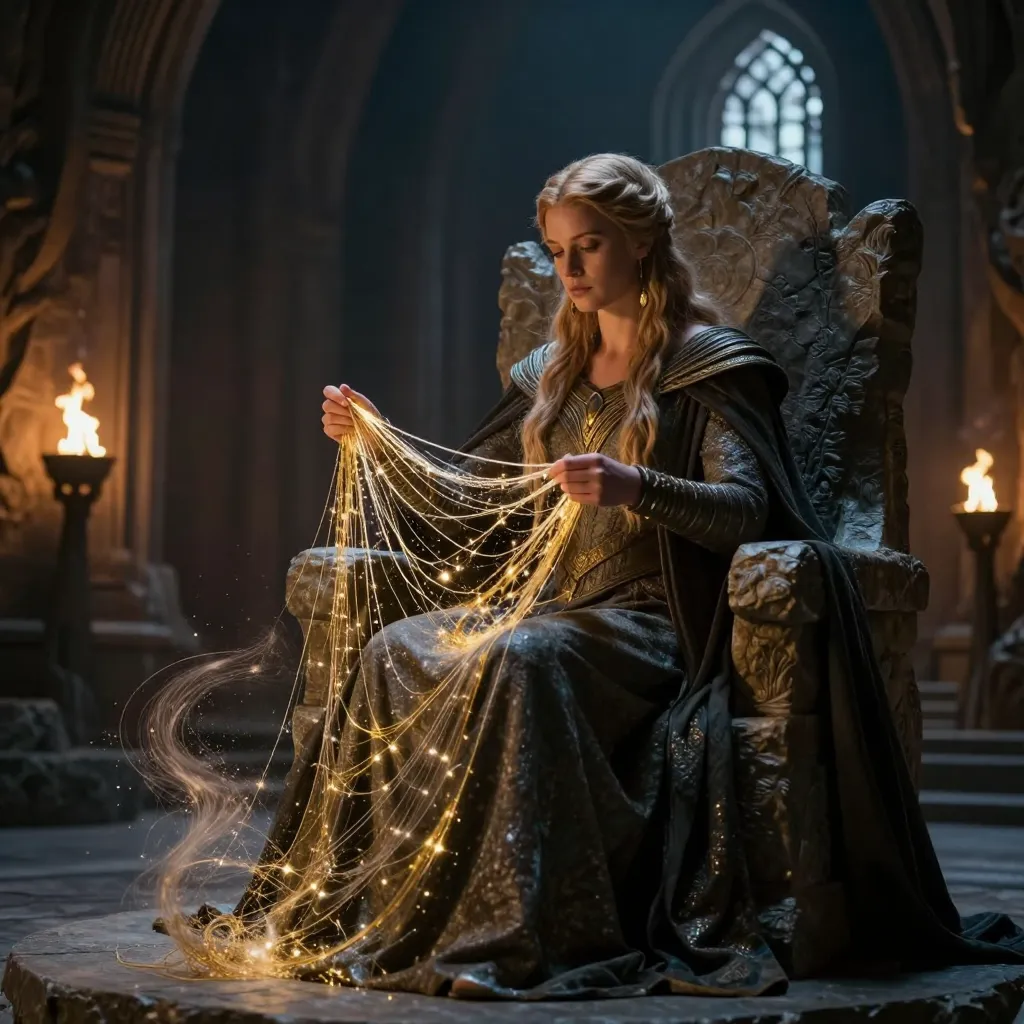
Frigg: The Enigmatic Queen Who Wove Norse Destiny
Frigg stands as Norse mythology's most enigmatic figure—Odin's consort, mother of Baldur, and master of seidr magic who perceives all fates yet speaks seldom. Her essence intertwines with Freya's, embodying the ancient feminine principle that weaves destinies across the cosmos.
Frigg: The Enigmatic Queen of the Norse Gods

In the shadowed halls of Asgard, where gods scheme and destinies intertwine, one figure stands apart—neither warrior nor trickster, yet holding power that rivals them all. Frigg, the highest-ranking goddess among the Aesir, moves through Norse mythology like mist through ancient forests: present everywhere, fully grasped nowhere. Her name, derived from Old Norse Frigg meaning "Beloved," barely hints at the depths of her enigmatic nature.
As consort to Odin Allfather and mother to the radiant Baldur, Frigg occupies the apex of the divine hierarchy. Yet the surviving sources—those fragmented chronicles preserved through centuries of oral tradition and Christian transcription—treat her with puzzling restraint. Where other deities boast exploits and adventures, Frigg exists in atmospheric presence: the silent weaver, the knowing seer, the queen who sees all fates yet speaks few of them.
The Twin Faces of the Divine Feminine
The most haunting aspect of Frigg's mythology lies not in what we know, but in what we cannot separate. She shares her essence with Freya, the Vanir goddess of love and war, to such an extent that scholars have spent generations attempting to draw lines where the ancients saw none. Both wield seidr, that primordial magic of spinning and reweaving fate itself. Both possess falcon-feathered cloaks for shapeshifting into the sky. Both know the destinies of all beings, as Freya herself acknowledges in the Lokasenna when warning Loki that Frigg perceives the fate of all creation.
This duplication runs deeper than shared attributes. The names themselves tell a story of fragmentation. Freyja translates simply as "Lady"—a title, not a distinct identity. Frigg speaks of love and longing. In the Proto-Germanic tongue from which both descend, they were one: Frija, the Beloved Lady, wife of Woðanaz who would become Odin. Only the Norse sources split them asunder, while other Germanic peoples maintained the unity their names suggest.
The völva—those wandering seeresses who moved between worlds and settlements, exalted and feared in equal measure—served as the human reflection of this divine archetype. During the Migration Period, before the Viking Age dawned, such women held institutional power within the warbands that defined Germanic society. Tacitus records the veleda, the chieftain's wife who divined battle outcomes and served the ceremonial mead cup that bound warriors to their oaths. The Old English Beowulf preserves this memory in Queen Wealhþeow, whose ritual actions maintain the very fabric of political power. These mortal women embodied the same force that Frigg and Freya represented in the heavens: the feminine principle that weaves together the threads of fate, desire, and social order.
The Absent Husband and the Weeping Wife
The mythology surrounding Frigg's marriage carries its own shadows of ambiguity. Her husband Óðr bears a name virtually identical to Odin—Óðr meaning "ecstasy, inspiration, furor," while Óðinn simply adds the masculine article. The Prose Edda tells us Óðr wanders endlessly, leaving Freya weeping tears of red gold for his absence. Yet Odin himself is the eternal wanderer, the god who sacrifices himself to himself upon Yggdrasil, who traverses the Nine Worlds under countless disguises. The parallel invites us to see not two distinct deities, but one divine nature refracted through different lenses.
Infidelity haunts both marriages. Saxo Grammaticus records Frigg's liaison with a slave. The Lokasenna and Ynglinga Saga describe how Odin's brothers Vili and Ve shared Frigg's bed during their sibling's exile—stories that echo accusations against Freya's own reputed promiscuity. The scholarly attempts to distinguish the "steadfast" Frigg from the "wanton" Freya collapse against such evidence. They are not moral opposites but mirror images, the same goddess viewed through different cultural moments and scribal choices.
The Loom of Fate
Frigg's most evocative attribute remains her spindle. In John Charles Dollman's 1909 painting "Frigga Spinning the Clouds," she appears as cosmic weaver, drawing threads through the heavens themselves. This imagery connects directly to seidr practice, where fate was literally spun and woven into being. The Norns at the Well of Urd may hold the ultimate threads, but Frigg possesses the knowledge—and perhaps the technique—to perceive and potentially influence their pattern.
Her silence regarding what she knows creates the atmosphere of mystery that surrounds her. Unlike Odin, who sacrifices an eye for wisdom and proclaims his knowledge widely, Frigg keeps her own counsel. When Loki slanders her in the Lokasenna, she responds not with revelation but with dignified restraint. She knows how all stories end. Perhaps that knowledge renders dramatic confrontation unnecessary, or perhaps it imposes its own heavy silence.
The Echoes of Friday
The week's fifth day preserves her memory across Germanic languages, named for Frija the Proto-Germanic foremother. That the Norse themselves could not decide whether Freyjudagr or Frjádagr deserved the honor—whether Freya or Frigg should claim the day—testifies to their fundamental unity. No other Germanic people fractured their great goddess thus. Only in the North did scribal tradition and regional variation create two divine personalities where one had sufficed for centuries.
This division may reflect historical processes now lost to us: the merging of different tribal traditions, the influence of Christian dualism on pagan recording, or simply the natural drift of oral culture across vast Scandinavian territories. The reasons remain as mysterious as Frigg herself, who watches from her high seat in Asgard, spindle in hand, knowing all that will come to pass yet weaving still—because even foreknowledge does not release us from the necessity of the work.
In the end, Frigg stands as mythology's great unknowable: the queen who needs no crown, the seer who needs no prophecy, the beloved who contains multitudes. She is the dark mirror in which Freya is also reflected, the ancient power that predates the names we give it, the eternal feminine principle weaving order from the chaos of becoming.