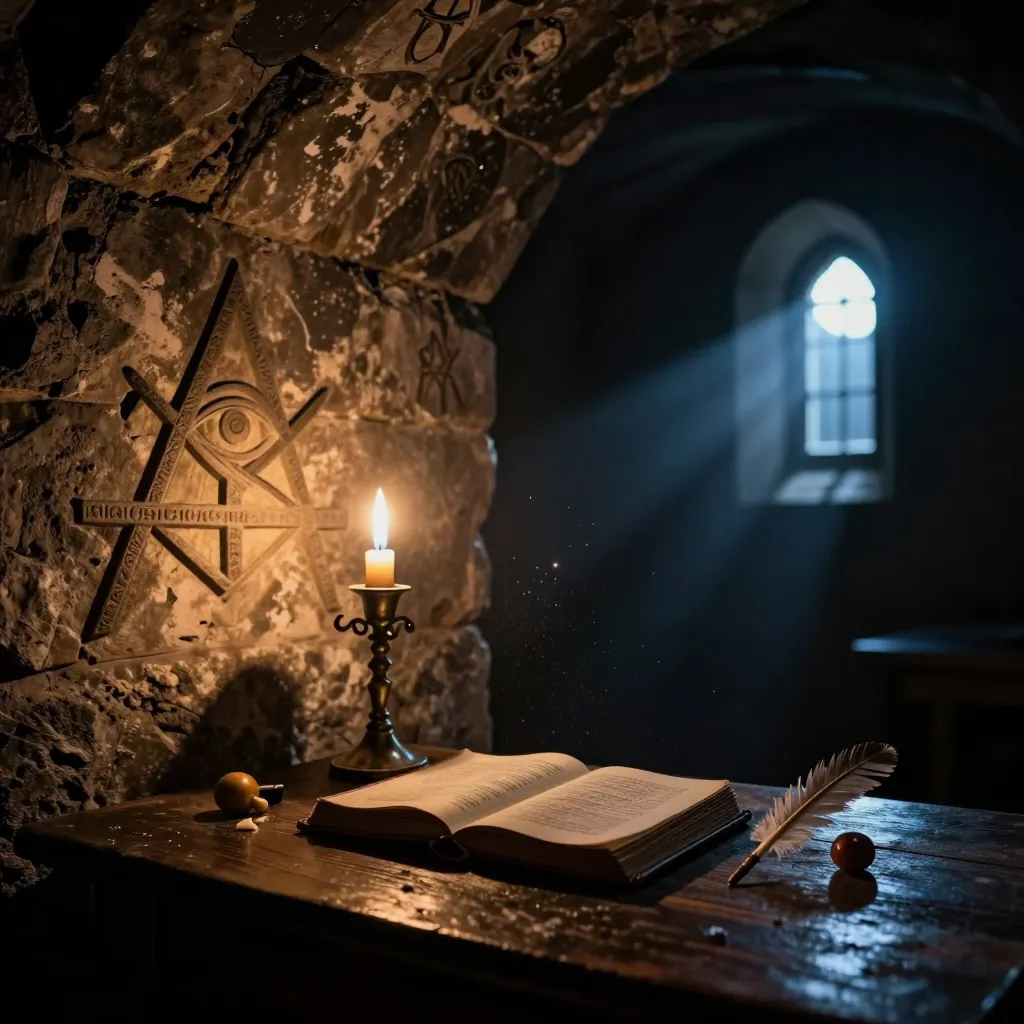
Freemasons vs. Illuminati: Secrets Shaping History
Dive into the real origins: Freemasons evolved from medieval stonemasons into a philosophical brotherhood of rituals and charity. Illuminati, a radical Enlightenment plot for rational perfection, collapsed amid raids and myths. Perfect for fans of true historical mysteries and why these societies still captivate imaginations.
Freemasons vs. Illuminati: The Secret Societies That Shaped the Shadows of History
For centuries, whispers have echoed through the corridors of power and the backrooms of taverns alike—whispers of two shadowy brotherhoods pulling the strings of empires, revolutions, and the very fate of nations. The Freemasons and the Illuminati. Names that conjure images of candlelit rituals, hidden symbols, and men in ornate robes guarding truths too dangerous for the common world.
But peel back the layers of conspiracy, and a far more fascinating story emerges—one of Enlightenment ideals, secret handshakes, coded correspondence, and a single question that still haunts historians: why do we crave the idea that someone, somewhere, is running the world from behind a velvet curtain?
The Craftsmen Who Became Brothers
The origins of Freemasonry stretch back to the misty Middle Ages, when guilds of skilled stonemasons traveled across Britain and Europe, their hands calloused from carving the soaring Gothic cathedrals that still pierce the skies today. These were not conspirators—they were artisans. Yet their trade held secrets: specialized techniques, proprietary knowledge, and a brotherhood bound by the work itself.
To prove membership when arriving in a new city, these traveling craftsmen developed signs, passwords, and grips—silent signals that identified them as fellow workers of the stone. Over time, as the great cathedral projects waned, the guilds faced a choice: fade into obscurity, or evolve.
They chose evolution. In the 17th century, "speculative" Freemasonry emerged—transforming from a trade organization into a philosophical fraternity open to men of learning and standing, not just those who could wield a chisel. The first Grand Lodge convened in London in 1717, marking the formal birth of modern Freemasonry as we know it: a society devoted to moral self-improvement, charitable works, and the bonds of brotherhood.
By the 1700s, membership in a Masonic lodge had become deeply fashionable among Europe's aristocracy and emerging middle class. It offered something revolutionary for its time—a space where a duke and a merchant could sit as equals, bound by ritual rather than rank.
The Professor and His School of Shadows
The Illuminati arrived nearly six decades later, born not in a stonemason's lodge but in the mind of a disillusioned academic.
In 1776, Adam Weishaupt, a professor of canon law at the University of Ingolstadt in Bavaria, gathered a small circle of students into what he initially called the "Perfectibilists." The name alone reveals his Enlightenment fervor—a belief that human society could be perfected through reason, knowledge, and the dismantling of religious dogma and political oppression.
By 1778, Weishaupt had rechristened his group the "Illuminati," a Latin-derived term meaning "the enlightened ones." The name was deliberate and defiant. In an era where the Catholic Church held immense sway over education, politics, and daily life, the Illuminati positioned themselves as bearers of light against the forces of darkness—specifically, the institutional church and the authoritarian states that propped it up.
Weishaupt's methods were radical for their time. He recruited from universities and, strategically, from within Freemasonry itself. The Illuminati adopted a tiered structure with grades of initiation, incorporating some Masonic rituals and symbols to lend his fledgling order an air of ancient mystery and established credibility. Yet beneath the theatrical trappings lay a genuinely subversive agenda: the gradual infiltration of positions of power to reshape society from within.
Two Kinds of Secrecy
Here lies the crucial distinction between these two brotherhoods—and it is a distinction that has been blurred by two centuries of conspiracy mythology.
Freemasonry was never truly hidden. In the 18th century, being a Freemason was a mark of social standing, something a man might mention with pride at dinner parties. The secrecy was specific and contained: the rituals conducted within the lodge walls, the grips and passwords exchanged during initiation ceremonies, the symbolic meanings of the tools and emblems. What happened in the lodge stayed in the lodge—but the lodge itself was no secret.
The Illuminati, by contrast, operated in genuine clandestinity. Members communicated in cipher. They used code names. Their local cells were called "Minerval Churches," referencing the Roman goddess of wisdom, and recruitment happened quietly, carefully, often without the recruit initially understanding the full scope of the organization.
One was a semi-public fraternity with private rituals. The other was a covert network with revolutionary ambitions. The difference matters.
The Allure of the Hidden
Why did Enlightenment-era men—rationalists who championed science and reason—flock to secret societies in such numbers?
The answer lies in the tension of the age. The Enlightenment challenged the divine right of kings and the absolute authority of the church, but it did not eliminate the human hunger for ritual, symbolism, and transcendent experience. Freemasonry offered a quasi-religious framework without theological dogma: candlelit ceremonies, symbolic journeys from darkness to light, the drama of initiation and advancement through degrees.
For the aristocrat, it provided rare egalitarian fellowship. For the bourgeois intellectual, it offered a space to speak freely among peers. For the spiritually inclined, it delivered mystery without superstition.
The Illuminati capitalized on this same hunger but added something more potent: the promise of genuine power to reshape the world. Weishaupt positioned his order as a kind of "higher-degree" Freemasonry, where initiates first passed through familiar Masonic ranks before ascending to Illuminati-specific grades. The allure was irresistible—a secret within a secret, knowledge beyond knowledge.
By 1783, what had begun as a professor's private reading circle had swollen to hundreds of members across German-speaking lands, its tentacles reaching into universities, government offices, and Masonic lodges.
Symbols, Misunderstood
No discussion of these societies would be complete without addressing the symbols that have fueled endless speculation—and endless misinformation.
The "Eye of Providence," that unsettling gaze within a triangle that watches from the back of the U.S. one-dollar bill, has been incorrectly attributed to both Freemasonry and the Illuminati for generations. In truth, it was a well-established Catholic symbol representing the Holy Trinity, displayed prominently in Jesuit churches across Europe long before either society adopted it. While some unpublished 18th-century Masonic writings do reference an "all-seeing eye," the symbol's origins are ecclesiastical, not conspiratorial.
The unfinished pyramid, another feature of the dollar bill's reverse, has similarly been misidentified. Egyptian imagery did appear in both Masonic and Illuminati ceremonies—the pyramid as metaphor for the unfinished work of perfecting oneself and society—but it was never central to either group's identity. For Freemasons, the Temple of Solomon held infinitely greater ritual significance than any pyramid.
The true symbols of Freemasonry are the compass and the square, the working tools of the stonemason's trade, often accompanied by a capital "G" for geometry or, in some interpretations, the Great Architect of the Universe. These emblems adorn lodge exteriors and ceremonial regalia, a constant reminder of the fraternity's origins in the medieval building trades.
The Illuminati's distinctive symbol, far less famous but historically verified, was the owl of Minerva perched upon an open book. Athena—Minerva to the Romans—goddess of wisdom and strategic warfare, daughter of Zeus, patron of those who would bring light to darkness. The image encapsulated the order's self-conception: learned, watchful, and illuminated.
The Unmasking and the Aftermath
The Illuminati's downfall came swiftly and brutally. In 1787, the Bavarian government raided Illuminati properties, seized their documents, and published the trove of private correspondence, coded messages, and ritual descriptions.
"The moment the Bavarians publish the Illuminati materials, the order collapses almost immediately," notes modern scholarship on the episode. "It's a quick end to the organization, because it doesn't have any secrets to offer new members. The secret is out."
The Elector of Bavaria outlawed the Illuminati outright. Adam Weishaupt fled into exile, his dream of a perfectly rational society dismantled by the very political forces he had sought to undermine.
But the story did not end there. It transformed.
Within years of the Illuminati's dissolution, the first conspiracy theories began to circulate. When the French Revolution erupted in 1789—overthrowing a monarchy, executing a king, and reshaping Europe's political map—conservative commentators scrambled for explanations. The Illuminati, defunct for years and never active in France, became the perfect scapegoat. The revolution, they claimed, was not the product of economic desperation and Enlightenment philosophy—it was orchestrated by Weishaupt's hidden network, still manipulating events from the shadows.
It was a fiction. But it was a compelling fiction, one that has never truly died.
The Society That Survived
Freemasonry, meanwhile, endured. It weathered the anti-Masonic political movements of the 19th century, adapted to changing social mores, and persists today in various forms across the globe. While it has lost much of its fashionable allure, the fraternity continues as a network of lodges dedicated to charitable work, community service, and the philosophical traditions of its founders.
Numerous affiliated organizations trace their lineage to Masonic roots, including charitable fraternal bodies that originated as "higher" or specialized Masonic orders. The stonemasons' ancient guild system, transformed into a philosophical brotherhood nearly three centuries ago, still maintains its rituals, its degrees of initiation, and its commitment to the idea that men can improve themselves and their communities through fellowship and moral reflection.
Why the Myth Persists
The Illuminati, in their historical form, lasted barely a decade. The Freemasons have endured for centuries as an open secret—visible yet veiled, public yet private. Yet both names remain potent in the popular imagination, invoked to explain everything from political assassinations to pop music videos.
Perhaps the persistence of these myths reveals something deeper about the human psyche. We want to believe that someone is in control, even if that someone is malevolent. The alternative—that history is chaotic, that power is diffuse and often incompetent, that no one is steering the ship—is in many ways more terrifying than the most elaborate conspiracy theory.
The Freemasons and the Illuminati were real. Their secrets, where they existed, were mundane—rituals and handshakes, not world domination. Their goals, where they were sincere, were idealistic—fraternity, equality, the pursuit of knowledge. The shadows they cast were largely of their own making, cultivated deliberately to attract members and inspire loyalty.
But in the darkness those shadows created, our imaginations have run wild for over two centuries. And in that wildness, perhaps, lies the truest secret of all: not that these societies controlled history, but that we have always wanted someone to.