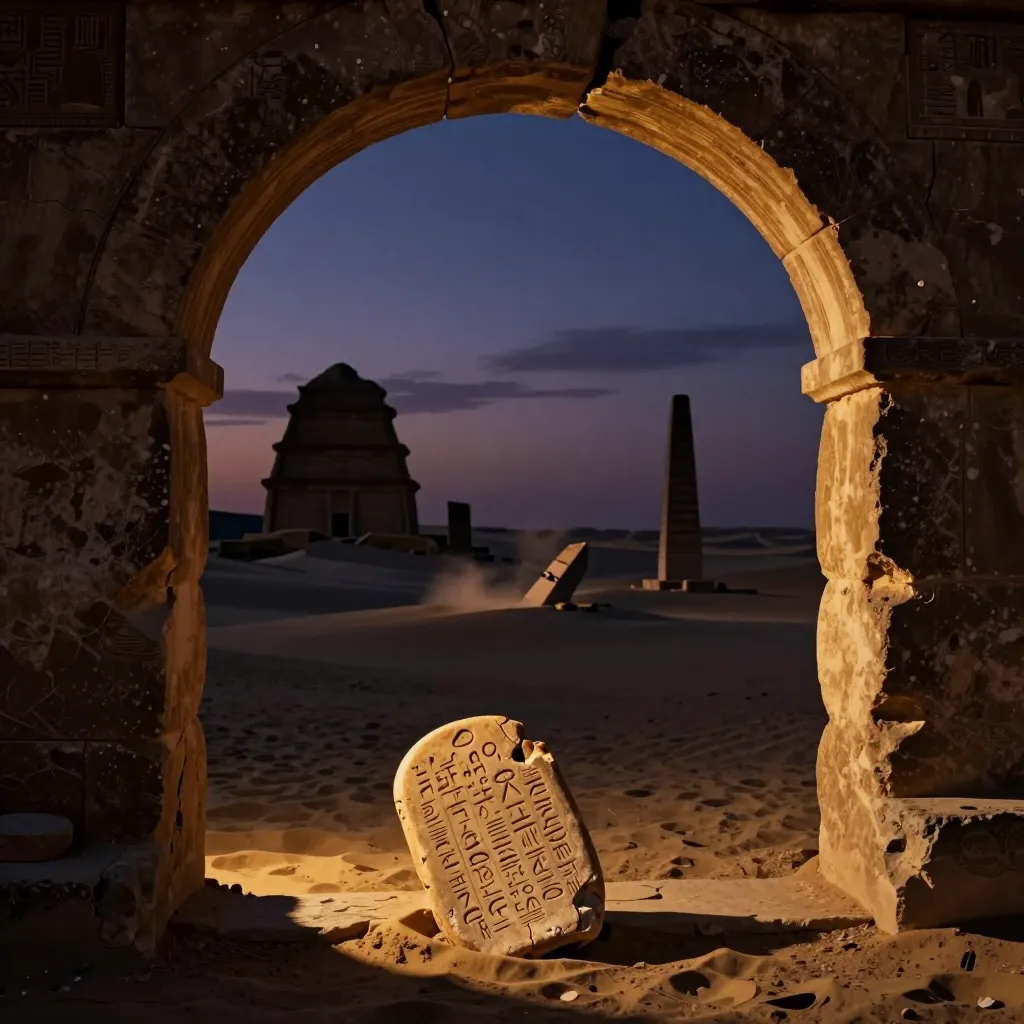
Five Vanished Civilizations That Still Haunt the Archaeological Record
From the invisible throne of Akkad to the phantom kingdom of Punt, these vanished civilizations survive only as whispers in ancient texts. Discover why rivers, silt, and time have erased history's most magnificent capitals—and why archaeologists are still hunting them.
Five Vanished Civilizations That Still Haunt the Archaeological Record
The ancient world is littered with ghost towns—cities that once pulsed with life, power, and commerce before vanishing into sand, silt, or silence. While modern technology has resurrected marvels like Petra and Pompeii from their graves, other capitals remain stubbornly invisible. They survive only as whispers in cuneiform tablets, fragments of papyrus, or the half-remembered grandeur of empire. These are not mere ruins waiting to be uncovered; they are absences—negative spaces in history where something magnificent once stood.
Here are five lost worlds that continue to defy discovery.
1. Akkad: The Invisible Throne of the First Empire
In the cradle of civilization, where the Tigris and Euphrates once nourished the birth of urban life, rose Akkad—the capital of history's first true empire. Sargon the Great founded this city around 2334 B.C., forging the Akkadian Empire from the fractious city-states of Mesopotamia. For nearly two centuries, it stood as the beating heart of an empire that stretched from the Persian Gulf to the Mediterranean.
Then, around 2154 B.C., it fell. And then it disappeared.
The mystery of Akkad's location persists because the city broke the rules of ancient urban survival. Unlike Babylon, Ur, or Nineveh—cities continuously inhabited for millennia that grew into towering tells of accumulated human history—Akkad's life was brief. In Mesopotamian terms, it barely existed. Its ruins, perhaps only a few meters high after abandonment, lacked the monumental bulk to withstand four thousand years of environmental erosion.
Shifting river courses have likely swallowed its foundations. Alluvial deposits—loose sediment carried by floodwaters—may have entombed it beneath meters of earth. Climate change and agricultural development finished what nature began, scrubbing the landscape clean of evidence. Unlike the great ziggurats that pierce the Iraqi horizon, Akkad left no silhouette against the sky. It is a city that collapsed not just politically, but physically—dissolving back into the alluvial plain from which it rose.
2. Itjtawy: The Pharaoh's City Buried by the Nile
Ancient Egypt's Middle Kingdom (circa 1985–1650 B.C.) needed a new capital. Amenemhat I, founder of the 12th Dynasty, established Itjtawy—"Seizer-of-the-Two-Lands"—to consolidate his power and mark a new era. For centuries, this city served as the administrative and royal seat of one of Egypt's most prosperous periods.
Today, its location remains one of Egyptology's most tantalizing voids.
Ancient texts like the Victory Stela of Piye place Itjtawy in the approximate region east of Lisht, near the Nile's floodplain. But the river is a merciless architect. Over four millennia, repeated flooding deposited layers of silt, sand, and clay—a process called alluviation—that gradually entombed the city. Memphis, Egypt's ancient capital near modern Cairo, now lies largely hidden beneath accumulated sediment; Itjtawy likely suffered a similar fate.
The catastrophe is twofold. Not only has the ground risen around it, but the Nile itself has migrated eastward, potentially obliterating entire districts that once stood on the eastern bank. What survives may lie beneath modern agricultural fields, inaccessible without large-scale subsurface exploration using coring, remote sensing, and geoarchaeology—techniques that have yet to be deployed at the necessary scale.
Itjtawy is not lost because we lack clues. It is lost because the very river that gave it life has rewritten the map.
3. Irisagrig: A City Known Only Through Its Bureaucracy
In the archives of ancient Mesopotamia, cities often emerge first as administrative abstractions—collections of tax records, labor rosters, and grain distributions. Irisagrig is the extreme case: a functioning urban center known almost exclusively through the banal minutiae of its bureaucracy.
Cuneiform tablets from the Ur III period (2100–2000 B.C.) and Old Babylonian era (2000–1600 B.C.) mention Irisagrig in passing. They document land grants, rations for palace workers, canal inspections, and even provisions for the "dogs of the palace." These records suggest a thriving administrative hub integrated into a sophisticated state network. Yet not a single tablet identifies its precise location in modern Iraq.
The trail is further poisoned by modern tragedy. Many Irisagrig tablets surfaced through the antiquities black market after the 2003 invasion of Iraq, stripped of their archaeological context. Like stolen memories, they retain information but have lost their provenance—their connection to place.
Scholars suspect Irisagrig lay along an ancient course of the Tigris River, perhaps in the marshlands or alluvial plains of central Iraq. But without systematic excavation or the recovery of in-situ artifacts, it remains a city of paper—real enough to feed its workers and inspect its canals, yet unreal in the physical world, a phantom generated by its own bookkeeping.
4. Thinis: The Capital Before History Began
Before Thebes, before Memphis, before the pyramids at Giza, there may have been Thinis. This shadowy city is tied to the very unification of Egypt—the legendary moment around 3000 B.C. when Upper and Lower Egypt became one kingdom under the First Dynasty rulers.
Ancient texts describe Thinis as a political and religious center associated with the earliest pharaohs. Archaeologists believe it stood near Abydos, one of Egypt's most sacred necropolises and the burial ground of predynastic and early dynastic kings. Yet despite its apparent importance, Thinis has never been definitively identified.
The forces that erased Thinis are both natural and political. Climatic shifts toward desertification may have strangled its water sources and agricultural base, forcing abandonment. Increased modern farming over potential archaeological zones has further obscured the evidence. But Thinis may also have been a victim of Egypt's own political evolution. As the ruling system centralized and fragmented across different periods, early capitals lost their primacy—and eventually, their memory.
Unlike later Egyptian cities that were built to endure eternity, Thinis belonged to an era before monumental stone architecture. Mudbrick and organic materials have returned to the earth, leaving little to distinguish a capital from the surrounding desert.
5. The Land of Punt: A Kingdom Without Coordinates
The Land of Punt was never a single city, but its inclusion here is essential—because its very existence as a defined place has evaporated from the map. For over a millennium (circa 2500–980 B.C.), Egyptian records describe Punt as a source of incense, gold, ivory, and exotic animals. The most vivid depictions come from the reign of Hatshepsut, whose mortuary temple at Deir el-Bahari includes detailed reliefs of organized expeditions to this mysterious realm.
Despite these rich records, Punt has never been located.
Scholars have proposed regions along the Red Sea coast of Africa—modern Eritrea, Somalia, Sudan, or even the Arabian Peninsula. But the ancient descriptions are frustratingly vague. Punt was "the land of the gods," a place of aromatic forests and strange beasts, reached by sea and desert routes that themselves have vanished.
The disappearance of Punt is different from the other cities on this list. It was not buried by a river or abandoned to desertification. Rather, it seems to have dissolved from the historical record as trade routes shifted, as the incense trade found new sources, and as the Egyptian memory of the place faded into myth. Punt may have been a real kingdom, or a composite of several trading partners, or a symbolic landscape that existed more in Egyptian imagination than in geographic reality.
What remains is the longing—a civilization's sustained effort to reach a place that, in the end, may have been more idea than location.
The Archaeology of Absence
These five vanishments share common threads. Rivers move, silt accumulates, climates shift, and empires fall. Cities built of perishable materials return to the earth; those built of stone are quarried by later generations. The ancient world was not constructed to last forever.
But there is another factor: archaeology itself has changed its focus. Where earlier generations of scholars dreamed of discovering lost capitals and treasure-laden tombs, modern archaeology increasingly studies how ordinary people lived—analyzing diet, disease, daily labor, and social organization through scientific methods. The romance of the lost city has given way to the science of the lost life.
Still, the absence persists. Somewhere beneath Iraqi farmland, Egyptian alluvium, or Sudanese desert, these places wait. They are not merely archaeological sites; they are gaps in the human story, reminders that even the greatest achievements of civilization can be reduced to silence by time, water, and the slow forgetting of the world.