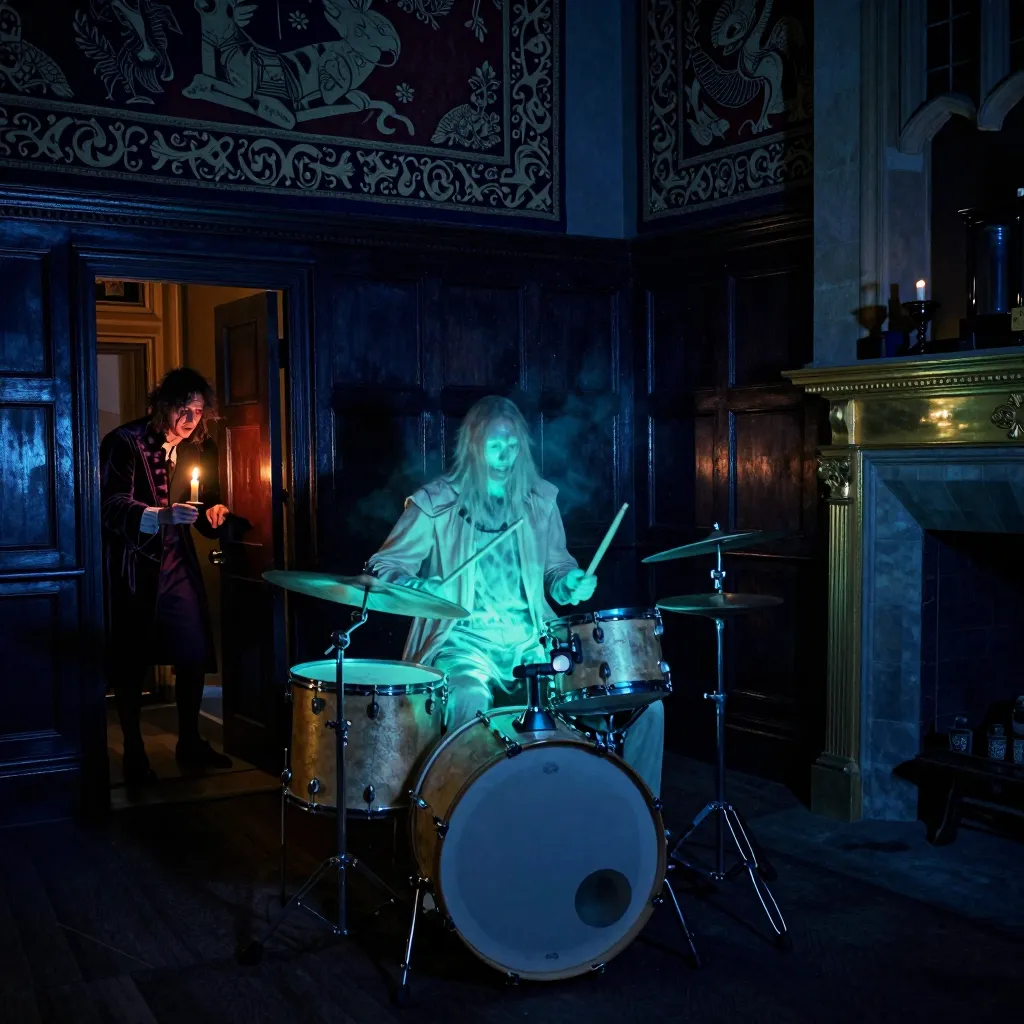
The Demon Drummer of Tedworth: England's First Documented Poltergeist Case
In 1661, John Mompesson faced a terrifying two-year ordeal involving levitating furniture and spectral drumming. Was it a vengeful curse from a disgruntled vagrant, or an elaborate 17th-century prank? Explore the history behind England's most famous and unsettling poltergeist encounter.
The Haunted Legacy of the Demon Drummer of Tedworth
For centuries, the veil between the living and the dead has been a source of both terror and fascination. [cite_start]While modern media is saturated with tales of the paranormal, one of the most significant accounts in British history dates back to 1661: the case of the Demon Drummer of Tedworth[cite: 5]. [cite_start]Regarded by many as the first documented poltergeist encounter in England, this 17th-century haunting remains a cornerstone of supernatural lore[cite: 5].
The Incident at Ludgershall
[cite_start]The saga began when John Mompesson, a local magistrate, visited the town of Ludgershall in Wiltshire[cite: 10]. [cite_start]During his stay, he encountered William Drury, a vagrant who had been disturbing the peace by relentlessly playing a drum and begging for money[cite: 11, 12]. [cite_start]Upon investigating, Mompesson discovered that Drury’s busking permit was a forgery[cite: 13].
[cite_start]As a consequence, the local authorities confiscated Drury’s drum[cite: 14]. [cite_start]Although the case never proceeded to a formal court, the instrument was eventually sent to Mompesson’s own home in Tedworth[cite: 14, 15]. [cite_start]Shortly after the drum arrived, the peace of the Mompesson household was shattered by inexplicable phenomena[cite: 15, 16].
A Household Under Siege
[cite_start]What started as rhythmic drumming sounds soon escalated into a full-scale haunting[cite: 16]. [cite_start]For two years, the family and their staff were subjected to a variety of physical disturbances[cite: 21, 23]:
- [cite_start]Auditory Phenomena: Constant knocks, bangs, and the unmistakable sound of ghostly drumming plagued the house, often preventing the inhabitants from sleeping[cite: 16, 26].
- [cite_start]Physical Manifestations: Objects were observed levitating through the air, and bedclothes were frequently yanked off sleeping guests[cite: 23, 25].
- [cite_start]Focus on the Children: The activity was most intense in the children’s bedroom, where screeching sounds emanated from under beds[cite: 19, 20]. [cite_start]Most disturbingly, the children were reportedly levitated several feet into the air, and witnesses claimed they could not be held down by force[cite: 20, 21].
[cite_start]In an attempt to cleanse the home, Mompesson sought the help of a priest[cite: 25]. [cite_start]Observers noted that while the drumming ceased during prayer, the disturbances returned with increased vigor once the religious rites concluded[cite: 26, 27].
Seeking an Explanation: Curse or Contrivance?
The "Demon Drummer" remains a subject of historical debate, with several theories attempting to explain the two-year ordeal.
The Sorcery of William Drury
[cite_start]At the time, many believed the haunting was an act of vengeance by William Drury[cite: 29]. [cite_start]Drury himself allegedly claimed he had cursed Mompesson for taking his livelihood, stating the haunting would only cease if his drum were returned[cite: 29, 30]. [cite_start]His apparent aversion to religious symbols led to his trial and conviction as a wizard, resulting in his deportation to the American colonies[cite: 31, 32].
The Possibility of a Hoax
Skeptics then and now suggest more earthly origins for the events. [cite_start]Some contemporary experts, including Joseph Glanvil, suspected the Mompesson children might have been responsible for the tricks, noting that the activity centered around their quarters[cite: 34]. [cite_start]Others suggest that the "haunting" was a coordinated effort by Drury’s associates or local groups who had been wronged by the magistrate, using the legend to systematically harass the family[cite: 35, 36, 39].
A Milestone in the Unexplained
[cite_start]Whether the result of a bitter curse or an elaborate 17th-century prank, the Demon Drummer of Tedworth helped define the modern concept of a poltergeist—a "noisy ghost" capable of physical manipulation[cite: 6]. It stands as a chilling reminder of an era where the lines between law, religion, and the occult were dangerously blurred.