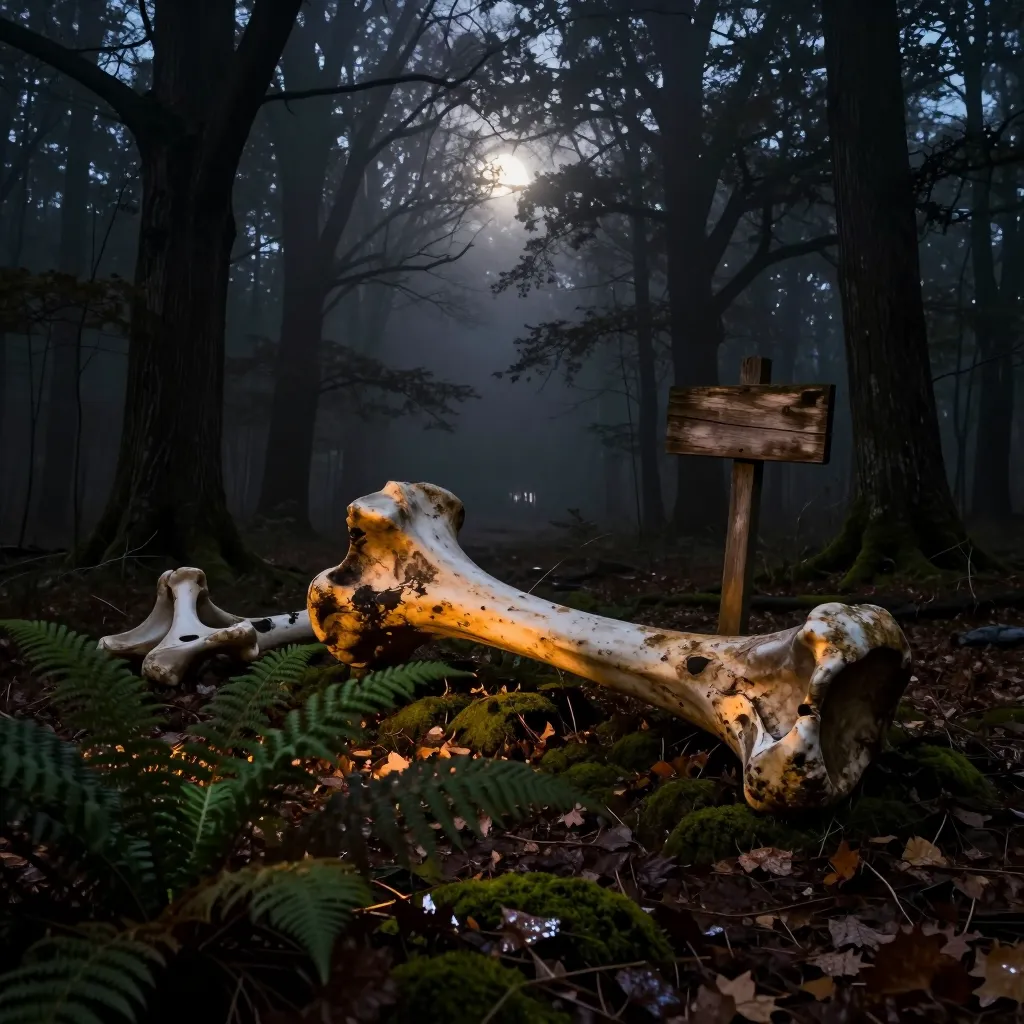
Conneaut Giants: The Mystery of Ohio's Lost Colossal Graveyard
Explore the haunting folklore of the Conneaut Giants, a lost civilization of colossal beings. From unearthed bones to local legends, we examine the strange phenomena surrounding Ohio's ancient, massive inhabitants and the mystery that still lingers today.
The Vanished Titans of Conneaut: Ohio's Most Enduring Burial Mystery
A Frontier Discovery That Defied Belief
In the waning years of the 18th century, as the American frontier pushed into the dense wilderness of the Ohio Valley, settlers anticipated hardship. They prepared for brutal winters, impenetrable forests, and the grueling labor of carving civilization from raw earth. What Aaron Wright could not have prepared for was the revelation lurking beneath his newly claimed land along Conneaut Creek.
Wright, a young pioneer who established his homestead in Ashtabula County in 1798, selected his parcel for its fertile soil and proximity to Lake Erie. Yet as he and his neighbors broke ground—clearing timber, turning soil, laying foundations for barns and cabins—they unearthed something that would haunt regional folklore for generations: an immense prehistoric cemetery spanning approximately four acres, containing an estimated two to three thousand carefully arranged graves.
The bones they exposed were not ordinary. Blackened by centuries of burial and shockingly brittle, the skeletal remains crumbled to dust almost as soon as they met open air and sunlight. But in those brief moments of exposure, the settlers observed proportions that defied everything they understood about human anatomy.
Accounts of Impossible Scale
Contemporary chroniclers, including schoolteacher and local historian Harvey Nettleton in 1844, recorded descriptions that read more like myth than excavation notes. The jawbones, witnesses claimed, were large enough to fit over a full-grown man's face with space to spare. Arm and leg bones suggested statures far exceeding any known population. Some accounts even described the discovery of a female skeleton—referred to in local lore as a "copper-clad queen"—standing roughly eight feet tall and adorned with elaborate copper jewelry.
These were not the crude remains of primitive survivalists. The grave goods spoke of sophistication: decorative beads, intricately carved stone implements, and copper artifacts indicating extensive trade networks and advanced metallurgical knowledge. The cemetery itself, with its systematic organization across thousands of burials, suggested a complex society with deeply formalized funerary customs.
The Conneaut finds were not isolated. Throughout the 1800s, similar reports filtered across the Midwest from ancient earthen mound excavations. But nowhere else did the concentration of allegedly massive remains match the scale described on Wright's property.
The Mound Builder Mythos
The true identity of these buried figures ignited one of the most persistent archaeological debates in American history. Nineteenth-century settlers, confronting earthworks of staggering scale in places like Circleville and Marietta, constructed a romantic narrative: a lost race of physically superior "Mound Builders" who had ruled the land before being annihilated by later populations.
This theory served the cultural needs of a young nation hungry for ancient grandeur. It transformed the frontier into a landscape of fallen titans and forgotten empires, lending mythological weight to westward expansion. Around hearths and in local papers, settlers wove archaeological observation into frontier legend, each retelling amplifying the mystery.
Modern archaeology offers a different explanation. The ancient mounds and burial complexes of Ohio are now attributed to the Adena culture (circa 1000/800 BC to 100/200 AD) and the later Hopewell tradition (circa 200 BC to 500 AD). These indigenous societies were remarkable for their monumental architecture, elaborate mortuary practices, and trade networks extending to the Gulf of Mexico. While certain individuals within these cultures may have achieved exceptional stature through elite nutrition and genetic factors, mainstream anthropology rejects the notion of an entire localized population of giants.
The Evidence That Dissolved
Skeptics argue that pioneer accounts were distorted by excitement and anatomical ignorance. Unearthing articulated skeletons from shifting soils can create optical illusions of exaggerated height, with bones appearing more spread apart than they were in life. The rapid decomposition of the remains—blackened, fragile, and centuries-old—meant no physical specimens survived for rigorous modern examination.
No photographs captured the massive jawbones. No museums preserved the crumbling skeletons. The institutions of the early 1800s lacked the conservation capabilities to stabilize such deteriorated organic material. What might have constituted extraordinary physical evidence dissolved into dust before scientific methodology could ever be applied.
Yet the detailed journals of men like Wright and Nettleton resist easy dismissal. These were pragmatic frontiersmen, grounded in agricultural reality and unaccustomed to fanciful storytelling. Their consistent descriptions of bone dimensions and cemetery scale suggest that something genuinely unusual lay beneath the Conneaut soil—even if the precise nature of that anomaly remains obscured by time and decay.
Buried Beneath Progress
The cultural footprint of the Conneaut Giants proved more durable than their physical remains. They became fixtures of northern Ohio folklore, inspiring treasure hunters, alternative historians, and generations of mystery enthusiasts drawn to the possibility that colossal humans once walked the Lake Erie shoreline.
The actual burial ground met a more prosaic fate. The four-acre cemetery that Wright discovered was eventually leveled, plowed under, and absorbed into the expanding village of Conneaut. Streets were paved. Houses were constructed. Commercial buildings rose atop the ancient graves, entombing whatever secrets remained beneath layers of asphalt and concrete.
Today, the Conneaut Giants exist primarily in archival records, fading local memory, and the peripheral debates of archaeological discourse. The tales of massive jawbones and copper-adorned queens persist as spectral reminders of how much ancient history remains irretrievable—lost not to conspiracy or cover-up, but to the simple, devastating passage of time and the relentless machinery of modern development.
Whether the settlers encountered genuine anomalies of human growth, misinterpreted remains of indigenous ancestors, or some combination of optical illusion and enthusiastic storytelling, the legend endures. The vanished titans of Ashtabula County stand as monuments to the enduring mysteries that lie just beneath the surface of the known world—waiting, perhaps, for some future excavation to finally reveal their truth.