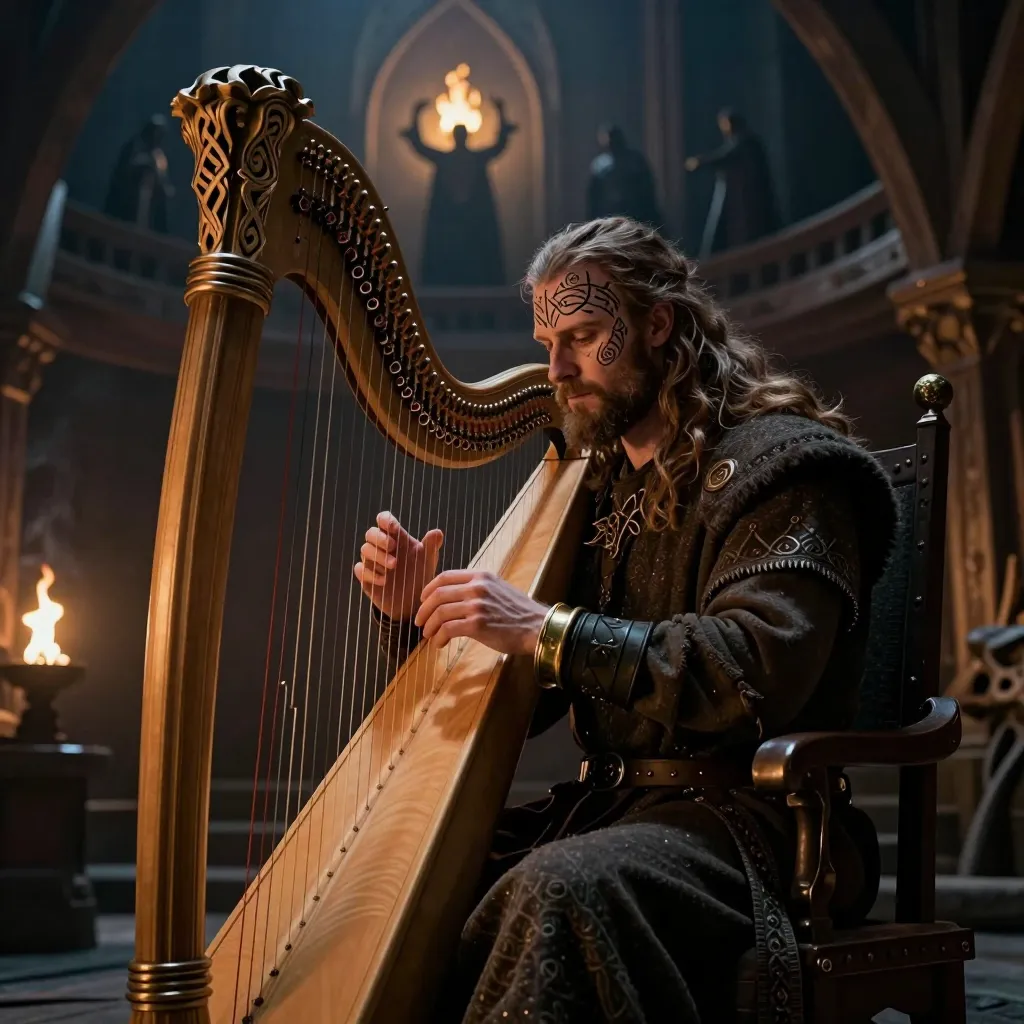
Bragi: The Skald of Valhalla Who Turned Warriors Into Eternal Legends
Bragi began as a mortal skald whose poetry moved the gods themselves. Elevated to Valhalla, he now immortalizes fallen warriors through verses carved with runic power. This article explores how Norse mythology elevated human artistry to divine status, and why the spoken word held more magic than any sword.
Bragi: The Skald of Valhalla
In the shadowed halls of Norse mythology, where warriors feast eternally and the mead flows like rivers of gold, there stands a figure whose words carry more weight than any sword. Bragi, the eloquent poet of the afterlife, serves as the eternal bard to Odin's chosen dead—transforming blood-soaked battlefields into verses that echo through eternity.
From Mortal Man to Immortal Voice
The origins of Bragi blur the line between history and legend. Before he became synonymous with poetic inspiration itself, Bragi Boddason walked the earth as a flesh-and-blood skald during the ninth century. His compositions were said to possess such devastating beauty that listeners wept without understanding why. The sagas suggest his craft was so transcendent that upon his death, the All-Father himself plucked the mortal poet from the void and installed him in Valhalla's highest seat.
This apotheosis through artistry speaks to how the Norse understood creative power. In a culture where spoken word could bind legal agreements, curse enemies, or summon supernatural forces, the poet occupied a liminal space between humanity and divinity. Bragi's elevation wasn't merely reward—it was recognition that certain forms of human excellence deserved preservation beyond the grave.
The Runes Upon His Tongue
Norse sources preserve a haunting image of this figure: runes carved directly into his tongue. This isn't mere decoration. In the cosmology of the North, runes existed as living forces—each character a key to hidden knowledge and transformative power. To bear them on the organ of speech suggests Bragi's words themselves became magical implements, his poetry functioning as active spellcraft rather than passive entertainment.
The einherjar—those slain warriors chosen by Odin's Valkyries—require more than simple entertainment during their eternal preparation for Ragnarök. They need their deeds transformed into something deathless. Bragi provides this service, welcoming newcomers with verses that place their mortal achievements into cosmic context. His presence ensures that no heroic death fades into obscurity; every battle finds its eternal echo through his recitation.
The God That Never Was
Medieval scholars working centuries after the Viking Age's conclusion attempted to systematize Bragi into the pantheon proper, even suggesting the Old Norse word bragr (meaning "poetry" or "the best of anything") derived from his name. They married him to Idun, goddess of eternal youth, creating a tidy divine couple overseeing inspiration and renewal.
Yet this theological tidiness likely misrepresents earlier beliefs. The pre-Christian Norse religion showed little evidence of worshipping Bragi as a deity proper. Instead, he remained what he had always been: the perfected idea of the poet, elevated to mythic status without requiring cultic devotion. His power derived from representation rather than invocation—he embodied what skalds aspired to become, not what farmers prayed to for harvest protection.
This distinction matters for understanding how the Norse conceptualized their supernatural world. Not every powerful figure required temples or sacrifices. Some existed as archetypes, as possibilities made manifest through story. Bragi stood as proof that human artistry could achieve immortality of a sort, that the right combination of sound and meaning might outlast the flesh that produced it.
The Persistence of the Poet
Bragi's legacy extends beyond his mythological functions. He represents an acknowledgment that certain forms of knowledge transmission transcend the material world. The Vikings lived in an oral culture where memory was paramount; Bragi's eternal recitation in Valhalla mirrors the skaldic tradition's real-world importance in preserving history, law, and identity.
In the darkened mead-hall of the afterlife, where the final battle looms and the wolf Fenrir waits to devour the sun, Bragi continues his work. Each new arrival receives their due—their courage, their cunning, their final moments transformed into something that will persist even after the worlds end and begin again. His is the magic of narrative, the alchemy that turns individual death into collective memory.
The skald of Valhalla reminds us that in the Norse worldview, how a life was remembered mattered as much as how it was lived. Through Bragi's endless verses, the fallen never truly die—they simply change their audience from the living to the legendary.