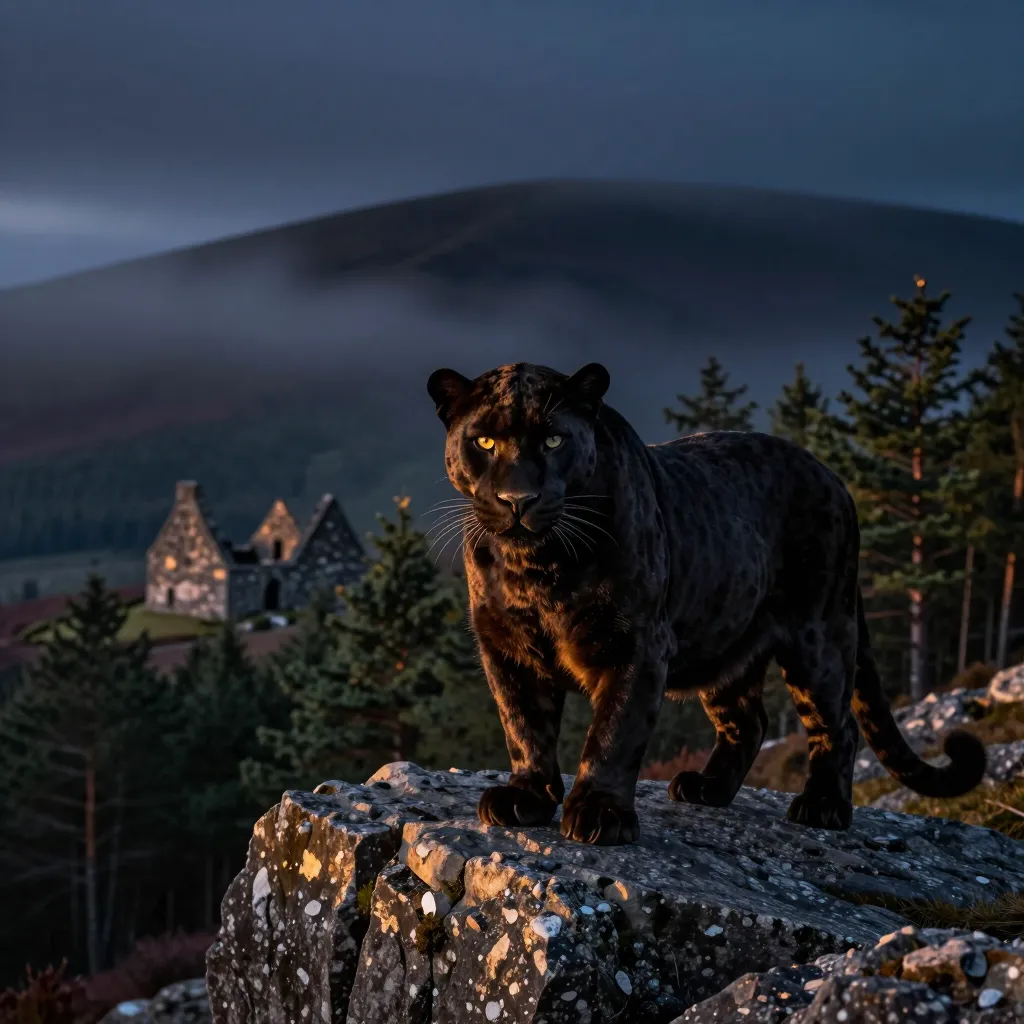
Mysterious Black Panther-Like Creature Reported in Scotland's Cairngorms
A local farmer spotted a massive black puma-like creature crossing a road near Grantown-on-Spey, adding to decades of unexplained big cat sightings across Britain. With the Cairngorms offering vast wilderness and a confirmed 2025 lynx release, investigators wonder what else lurks in the mist.
Mysterious Black Panther-Like Creature Reported in Scotland's Cairngorms
A New Chapter in Britain's Long History of Big Cat Sightings
Something shadowy and out of place is moving through the mist-shrouded valleys of Scotland's Cairngorms National Park. In recent weeks, multiple witnesses have described encountering a large, dark feline—roughly the size of a puma—prowling the rugged terrain near Grantown-on-Spey, reigniting one of the British Isles' most persistent mysteries.
The Highland Sighting
The most recent report came from a local farmer traveling with his wife through Grantown-on-Spey on a Friday evening. Around 9:45 PM, as their vehicle approached the area near the old filling station and cemetery, a massive black cat emerged from the darkness and crossed the road directly in front of them.
This was not the witness's first encounter. The farmer claimed to have spotted a similar animal on a previous occasion in the same region, as well as another large feline near Boat of Garten, a village roughly fifteen miles to the south. The consistency across multiple sightings from the same observer lends weight to a phenomenon often dismissed as misidentification or folklore.
Britain's Hidden Predators
The United Kingdom has maintained a complex relationship with tales of exotic big cats for decades. From the legendary Beast of Bodmin Moor in Cornwall to the Beast of Exmoor in Somerset, these stories occupy a peculiar space between cryptozoology and plausible reality. Scotland, with its vast, sparsely populated wilderness and abundant deer populations, represents particularly suitable habitat for a large predator seeking to remain undetected.
What distinguishes contemporary Scottish reports from earlier English counterparts is the mounting circumstantial evidence that some of these animals are not merely phantoms of imagination. The Scottish Highlands offer deep forests, remote glens, and minimal human presence across hundreds of square miles—conditions that could theoretically support a small population of elusive carnivores.
Precedent for the Impossible
The plausibility of these sightings received unexpected validation in 2025, when authorities confirmed that two lynx had been illegally released within the Cairngorms region. Wildlife officials successfully located both animals and relocated them to a licensed facility, but the incident served as concrete proof that exotic felines do occasionally enter British ecosystems through human intervention.
This precedent raises uncomfortable questions about what else might remain undiscovered. If lynx could be released and survive long enough to be documented, larger species—pumas, leopards, or even black panthers—could theoretically experience similar fates. Private ownership of exotic cats, while heavily regulated, has historically occurred across Britain, and not every released or escaped animal is recovered.
The Puma Hypothesis
If the Grantown-on-Spey creature is indeed a puma—also known as a cougar or mountain lion—it would represent an extraordinary survival story. Native to the Americas, pumas are among the most adaptable large predators on Earth, capable of thriving in environments ranging from Canadian forests to Patagonian mountains. A single adult requires roughly fifty square miles of territory, well within the carrying capacity of the Cairngorms ecosystem.
The "black puma" description presents its own complications. While melanistic (black) variants are well-documented in leopards and jaguars, no scientifically verified black puma has ever been recorded. Witnesses may be observing a very dark brown individual, experiencing lighting effects during dusk or nighttime encounters, or potentially observing a different species entirely—perhaps an escaped melanistic leopard, which do occur in captivity.
The Vanishing Pattern
Historical patterns of British big cat sightings often follow a frustrating trajectory: initial excitement, multiple corroborating reports, intensive media coverage, and then... silence. Animals that generate dozens of sightings across weeks or months frequently disappear without physical trace—no remains, no clear photographs, no DNA evidence. This vanishing act fuels skepticism while simultaneously deepening the mystery for believers.
Several factors may explain this pattern. Large predators are inherently elusive, capable of avoiding human contact across vast territories. Scotland's terrain offers countless caves, thickets, and ravines where a cautious animal could remain concealed indefinitely. Additionally, any released exotic cat facing harsh Scottish winters, unfamiliar prey, and potential competition from native species would face significant survival challenges, potentially resulting in natural mortality far from human observation.
The Search Continues
Whether the Cairngorms creature proves to be an escaped exotic pet, a case of mistaken identity involving large domestic cats or dogs, or something genuinely unexplainable, the phenomenon speaks to something deeper in human psychology—the persistent hope that wilderness still holds secrets, that our maps remain incomplete, and that extraordinary things might still lurk just beyond the reach of our headlights on dark country roads.
For now, the Highlands keep their secrets. Those traveling the roads around Grantown-on-Spey after nightfall may want to drive slowly, keep their cameras ready, and watch the tree line where shadow meets shadow. Something is moving out there, and it has no intention of being understood.