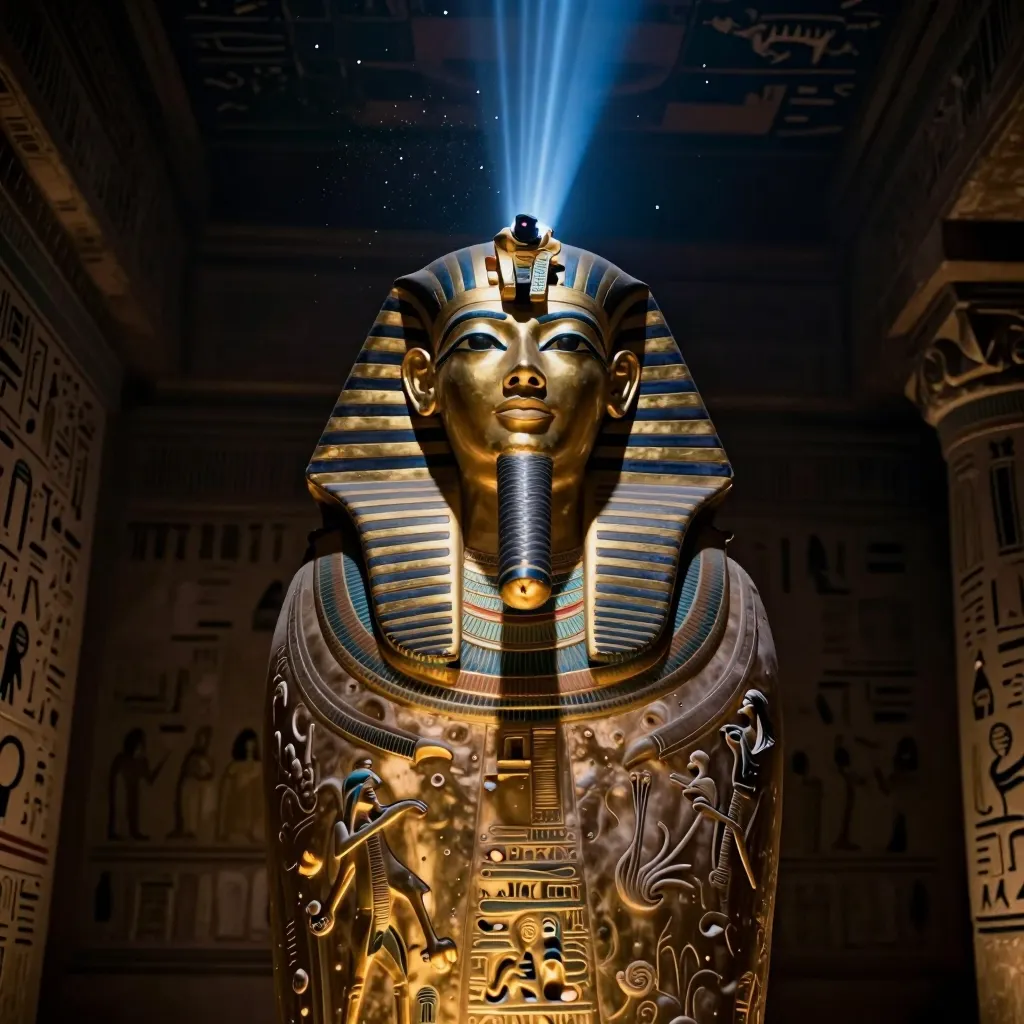
Ancient Egyptian Mummies: CT Scans Reveal Hidden Secrets
Advanced CT scanning technology is revealing the hidden secrets of ancient Egyptian mummies while keeping them intact. Researchers are uncovering medical conditions, burial treasures, and cultural practices lost for millennia by peering inside sealed coffins without disturbing them. This groundbreaking non-invasive technique is revolutionizing Egyptology and providing unprecedented insights into one of history's most fascinating civilizations.
Whispers from the Tomb: High-Resolution Scans Unveil Secrets of Ancient Egyptian Mummies
Deep within the halls of a Hungarian medical museum, ancient Egyptian mummies—silent guardians of a forgotten era—undergo a profound awakening. Using cutting-edge photon-counting CT technology, researchers pierce the millennia-old wrappings to expose intricate details of life, death, and preservation rituals that have endured for over 2,300 years.
Night Scans into Eternity
The examinations unfold under the cover of darkness at Semmelweis University, where fragile artifacts from the Semmelweis Museum of Medical History and the Hungarian National Museum Public Collection Centre are gently positioned within the scanner's embrace. Unlike prior conventional CT imaging, which yielded only blurred glimpses, this advanced system captures the subtle energy of individual X-ray photons. The result: razor-sharp images with superior contrast, ideal for navigating the dense, layered mysteries of mummified remains.
These night-time sessions prioritize precision, aiming to map internal structures, detect anomalies, and decode the sophisticated techniques employed by ancient embalmers to defy decay.
Revelations from Fragmented Remains
Among the specimens, two mummified heads yield startling clarity. Teeth and cranial sutures emerge in vivid detail, enabling refined estimates of age at death and paving the way for potential 3D reconstructions—or even facial recreations—that could one day stare back from the void of history.
A preserved left lower limb hints at osteoporosis, a condition that plagued the individual in life, whether through advanced age or underlying pathology. Further analysis promises to clarify this shadow of frailty.
Nearby lies a second left lower limb, belonging to a younger person—the first high-definition imaging of this piece, shedding light on its developmental stage.
What was once dismissed as an enigmatic "mummy bundle"—mistaken for a head or even a bird—reveals itself as an adult foot. Layered bandages unwind their secrets under the scan, illustrating the meticulous mummification process.
A mummified hand offers additional clues: indicators of whether it grasped tools as an adult or toys as a child, alongside clues to sex and precise age.
Echoes of the Late Period
Radiocarbon dating anchors these relics in time. The eldest fragments trace back to 401–259 BCE, during Egypt's Late Period, when pharaohs clung to power amid invading forces and shifting dynasties. Of six samples tested, three provided dates, while others remain shrouded in the limits of organic preservation.
A Bridge Across Millennia
This non-destructive approach ushers in a transformative phase for mummy studies. The scanner's prowess excels at dense tissues and wrappings, minimizing noise to reveal pathologies, embalming methods, and daily hardships etched into bone. What emerges is not mere anatomy, but fragments of ancient narratives: lives suspended in linen and resin, now illuminated by technology born thousands of years later.
Through these scans, the dark veil of time lifts slightly, inviting contemplation of an civilization obsessed with immortality—its successes and silent failures preserved eternally.