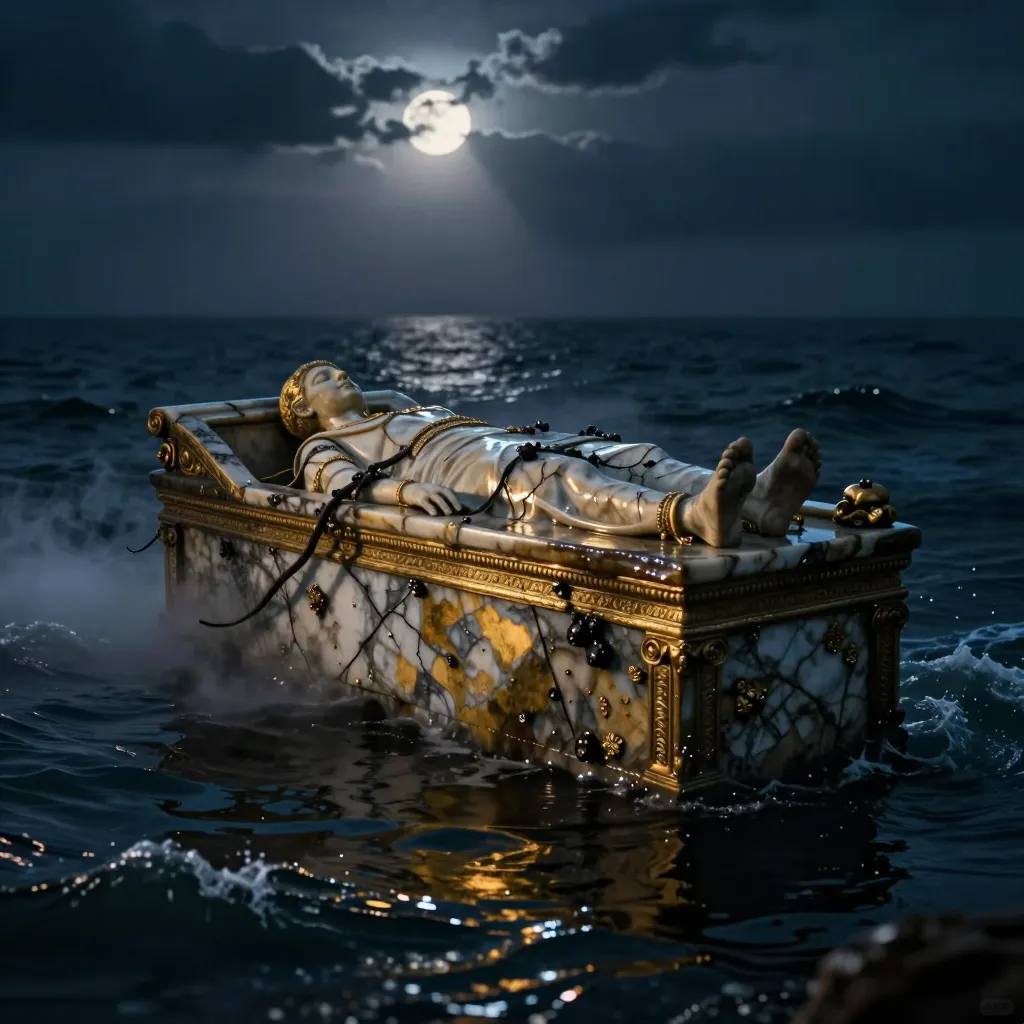
The Mystery of Alexander the Great's Vanished Tomb: A 2,000-Year Cold Case
Alexander the Great died at 32, but his corpse sparked a political war. Hijacked by Ptolemy, worshipped by Caesar and Augustus, his tomb vanished beneath Alexandria's waves. Over 140 excavations have failed. Was he buried alive? Does he rest underwater—or under St. Mark's Basilica? Dive into history's most thrilling cold case.
The Mystery of Alexander the Great's Vanished Tomb
For a man who conquered the known world before his thirtieth birthday, Alexander the Great met an end as enigmatic as his life was glorious. But the true mystery began after his death—a two-millennia puzzle that has consumed archaeologists, treasure hunters, and historians alike. What became of the body of history's most legendary conqueror?
A Sudden End in Babylon
In June 323 B.C., at just 32 years old, Alexander died in Babylon after twelve days of agonizing fever and abdominal pain. The cause remains one of antiquity's most debated medical cold cases. Ancient sources whispered of poisoning. Modern scholars have proposed malaria, typhoid, even the neurological disorder Guillain-Barré syndrome—a chilling theory suggesting Alexander may have been buried alive after physicians, measuring life by breath rather than pulse, declared him dead prematurely.
What happened next defied both nature and expectation. Six days after his death, in the brutal Babylonian summer heat, embalmers examined the corpse and reportedly found no signs of decay. For a civilization that already viewed Alexander as something between man and god, the preservation seemed almost supernatural.
The Body Becomes a Weapon
Alexander's death detonated a power struggle across his fractured empire. Two men emerged as principal rivals: Perdiccas, who served as regent for Alexander's infant son, and Ptolemy, the ambitious satrap of Egypt. But the battle wasn't merely fought with armies—it was fought over a corpse.
On his deathbed, Alexander had reportedly requested burial at the oracle of Zeus Ammon in Egypt's Siwa Oasis. Yet historians argue this was likely a strategic misdirection. Perdiccas, controlling the body, almost certainly intended to transport it to the royal tombs of Macedon, using possession of the remains to legitimize his claim over the entire empire.
The body lay preserved in a golden sarcophagus filled with spices while craftsmen labored for two years constructing an ornate funeral carriage. Ionic columns shaped like a temple, Nike victory statues, golden lions—the catafalque was a mobile monument to divine kingship. Pulled by sixty-four mules draped in precious stones, the procession must have been a staggering sight.
But it never reached its destination.
The Hijacking
Somewhere along the route, Ptolemy struck. The precise details are lost in the murk of biased ancient accounts written centuries later, but the outcome is clear: Egypt's governor seized the golden coffin and the political weapon it represented.
For an uncertain ruler, the body of a predecessor becomes a talisman of legitimacy. Ptolemy understood this perfectly. By capturing Alexander's embalmed remains, he transformed them into the ultimate badge of sovereignty—a physical claim to the conqueror's legacy.
The body first rested at Memphis, Egypt's longstanding capital and Ptolemy's initial power base. But as Ptolemy shifted his administrative center to Alexandria—the city Alexander himself had founded—moving the remains became both practical and symbolically essential. Founders were traditionally buried within their city's walls. Alexander would become Alexandria's eternal guardian.
The Soma: A Tomb in the Heart of Power
Between 298 and 283 B.C., Alexander's body was transferred to Alexandria, where it became the centerpiece of a burial complex known as the Soma—Greek for "body." The Greek geographer Strabo, who lived in Alexandria during the 20s B.C., described it as an enclosure within the royal palaces containing the tombs of kings alongside Alexander's own.
But the tomb held secrets even Strabo couldn't fully penetrate. He noted that Ptolemy had replaced Alexander's original golden sarcophagus with one of glass—a detail that hints at the reverence and perhaps the vulnerability of the remains.
Later sources used a different name: the Sema, meaning tomb or burial site. Whether these referred to the same location or a rebuilt complex remains uncertain. What is known is that the tomb stood somewhere in Alexandria's northeastern quarter, a district that would gradually shift from "palace district" to simply "middle of the city" as the metropolis expanded beyond its original boundaries.
Roman Pilgrims and Imperial Vandalism
For centuries, Alexander's tomb drew the powerful and the curious. Julius Caesar visited in 48 B.C., reportedly weeping before the sarcophagus while reflecting on his own achievements. The first Roman emperor, Augustus, came in 30 B.C. after conquering Egypt—accounts vary between him placing a golden crown on the body or accidentally breaking off part of Alexander's nose in his enthusiasm.
Emperor Septimius Severus sealed the tomb in A.D. 199, perhaps to protect it from further desecration. His son Caracalla reopened it in A.D. 215, removing items for reasons unknown. According to historians, this was the last authenticated visit.
Then silence.
The Disappearance
The tomb's vanishing coincides with profound transformation in the Roman world. The rise of Christianity offered a new gravitational center for pilgrimage: the tomb of Christ, discovered under Emperor Constantine. Alexander's mausoleum, once unique, suddenly competed with a relic that carried divine rather than merely imperial resonance.
But religious shift wasn't the only force erasing Alexander from memory. In A.D. 365, a catastrophic earthquake triggered a tsunami that slammed into Alexandria with devastating force—ships were reportedly tossed onto rooftops. The Soma's fate remains unrecorded, but the disaster marked the beginning of two centuries of seismic unrest and rising seas that fundamentally reshaped the coastline.
The most compelling explanation is also the simplest: a combination of sea-level rise and earth movements has gradually submerged the old royal quarter beneath the Mediterranean since the third century. Alexander's tomb likely rests underwater, buried beneath centuries of sediment and urban renewal.
The Search Continues
Over 140 officially sanctioned excavations have hunted for Alexander's remains. Modern searches have extended offshore, where sonar surveys and GPS mapping have revealed submerged foundations from the Ptolemaic royal quarter—obelisks, stone sphinxes, a colossal statue believed to depict Ptolemy and his queen Berenice. The tomb itself remains elusive.
Alternative theories persist. Some researchers suggest the body was secretly transported to the Siwa Oasis, fulfilling Alexander's original wish. A more exotic theory proposes that Venetian merchants acquired the remains in the ninth century, and that they now lie beneath the altar of St. Mark's Basilica in Venice—a macabre possibility that would make one of history's greatest conquerors the hidden occupant of another man's tomb.
The Thrill of the Unsolved
What makes Alexander's vanished tomb so compelling is not merely the absence of answers, but the layers of meaning embedded in the mystery. A body that refused to decay. A funeral procession hijacked for political gain. A tomb that drew emperors to veneration and vandalism alike. A city that swallowed its own history beneath the waves.
The conqueror who mapped the boundaries of the known world remains unmapped in death. His body—once the most politically potent corpse in antiquity—has become something else entirely: a phantom at the heart of one of history's longest-running cold cases, waiting somewhere beneath the accumulated weight of two thousand years.